ADAD
ADAD
Updating your news feed...
NEWS EXPRESS is Nigeria’s leading online newspaper. Published by Africa’s international award-winning journalist, Mr. Isaac Umunna, NEWS EXPRESS is Nigeria’s first truly professional online daily newspaper. It is published from Lagos, Nigeria’s economic and media hub, and has a provision for occasional special print editions. Thanks to our vast network of sources and dedicated team of professional journalists and contributors spread across Nigeria and overseas, NEWS EXPRESS has become synonymous with newsbreaks and exclusive stories from around the world.





Loading banners
Loading banners...

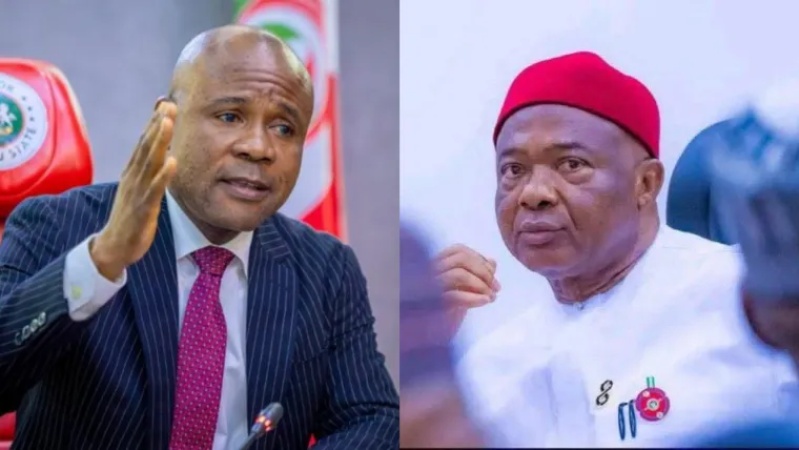
Uzodimma, Mbah
As preparations for the 2027 general elections gather momentum, the struggle for control of the soul of the ruling All Progressives Congress (APC) and the desperation to retain political relevance in the South-East have continued to fuel tension among key political actors, especially between Hope Uzodimma and Peter Mbah, perhaps to the detriment of regional aspiration, LAWRENCE NJOKU reports.
Call it greed, desperation or politics stripped of conscience, the conduct of many political leaders in the South-East has again raised troubling questions about the priorities of the region’s elite.
At a time when the estimated 36 million population in the South-East grapple with economic hardship, insecurity, poor infrastructure and deep feelings of political exclusion, many of the region’s power brokers appear consumed by the scramble for personal relevance and the quest to win the favour of President Bola Tinubu ahead of 2027.
Rather than forging a common front to demand justice, equity and a stronger federal presence for the zone, the political class has become entangled in supremacy battles, shifting alliances and survival politics driven largely by personal ambition.
The development has left many residents disillusioned, with growing fears that the collective interest of the South-East is being sacrificed on the altar of individual political gains.
The recent failed attempt to alter the leadership of the Progressive Governors Forum (PGF) again exposed the struggle for power and influence within the APC in the South-East between Uzodimma and Mbah.
A fortnight ago, reports emerged that Uzodimma, who has chaired the PGF since 2023, had been removed. The reports claimed that the decision was taken at a meeting held at the Ogun State Governor’s Lodge in Abuja and attended by about 20 APC governors, including Mbah.
The meeting, which came barely a day after Uzodimma led APC governors to submit Tinubu’s nomination forms for a second term, was said to have endorsed Mbah as his replacement. It was further alleged that some governors were uncomfortable with the management of the Forum under Uzodimma.
However, hours later, another closed-door meeting involving some governors reportedly reaffirmed confidence in Uzodimma’s leadership. Although he retained his position, the botched attempt to replace him with Mbah has continued to fuel speculations across the South-East about a growing power struggle between the two governors.
Questions are now being asked about what Mbah stood to gain if the plot had succeeded and what the larger implications could be for a region where the APC is still battling for wider acceptance.
Unlike Uzodimma, who has been a longstanding APC figure, Mbah is relatively new in the party, having defected from the Peoples Democratic Party (PDP) less than a year ago. Critics argue that he still needs time to build trust within the governors’ circle before aspiring to such a strategic leadership role.
Others, however, insist that the PGF position belongs to the South-East and that, with concerns over Uzodimma’s standing among some colleagues, a more acceptable face was needed.
Whatever the argument, the controversy surrounding the reported removal and subsequent reversal exposed cracks within the Forum and reinforced suspicions that the two men are not politically comfortable with each other.
In the beginning…
THE failed PGF drama was only one of several signs of a strained relationship between Uzodimma and Mbah.
Their frosty relationship reportedly dates back to the 2023 governorship election in Enugu State. In his determination to see APC candidate Uche Nnaji emerge governor, Uzodimma was said to have influenced the restructuring of the party in the state.
The exercise reportedly brought in several non-party members into strategic positions with the sole objective of delivering Nnaji at the polls. Nnaji eventually secured the APC governorship ticket but finished fourth in the election won by Mbah.
Despite the loss, Uzodimma’s influence in Enugu politics remained visible. Nnaji was later appointed minister and, alongside allies loyal to Uzodimma, reportedly became influential in determining federal appointments from the state.
With Uzodimma’s backing, Nnaji also took on the responsibility of rebuilding the APC in Enugu State ahead of the 2027 elections. The party gradually began attracting defectors, including elected officials from rival parties, thereby posing a growing threat to Mbah and the PDP at the time.
As the PDP faced internal crises nationwide, Mbah reportedly began exploring joining the APC. However, his initial moves were allegedly resisted by the APC structure in Enugu loyal to Uzodimma and Nnaji.
The political equation later changed following allegations surrounding Nnaji’s academic credentials. The controversy eventually forced the minister to step aside temporarily to clear his name in court.
His resignation reportedly paved the way for the dissolution of the APC state executive in Enugu, creating an opening for Mbah to join the ruling party and subsequently assume control of its state structure.
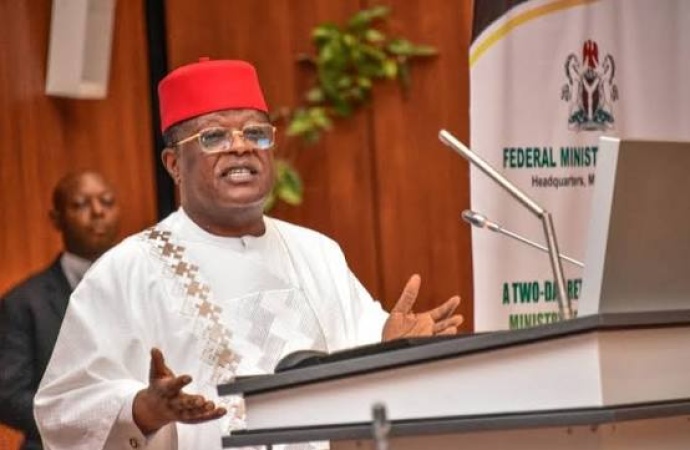
Since joining the APC, Mbah has reportedly moved swiftly to dismantle structures loyal to Uzodimma in Enugu. He also strengthened his grip on the party by nominating his former Attorney General and Commissioner for Justice as Minister of Innovation, Science and Technology, replacing Nnaji.
Political observers in the state say Mbah has effectively transplanted his old PDP political structure into the APC while sidelining many longstanding party members who had opposed his entry.
Uzodimma’s ally, Emma Enukwu, also lost his position during the APC national convention after protests allegedly linked to Mbah’s camp. In his place emerged Ben Nwoye.
Several APC members in Enugu now believe they are being punished for previously resisting Mbah’s entry into the party.
Implications for APC and the South-East
DESPITE the setbacks, Uzodimma’s alleged determination to see Nnaji emerge governor of Enugu State in 2027 remains strong. Nnaji has reportedly resumed political consultations and recently told supporters that he would need only one term to transform the state. Since then, political discussions across Enugu have intensified over whether he remains a viable challenger to Mbah.
For many observers, Nnaji represents Mbah’s biggest political threat ahead of 2027.
Aware of Uzodimma’s alleged support for the former minister, Mbah is also believed to be positioning himself to weaken Uzodimma politically, especially within APC power circles. This perception has fueled speculation about the recent PGF leadership drama.
Concerned people of the region say the growing rivalry between the two governors could have wider implications for both the APC and the South-East.
Currently, the APC controls three South-East states — Imo, Ebonyi and Enugu. While the party secured electoral victories in Imo and Ebonyi, Enugu became an APC-controlled state mainly through Mbah’s defection from the PDP. Until the party wins a fresh governorship election in Enugu, some observers still hesitate to describe the state as a fully established APC stronghold.
The rivalry has also deepened divisions within the APC in the region. Since Mbah joined the party, APC stakeholders in the South-East have reportedly struggled to maintain cohesion, while meetings among governors in the zone have become infrequent.
Similarly, critics argue that the South-East Governors’ Forum, chaired by Uzodimma since 2023, has not achieved significant regional coordination despite mounting economic and security challenges.
The Forum, headquartered in Enugu, has held a few notable meetings under Uzodimma’s leadership. One of the major gatherings took place in July 2024 amid worsening insecurity and during preparations for the burial of former Abia State governor, Ogbonnia Onu.
Even then, several resolutions reportedly reached at the meeting, including plans to engage Tinubu over insecurity and the release of Nnamdi Kanu, were never fully implemented.
In February this year, Uzodimma was also absent at the launch of the South-East Vision 2025 development blueprint organised by the South-East Development Commission in Enugu. The event was attended by Vice President Kashim Shettima, along with the governors of Enugu, Abia, Ebonyi, and Anambra states. Uzodimma was represented by the Speaker of the Imo State House of Assembly.
Speaking on the growing tensions, APC chieftain Damian Ekwueme argued that the rivalry is rooted largely in the quest for influence around Tinubu and the party’s future direction in the South-East.
“With their closeness to the President, each of them believes he can gain greater control of the party structure in the region. The struggle is about relevance and political survival,” he said.
He added that many of the calculations are tied to long-term ambitions within the APC ahead of the post-Tinubu era.
A former House of Representatives aspirant in Enugu State, Jude Onyia, also described the conflict as a battle of ego that may persist until after the 2027 elections.
“I see Uzodimma doing everything possible to ensure that Nnaji becomes governor in Enugu. On the other hand, Mbah will continue consolidating his hold on the APC to weaken Uzodimma politically. Each sees the other’s fall as his own political gain,” he said.
While the political manoeuvring continues, Uzodimma, a founding APC member, is believed to be eyeing the Imo West Senatorial seat ahead of the expiration of his tenure as governor.
Uzodimma contested the 2019 Imo governorship election and initially lost to Emeka Ihedioha of the PDP before the Supreme Court overturned the result in 2020 and declared him the winner.
Now serving his second term, the Imo governor remains one of the APC’s most influential figures in the South-East.
Mbah, on the other hand, currently stands as the dominant APC figure in Enugu and is expected to seek re-election on the party’s platform in 2027.
Yet beyond the calculations of both men lies a deeper concern: whether the South-East political elite can rise above personal ambitions and present a united front capable of advancing the collective interest of a region that still feels politically marginalised within the Nigerian federation. (The Guardian)