ADAD
ADAD
Updating your news feed...
NEWS EXPRESS is Nigeria’s leading online newspaper. Published by Africa’s international award-winning journalist, Mr. Isaac Umunna, NEWS EXPRESS is Nigeria’s first truly professional online daily newspaper. It is published from Lagos, Nigeria’s economic and media hub, and has a provision for occasional special print editions. Thanks to our vast network of sources and dedicated team of professional journalists and contributors spread across Nigeria and overseas, NEWS EXPRESS has become synonymous with newsbreaks and exclusive stories from around the world.





Loading banners
Loading banners...

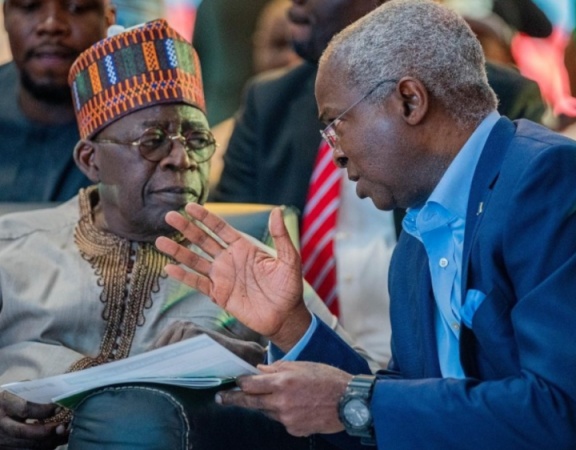
President Tinubu and Lagos Gov Fashola
As Lagos State gears up for the 2027 governorship election, the race within the APC is shaping up to be a contest of technocratic competence, party loyalty, and strategic zoning, but the party’s consensus model and President Bola Tinubu and the Governor’s Advisory Council’s historical penchant for surprising selections also opens up the possibility of wildcard candidates, writes WALE AKINSELURE
Lagos has long been a fortress of the All Progressives Congress (APC), which has consistently produced the state’s governor since 1999, projecting an image of unshakeable dominance. That grip was first seriously challenged when the APC lost the 2023 presidential election to the Labour Party, a shock that continues to haunt party politicians. APC stakeholders attribute the loss to disunity during the campaign, the ripple effects of the 2020 #EndSARS protests, and the nationwide Obidient wave. Even though the APC comfortably won the Lagos governorship, the unexpected presidential defeat exposed vulnerabilities in the party’s stronghold. Now, for the first time in nearly three decades, the stakes for picking the consensus Lagos APC governorship candidate are higher, with aspirants divided among competing political blocs and the city’s elite bracing for a contest where loyalty, strategy, and ambition collide.
The 2027 mandate
The pain of that loss continues to reverberate, evidenced by the rhetoric of APC politicians ahead of the 2027 election. At every forum, the past is recalled, with politicians vowing to do all it takes to avert a repeat of the 2023 result in Lagos. Chairman, Lagos APC, Cornelius Ojelabi, said reversing the 2023 result would also be a way of appreciating Tinubu, whom he described as a leader who had contributed significantly to the development of Lagos State and Nigeria’s democracy. Ojelabi said, “You are coming on board at a very critical period, a period when we are very close to the emergence of our candidates for the 2027 election. All eyes are on us, and the question they are asking is: are we going to change the narrative? They are asking if we are going to consolidate on the achievements of our party since 1999, and also change the narrative of our performance in the presidential election we witnessed in 2023. That particular question should preoccupy our minds, and it is a task that must be done collectively. So, the rallying call is that of unity among all groups, movements across the 20 local government areas and 37 local council development areas in the state, ahead of the 2027 election.
Ambition in the shadows
For the past months, groups and individuals have continued to lead campaigns for the return of President Bola Tinubu for a second term. Most of these Tinubu for second term campaigns have been led by politicians believed to be eyeing the Lagos governorship seat. While promoting Tinubu, these aspirants subtly promote their own governorship ambitions. Among them is Mr Samuel Ajose from the Badagry division of the state, under the SMA movement, who staged a rally at the Nigeria Police College, Ikeja, to mobilise support for Tinubu’s second term bid. The rally, tagged “SMA Gold Mobilisation for Asiwaju,” attracted over 20,000 persons across the 57 local council areas in the state. In fact, the SMA large-sized billboards rallying support for Tinubu’s second term are visible not only in Lagos but across the other five states of the South-West geopolitical zone. Similarly, the Speaker of the Lagos State House of Assembly, Mudasiru Obasa, also organised an interfaith prayer session in Ikeja, Lagos, to commemorate Tinubu’s 74th birthday. The event organised under the platform of The Mandate Movement featured calls for continuity of Tinubu’s administration beyond 2027 to consolidate the gains of the Renewed Hope Agenda. At the Obasa-organised event, former Lagos State Governor, Mr Akinwunmi Ambode and Mr Tayo Ayinde, the Chief of Staff to Governor Babajide Sanwo-Olu, also a potential candidate, praised Tinubu’s leadership, urging Nigerians to rally behind the president’s re-election bid. At a rally organised by the APC leadership in the Lagos East Senatorial District, held in Ikorodu, Lagos, Senator representing Lagos East, Tokunbo Abiru; lawmaker representing Ikorodu Federal Constituency, Babajimi Benson and Abike Dabiri-Erewa, chairman of the Nigerians in Diaspora Commission, called for support for Tinubu’s second term bid. The decision of some notable politicians to conceal any purported governorship ambition under the banner of promoting Tinubu’s second term bid is in line with the peculiarities of Lagos politics. A party chieftain argued that, given the trajectory of Lagos politics, where the ruling party has never picked anyone whose name is largely in the news or widely speculated, it would be detrimental for anyone to go all out pushing for their candidature. However, he noted, “No two elections are the same.”
So far, several Lagos politicians have kept their governorship desires at the level of consultations and hushed tones, except for Olajide Adediran, popularly called Jandor, who has formally declared his intention to contest the 2027 Lagos governorship election under the platform of the APC. These consultations are expected to get more intense among stakeholders in the Lagos project, ahead of the commencement of party primaries for the 2027 elections on April 23. Aside from the earlier-mentioned names, others being promoted by APC supporters as potential candidates of the party are the current deputy governor, Obafemi Hamzat; Minister of Education, Tunji Alausa; Chief of Staff to the President, Femi Gbajabiamila; Principal Secretary to the President, Hakeem Muri-Okunola; and the president’s son, Seyi Tinubu. Only a few opposition members have declared their interest in running in the 2027 election. Gbadebo Rhodes-Vivour, who was the governorship candidate of the Labour Party in the 2023 election, has joined the African Democratic Congress and has expressed his desire to run again for governorship in 2027. Similarly, a former House of Representatives candidate, Naheem Balogun, also declared interest. For the PDP, there is also a businessman and entrepreneur, Laja Adeoye.
Fractured fortress?
Since 1999, political parties aligned with Tinubu: the Alliance for Democracy, Action Congress, Action Congress of Nigeria, and now the APC, have consistently produced the state’s governor. Tinubu governed the state from 1999 to 2007; former Governor Babatunde Fashola from 2007 to 2015; ex-Governor Akinwunmi Ambode from 2015 to 2019; and the incumbent, whose tenure began in 2019, is billed to expire on May 29, 2027.
For the first time since 1999, the Labour Party, through Gbadebo Rhodes-Vivour, pushed the Peoples Democratic Party from its constant second position to third place in the 2023 election. The APC candidate, Sanwo-Olu, received 762,134 votes, while the LP candidate received 312,329 votes. Sanwo-Olu (APC) won by a margin of 449,805 votes.
Since 1999, the closest the PDP has been to winning was in 2015, when Akinwunmi Ambode (APC) polled 811,944 votes against Jimi Agbaje (PDP), who scored 659,788 votes—a margin of 152,206. Meanwhile, the largest margin between the winner and the PDP candidate was in 2011, when Babatunde Fashola won by 1,208,663 votes, polling 1,509,113 votes against Shamisideen Adegboye’s 300,450.
Clearly, opposition efforts to dislodge the APC have consistently faltered. Only the PDP and Labour Party have attempted to wrest power from the ruling APC. However, present divisions in both parties suggest they may not match their previous vote counts in Lagos. PDP members in Lagos are split between the Nyesom Wike and Seyi Makinde factions. The LP is also in limbo with internal crises, while Obidients await guidance from former LP presidential candidate Peter Obi. The African Democratic Congress, branded as the new opposition, has not yet shown the capacity to challenge the APC in Lagos. Recent electoral losses further raise doubts about its formidability ahead of 2027. Yet, opposition members continue to assert that the forthcoming general election will be between Nigerians and the APC, on what platform remains unclear.
Head of the Political Science Department, Lagos State University, Dr Moshood Babatunde, decries the bleak state of opposition in Lagos. Babatunde said, “The future of opposition parties still seems bleak in Nigeria. The new African Democratic Party doesn’t have a strong footing in Nigeria, and Lagos specifically. The old Peoples Democratic Party has become a problem unto itself. You can then ask, where is the formidable opposition to wrest power in Lagos come 2027?” He notes that Tinubu will want to consolidate his reach in his base. “This gives further impetus to APC in Lagos and poses a serious threat to any opposition, if one exists,” Babatunde said. He, however, highlights the need for opposition to drive good governance in the state. “People’s opposition is what will count and what will favour any fragments of political parties come 2027,” he added.
Another political science professor, Sylvester Akhaine, said, “Given the cosmopolitan nature of Lagos, Tinubu has never really had a total grip on the population but control of the political machinery.” He notes, however, that Tinubu may again determine who becomes the next Lagos governor, given the authority he commands as president. Akhaine said, “Currently, he (Tinubu) holds a trump card by virtue of his control of central authority, which could go a long way in determining who wins in Lagos.”
A Lagos APC chieftain simply noted that the real battle lies in who emerges as the APC candidate, while defeating the opposition would be “easy peasy.”
The Tinubu playbook
In Lagos, history favours the emergence of a consensus candidate, around whom other aspirants, party structures, and members are expected to rally to ensure victory. Typically, Tinubu, as head of the Governor’s Advisory Council, mentions some names for scrutiny. The GAC comprises political leaders across state zones, including serving and former governors and deputy governors. After interviews, stakeholder consultations, and meetings with traditional institutions, Lagos leaders, and stakeholders, the GAC recommends one or two names for Tinubu’s approval. Tinubu usually trusts the GAC’s recommendation, after which the candidate emerges.
According to a GAC member, key factors for candidate selection include the ability to “continue Lagos’ development trajectory, implement policies without disruption, show loyalty to party powerbrokers, and work with Lagos elites.” Preference is usually given to technocrats who are seen as more capable of advancing developmental projects than politicians. However, a party chieftain warned that, based on 2023’s experience, a politician who understands Lagos politics’ peculiarities should be chosen. Another noted that, with social media and greater public sophistication, any “abracadabra” that worked in the past may not work this time. Factors considered include competence, past governance or public service performance, appeal to stakeholders from state to ward level, perceived acceptance by Lagosians, ability to mobilise support and fund grassroots outreach, tendency to avoid controversy, and respect for party hierarchy. “The choice is largely influenced by who can protect the interests of Lagos brokers while delivering results acceptable to most Lagosians,” a GAC member said.
Speaking on where things stand, a member of the GAC, Chief Muraina Taiwo, said, “The name Hamzat being mentioned is possible, but the GAC has not reached a consensus on a candidate. At our last meeting, we did not even discuss the Lagos governorship candidate. We discussed the progress of the APC both at the national level and in Lagos. The decision on candidature will be made at the GAC. Hamzat is on the ground and has his leaders, but the issue is that the issue of governorship has not been brought up at the GAC. When we sit, discuss, and there is no objection, and our leader, the President, approves of it, then the candidate would emerge. Other purported aspirants joined the GAC meeting, including ex-governor Akinwunmi Ambode; the deputy governor, Obafemi Hamzat; Senator Tokunbo Abiru; and Femi Gbajabiamila. They were already there with the leader before we arrived.”
Zoning wars
For 2027, there is a clamour for the candidate to emerge from the Lagos East Senatorial District. Advocates argue it is the zone with the fewest years in power. Lagos Central, with Raji Fashola and Babajide Sanwo-Olu, boasts 16 years; Lagos West, with Bola Tinubu, eight years; Lagos East, with Akinwunmi Ambode, four years, the least. Potential Lagos East candidates include Ambode, Hamzat, Alausa, Abiru, Ayinde, and Tokunbo Wahab, Commissioner for Environment and Water Resources.
Ambode has a strong administrative record as governor; though he previously lost support of some stakeholders, he did not rock the boat and maintained party ties with credentials that can be leveraged on if endorsed Party stakeholders however note that the sentiment of being allowed to have a second time like others, having previously had only one term, may not be enough for him to emerge. Hamzat is seen as cerebral, educated, policy-oriented, and experienced, having been in political circles since 1999. He also boasts of strong family ties to the GAC, as his father was a former GAC leader. If he gets the candidature, he would be breaking a jinx in Lagos as no deputy governor has ever become the party’s candidate. Alausa has sufficient public service and corporate background. He fits the technocrat bill with governance experience as minister, but would require broad party rallying to emerge. But a member of the party exco in the state confidently said, “Alausa will get it.” Abiru, a banker with technocratic experience, is seen as a loyal technocrat with strong administrative credentials, appealing to youth and grassroots engagement. Chief of Staff Ayinde boasts of an appreciable administrative background and strong insider influence. Furthermore, the Lagos East push is also fuelled by the calculation that the outgoing governor is from Lagos Central and the party chairman is from Lagos West. However, Lagos West stakeholders argue that they have yet to match Lagos Central. Potential Lagos West candidates include Speaker Obasa, Jandor, Samuel Ajose, and Seyi Tinubu. Obasa, speaker since 2015, is politically experienced and has a strong political network; however may not be strong on the technocrat categorisation. At a constituency event organised by federal lawmaker Wale Ahmed last year, the people of Agege constituency declared that they are Obasa foot soldiers and are simply awaiting the whistle to blow in their leader’s favour for them to go all out in the race. Notably, he was able to raise his head above water when the political waters of impeachment almost drowned him. However, he would require broad party and stakeholder support to overcome those forces that once attempted to drown him, which may still exist. There are permutations that Obasa may be handed a senatorial ticket in place of the governorship push.
Both Ajose, popularly called SMA and Jandor are pushing the “Badagry lokan” cause. Religious, community, women, youth groups, including traditional rulers, have held various town hall meetings and gatherings in Badagry, urging Tinubu to pick their son, Mawuyon Ajose, as the party’s candidate. They argue that Badagry has never produced a governor and seek to break what they call a historical imbalance. Ajose has been active locally and promoted Tinubu’s second-term bid; Jandor, with Lagos4Lagos, returned to APC after contesting in 2023 under PDP. He declared his bid but promised to subordinate it to party decisions for 2027.
Some groups have held events encouraging Seyi Tinubu to run for the governorship. They downplay the fact that his father is president, urging that Lagosians look at his capabilities. However, there remains speculation that any such bid may be aimed at 2031. A GAC member noted that zoning is not decisive; Lagos politics is fluid, and leaders are chosen for governance competence and continuity. “Merit is important; good governance has nothing to do with religion,” a stakeholder said. Lagos APC spokesperson, Seye Oladejo, said the party is ready to mobilise behind any candidate and dismissed the opposition’s chances in 2027.
Calculating the religious balance
Like zoning, stakeholders downplay religion in candidate selection. Some argue that Governor Sanwo-Olu, a Christian, should be succeeded by a Muslim. Since 1999, Muslims have had 16 years with Tinubu and Fashola, while Christians will have 12 years by 2027 with Ambode and Sanwo-Olu. A party stakeholder said, “If Muslims argue that they should succeed Sanwo-Olu, Christians can make the same calculation. In fact, the three Senators are Muslims: Abiru, Idiat Adebule, and Eshilokun Wasiu. Obasa is Muslim, and the House of Assembly and House of Reps are dominated by Muslims.”
The Wildcard factor
Observers argue that Tinubu is adept at identifying talent, so someone outside the purported aspirants may emerge. A top party stakeholder said, “When you project based on past experiences, I won’t be surprised if none of those names going around emerges. All of them are rallying round the Asiwaju for 2027 project to market themselves, but it doesn’t confer on them being anointed. You hardly ever see it coming. This is buttressed by another party stalwart who said, “No one who has on his own thrown his hand into the ring has ever emerged.” “Fashola was almost a reluctant governor; there was a multitude of people who were also as eminently qualified (The PUNCH)