ADAD
ADAD
Updating your news feed...
NEWS EXPRESS is Nigeria’s leading online newspaper. Published by Africa’s international award-winning journalist, Mr. Isaac Umunna, NEWS EXPRESS is Nigeria’s first truly professional online daily newspaper. It is published from Lagos, Nigeria’s economic and media hub, and has a provision for occasional special print editions. Thanks to our vast network of sources and dedicated team of professional journalists and contributors spread across Nigeria and overseas, NEWS EXPRESS has become synonymous with newsbreaks and exclusive stories from around the world.


























Loading banners
Loading banners...

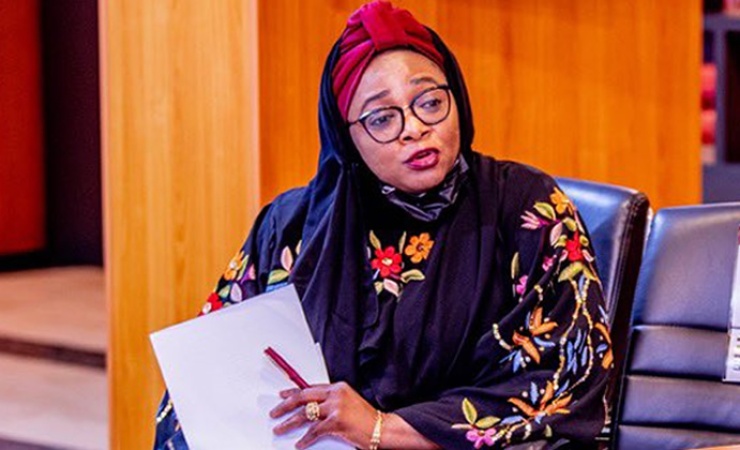
Minister of Women Affairs, Imaan Sulaiman-Ibrahim
The Federal Government has approved its first National Policy on Menstrual Health and Hygiene Management, a landmark initiative designed to improve the health, dignity and educational opportunities of women and girls across the country.
The policy was validated in Abuja by the Minister of Women Affairs, Imaan Sulaiman-Ibrahim, who was represented by the Permanent Secretary of the ministry, Dr. Maryam Keshinro.
In her keynote address, Sulaiman-Ibrahim described menstrual health as not only a women’s issue but also a community and national development concern, stressing that the policy would guarantee dignity, safety, and support for women and girls while improving health outcomes and increasing educational and economic participation.
“This policy sets a clear vision: by 2030, no girl in Nigeria should have to choose between managing her menstruation and pursuing her education; no woman should be hindered in her personal or professional development because of menstruation; and no community should sustain stigma or exclusion linked to it.
“Implementation will require strong collaboration across sectors, political will, and active participation from states, communities, and development partners.
“Let us validate this policy with unity of purpose and commitment to action, knowing that menstrual health is not a privilege but a right. Together, we can make it a lived reality for every woman and girl in Nigeria,” the minister said.
Meanwhile, a development-focused private organisation, Datametrics Associates Limited, has intensified advocacy against period poverty and renewed its commitment to advancing girls’ education and empowerment as it marked its 12th anniversary in Abuja.
The organisation celebrated the milestone with a series of community outreach activities, including a menstrual hygiene sensitisation programme for female students of Government Secondary School (GSS), Gwarinpa, in the Federal Capital Territory (FCT).
Speaking at the event, the Technical Director and Chief Executive Officer of Datametrics Associates Limited, Dr. Abiodun Feyikemi-Ipadeola, said the initiative was organised to coincide with activities around International Menstrual Hygiene Day 2026 and to draw attention to challenges that continue to affect adolescent girls.
She stressed the need to equip young girls with accurate information and practical skills to manage their menstrual health with confidence and dignity.
“Menstrual hygiene is not just a health issue; it is about dignity, confidence and equal opportunity. No girl should have to miss school because of her period,” she said.
According to Feyikemi-Ipadeola, period poverty remains a significant barrier to education for many girls, including those in the FCT.
"We are celebrating 12 years of work, but more importantly, we are reflecting on the gaps that still exist. Period poverty is real, and it continues to limit the potential of many young girls, even here in the FCT,” she said.
She noted that access to sanitary products and adequate sanitation facilities remains a challenge for many students, forcing some girls to adopt unsafe alternatives.
“It is unacceptable that in this day and age, girls still resort to using unsafe materials because they cannot afford sanitary pads. This is not just a health concern; it is a social justice issue,” she added.
The Datametrics CEO called for stronger collaboration among government institutions, development partners, and the private sector to tackle the challenge through sustainable interventions.
“We need policies that go beyond paper. Schools must be equipped with functional WASH facilities, and menstrual hygiene products should be accessible and affordable to every girl, regardless of her background,” she said.
Citing available findings, Feyikemi-Ipadeola said about one in four girls in Abuja experiences period poverty, a situation that often contributes to school absenteeism.
She explained that although government agencies and civil society organisations have introduced awareness campaigns, distributed sanitary products and promoted menstrual hygiene policies, infrastructure deficiencies remain widespread.
According to her, studies indicate that nearly half of public schools in the FCT lack functional Water, Sanitation and Hygiene (WASH) facilities, a stark contrast to private schools where such facilities are generally available.
She further revealed that while disposable sanitary pads remain the preferred option for many students, about 15.5 per cent still rely on old clothes, tissue paper, and newspapers because they cannot afford sanitary products.
Feyikemi-Ipadeola warned that such practices expose girls to infections and other reproductive health risks. At the same time, inadequate sanitation facilities, menstrual discomfort, and stigma continue to undermine school attendance and academic performance.
Students who participated in the programme said the session helped dispel myths surrounding menstruation and improved their understanding of personal hygiene.
One of the participants, Mariam Ahmed, said the engagement boosted her confidence.
“I used to feel shy talking about my period, but today I learned it is normal and nothing to be ashamed of,” she said.
Another student, Hannatu Amos, described the session as informative, noting that it provided practical guidance on maintaining hygiene and seeking support when necessary.
Education stakeholders at the school commended the initiative, describing it as a timely intervention that could improve girls’ health outcomes and encourage regular school attendance. They also called for stronger partnerships among governments, schools, and civil society groups to expand similar programmes across the country.
As part of the anniversary activities, Datametrics also organised a motivational session titled “The Power of Vision and Purpose for Young Girls,” encouraging students to pursue their ambitions despite social and economic challenges.
Reflecting on the organisation’s 12-year journey, Feyikemi-Ipadeola reaffirmed its commitment to using evidence-based approaches to address social development challenges.
“Our work is rooted in evidence. We believe that with the right data, policies and partnerships, we can create lasting change and improve outcomes for vulnerable populations,” she said.
Stakeholders at the event maintained that addressing menstrual hygiene challenges is essential to improving educational outcomes, safeguarding girls’ health and advancing gender equality in Nigeria. (Nigerian Tribune)