Updating your news feed...
NEWS EXPRESS is Nigeria’s leading online newspaper. Published by Africa’s international award-winning journalist, Mr. Isaac Umunna, NEWS EXPRESS is Nigeria’s first truly professional online daily newspaper. It is published from Lagos, Nigeria’s economic and media hub, and has a provision for occasional special print editions. Thanks to our vast network of sources and dedicated team of professional journalists and contributors spread across Nigeria and overseas, NEWS EXPRESS has become synonymous with newsbreaks and exclusive stories from around the world.






















Loading banners
Loading banners...


Peter Obi joins protesters at the National Assembly Photo: Ikechukwu Ibe
Pressure has continued to mount on the National Assembly to approve mandatory real time electronic transmission of results from polling units to IRev portal in the ongoing Electoral Amendment process before the parliament.
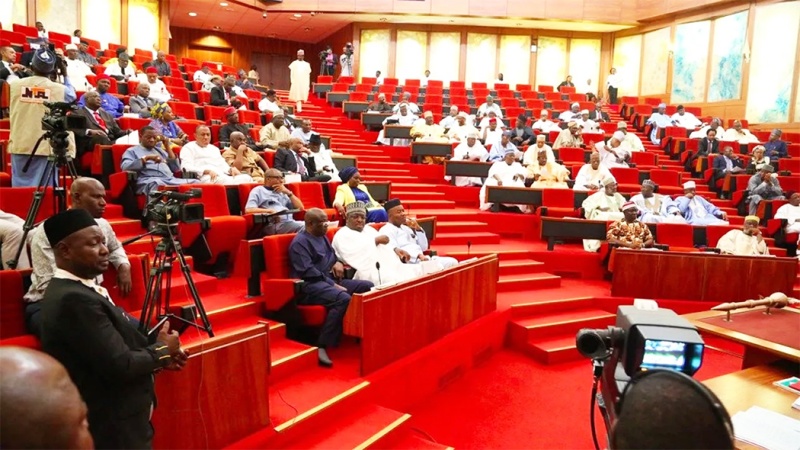
This is as senators are set to reconvene for an emergency plenary session today amid growing demands for the inclusion of mandatory electronic transmission of results in the amendment to the Electoral Act.
The upper chamber had adjourned plenary for two weeks last Wednesday after passing the Electoral Act amendment bill, to enable lawmakers engage heads of Ministries, Departments and Agencies (MDAs) in the defence of their 2026 budget proposals.
The notice of the emergency sitting was contained in a memo dated 8 February and circulated to senators. It was signed by the Clerk of the Senate, Emmanuel Odo.
In the memo, Mr Odo said he was acting on the directive of the Senate President, Godswill Akpabio.
The memo did not state the reason for the emergency plenary. However, there are strong indications that it is connected to the outrage over the Electoral Act amendment bill passed last Wednesday before the adjournment.
Although several provisions of the law were amended, public attention has focused mainly on one controversial clause: the rejection of mandatory electronic transmission of election results from polling units to the Independent National Electoral Commission’s (INEC) Result Viewing Portal (IREV).
Last week, the Senate passed the Electoral Act 2022 (Repeal and Reenactment) Amendment Bill, 2026 through third reading. A major point of contention in the amended bill is the removal of the phrase “real-time” in provisions dealing with the electronic transmission of election results, move critics say weakens safeguards against manipulation.
Although the Senate has since issued multiple clarifications, insisting that it did not reject electronic transmission outright, protesters argue that the absence of the words “real-time electronic transmission” creates room for abuse and post-poll interference.
Obi, CSOs protest at NASS, demand mandatory electronic transmission of election results
Yesterday, presidential candidate of the Labour Party in the 2023 election and one of the presidential hopefuls in 2027 election, Peter Obi alongside hundreds of demonstrators marched at the National Assembly Complex in Abuja to protest the Senate’s decision to remove “real-time” mandatory electronic transmission of election results from the Electoral Act Amendment Bill.
Obi joined the protest tagged: ‘Occupy the National Assembly,’ and organised by members of the Obidient Movement, National Opposition Movement and other pro-democracy activists.
They described the lawmakers’ action as a deliberate attempt to undermine electoral transparency ahead of the 2027 general elections.
Chanting solidarity songs and carrying placards with inscriptions such as “Our votes must count”, “No to electoral fraud”, “Akpabio, don’t destroy democracy”, “We reject the Senate rejection”, “Protect democracy now” and “Stop betrayal of the ballot”; the demonstrators marched from the Federal Secretariat towards the National Assembly.
However, they were prevented from gaining access to the complex by a heavy deployment of security personnel drawn from the Nigeria Police Force, the Nigerian Army and the Nigeria Security and Civil Defence Corps. The security operatives barricaded the main entrance, forcing the protesters to hold their demonstration outside the gates.
Addressing journalists at the protest ground, Obi condemned what he described as the steady erosion of democratic gains in the country, warning that credible elections remain the foundation of national stability and development.
“We must dismantle this criminality and prove that we are now a nation that shows light in Africa,” he said.
He declared that Nigerians would not entertain glitches in the next general election. Obi, who alleged that glitches marred the 2023 presidential election, insisted that the National Assembly must pass the proposed amendment to ensure transparency in the electoral process as Nigerians prepare for next general election.
“What we want is an electoral process that is transparent from the beginning to finish. Let’s have an amendment that will allow free and credible elections.
“Allow the elections to go through the normal process. Whoever wins, we would accept. So, why are you bringing this confusion?” he said.
He said Nigeria, as the giant of Africa must rise up and live up to expectations in deploying technology to engender credible elections.
Also speaking, National Coordinator of the Obidient Movement Worldwide, Dr Yunusa Tanko, said the agitation would continue until the National Assembly restores real-time electronic transmission of results in the amended law.
He said, “If there is no electronic transmission of results, there will be no election. Our elections must be credible.”
Tanko said past elections had been marred by manual interference during result collation, a problem electronic transmission was meant to address following reforms introduced after the 2011 and 2015 elections.
Speaking during the protest, Ike Bishop Okoronkwo, a member of the National Opposition Movement, accused political actors of manipulating election results after votes are cast, insisting that electronic transmission would curb electoral fraud.
“People will come out on election day, after they vote; their votes are counted and recorded. Somebody will sit down somewhere and mutilate the results and make the process look like child’s play,” Okoronkwo said.
He argued that tampering with election results should attract the severest punishment, warning that failure to criminalise it amounted to complicity.
“It must be a capital offence. If they don’t make it a capital offence, then they are complicit,” he said.
Okoronkwo also directed his remarks at Senate President Godswill Akpabio, saying lawmakers must recognise that public opinion now carries greater weight.
“The will of the people is greater than the will of people in power. This is 2026, not 2022 or 2023. Things have changed. Young people are more aware, and the population has grown,” he said.
Dismissing claims that Nigeria lacks the capacity to transmit election results electronically, Okoronkwo described such arguments as “a blatant lie,” citing the widespread use of Point of Sale (POS) terminals across the country.
“There is no community in Nigeria that does not have a POS. If POS can work everywhere, why can’t we transmit results from all communities?” he asked, adding that emerging technologies could be deployed to support INEC’s infrastructure.
He warned that the group would sustain its protest if the Senate failed to act, though he stressed that the demonstrations would remain peaceful.
“If they don’t do the right thing, what they will see here, they will not believe it. We will shut down here peacefully. If it means sleeping here, we will sleep here until they do the right thing,” he said.
Okoronkwo added that the group was also opposed to the proposed tax law, insisting that Nigerians were yet to see clear guidelines on its implementation.
Also speaking at the protest, the Deputy National Publicity Secretary of the African Democratic Congress (ADC), Jackie Wayas, said the demonstration reflected a shared demand by Nigerians for credible elections.
“We’re here with fellow Nigerians, demanding one thing: real-time electronic transmission of results comes 2027,” she said.
Wayas urged the Senate to “do the right thing,” noting that the decision should not be left solely to the discretion of the Independent National Electoral Commission (INEC).
She expressed hope that the Senate would heed concerns already raised by some lawmakers but warned that protests would continue if the demand was ignored.
“It is our fundamental right to ask our leaders for real-time transmission of results. If it takes us one week or two weeks, we’ll come out every other day for this,” she said.
Popular activist, Randy-Peter Akah, who also spoke at the protest ground, accused the political class of betraying the ideals of democracy and vowed that demonstrators would return to the National Assembly until their demands are met.
“Tomorrow, we will be back here until the Senate does the right thing. The current administration supported the June 12 campaign. It was about free and fair elections,” he noted.
Invoking the spirit of the June 12, 1993 election, widely regarded as Nigeria’s freest and fairest poll, Peters questioned why elected leaders would resist reforms that guarantee credible outcomes.
He said, “Do we have Democrats who are afraid of losing elections? In 2027, our votes must count. The most important thing is that our votes must count. Tomorrow, they will meet us here again.”
Kukah Centre, Yiaga Africa, others issue 2-week ultimatum to Senate
Civil Society Organisations including Centre for Media and Society (CEMESO), The Kukah Centre, International Press Centre (IPC), Elect Her, Nigerian Women Trust Fund, TAF Africa and Yiaga Africa, have urged the Senate to adopt the House of Representatives position on mandatory electronic transmission of results.
The appeal was made during a press conference in Abuja, yesterday. They expressed concerns over the Senate’s rejection of electronic transmission of election results and use of downloaded missing or unissued voter cards for elections, as well as shortening of critical electoral timelines.
They noted that the protracted amendment process has created legal uncertainty that delays INEC’s constitutionally mandated electoral preparations, potentially compromising the Commission’s ability to conduct credible elections.
The CSOs gave the National Assembly a two-week ultimatum to conclude the amendment process and transmit the final bill to the president.
The statement reads in part, “Subsequent to the Senate vote, public discourse has been saturated with conflicting narratives regarding the precise position of the Senate.
“Three competing narratives have emerged: First, that the Senate approved real-time electronic transmission; Second, that existing Electoral Act 2022 provisions granting INEC discretionary powers over the procedure for results management were retained; and third, that the Senate substituted “transmit” with “transfer” and removed the qualifier “real-time” from its version.
“It is deeply concerning that legislation of such significance is mired in political contestation”.
The CSO’s, however, urged INEC to issue the election timetable and schedule for the 2027 general election in accordance with the provisions of the Electoral Act 2022 without further delay.
They warned that delay in concluding the electoral amendment would introduce legal uncertainty that may compromise preparations for the 2027 elections.
The statement added, “Legal uncertainty created by ongoing amendments has apparently deterred INEC from releasing the timetable for the 2027 elections, placing the Commission in potential violation of the extant law. The 2022 Electoral Act remains operative until amended. The inchoate status of the Electoral Bill does not suspend INEC’s statutory obligations.
“INEC’s established policy framework schedules general elections for the third Saturday of February in the election year, a convention designed to provide certainty for electoral stakeholders, facilitate systematic planning, and accommodate potential contingencies such as reruns, runoff elections, and post-election litigation.
“Applying this framework to the 2027 cycle yields an election date of February 20, 2027, requiring notice issuance by February 24, 2026.”
According to them, the divergence between the Senate and the House of Representatives on these amendments has profound implications for the integrity of the 2027 general elections.
Real-time electronic transmission of results only way to curb manipulation – El-Rufai
Former Kaduna State governor and chieftain of the coalition African Democratic Congress (ADC), Nasir El-Rufai, has thrown his weight behind the agitation for mandatory real-time electronic transmission of election results, describing it as the only effective way to curb manipulation in Nigeria’s electoral process.
Speaking in an interview on TRUST TV’s 30 Minutes with Mannir Dan-Ali, on Monday, amid ongoing protests at the National Assembly over amendments to the Electoral Act, El-Rufai said rigging rarely occurs at polling units but at collation centres, where results are allegedly altered after voting has taken place.
“It is the only way we can stop the manipulation that goes on in the collation centres. That is where the real rigging takes place. Rigging doesn’t take place in the polling unit,” he said.
El-Rufai said he would have joined Peter Obi for the protest if he had been in the country earlier.
The former governor criticised the Senate for frustrating the provision mandating real-time transmission of results, noting that the House of Representatives had already passed it. According to him, restoring the provision would significantly improve the credibility of elections in the country.
“This provision, which has been passed by the House of Representatives, but sadly being frustrated by the Senate, would have improved the quality of our elections,” he said.
El-Rufai further alleged that resistance to the reform was politically motivated, arguing that the ruling party and the sitting government were opposed to it because of fears of losing elections.
NBA joins calls
The Nigerian Bar Association (NBA) has also lent its voice to the demand. Speaking during the National Executive Council (NEC) over the weekend, the association said it accepted the position after considering the report presented by the NBA President, Mazi Afam Osigwe (SAN) at its February 5, meeting in Maiduguri, Borno State.
In its report, NBA warned that such discretionary phrasing weakens the legal basis for transparent, real-time result reporting, leaving space for manipulation and post-election disputes.
The association said a clear statutory requirement for electronic transmission is essential to protect the integrity of votes and restore public confidence in Nigeria’s electoral system.
It also noted that credible elections remain the foundation of constitutional democracy and warned that continued resistance to enforceable electronic transmission provisions undermines democratic accountability.
The association said technology-driven transparency is no longer optional in modern democracies, urging Nigeria to align its electoral framework with global best practices.
Accordingly, the NBA called on members of the National Assembly to demonstrate legislative responsibility by voting in favour of the amendment compelling the electronic transmission of election results.
“The council resolved that the National Assembly must urgently revisit clause 60(3) and pass the proposed amendment to expressly mandate electronic transmission of results from polling units,” the statement reads.
“They know they can’t win the elections. And the only way they have a fighting chance is to be able to manipulate the results after people have voted,” he claimed.
On the next steps, El-Rufai expressed confidence that the conference committee of the National Assembly would recommend the restoration of the real-time transmission provision.
“I am confident, looking at the composition of the conference committee and the integrity of the majority of its members, they would recommend the restoration of the provision for the real-time transmission of results from the polling unit,” he said.
He described the issue as one that transcends party politics, stressing that it was about protecting the right of Nigerians to freely choose their leaders without interference.
“This is about the people of Nigeria. It’s really not about elections or about APC or ADC or any other party. It’s about giving Nigerians the opportunity to vote for whom they want, and that result should not be subject to any manipulation,” El-Rufai added.
The former governor also predicted that the Senate would eventually approve the recommendation, saying a majority of senators were committed to Nigeria’s progress. However, he accused the Senate President, Godswill Akpabio, of standing in the way of the reform.
“Let’s be clear, it is not the senators that are the problem. Akpabio is the problem,” he said, adding that senators might be forced to assert themselves when they reconvene.
On concerns that President Bola Tinubu might withhold assent to the bill if passed with the provision, El-Rufai said the National Assembly could override a presidential veto if public pressure remains strong.
“When the National Assembly overrides Akpabio and includes this provision, the president may withhold assent, in which case it will come back to the National Assembly for them to exercise their two-thirds override,” he said.
According to him, preserving real-time electronic transmission of results is crucial not only for lawmakers’ political survival but also for the survival of Nigeria’s democracy.
Senate’s stance on electronic transmission a missed opportunity – Guild of Editors
Meanwhile, the Nigerian Guild of Editors (NGE) has expressed concern over the controversy surrounding the Senate’s position on the transmission of election results, describing it as “a missed opportunity.”
The current development, the Guild said, was already “creating room for doubt and mistrust in the electoral process among Nigerians.”
The Guild, in a statement by its President, Eze Anaba and General Secretary, Onuoha Ukeh, maintained that mandatory and immediate transmission of election results will not only enhance free and fair elections but also give Nigerians the confidence that their votes will truly count.
“The uncertainty arising from the Senate’s adoption of provisions in the proposed 2022 Electoral Act—allowing for the transmission of election results without making it mandatory and immediate—runs contrary to the widely held position of most Nigerians and many lawmakers. The resulting public outrage has pitted citizens against the Senate and could potentially discourage voter participation in future elections.
“At a time when Nigerians are calling for mandatory and immediate transmission of election results from polling units to central collation centres—and as countries across the world adopt electronic transmission as part of electoral reforms to enhance transparency—the Senate’s position leaves much to be desired.
“To say the least, this stance represents a missed opportunity to strengthen transparency and accountability in Nigeria’s electoral process.
“It undermines ongoing efforts to deepen democratic governance and ensure credible elections.
“Globally, mandatory electronic transmission of election results has become a standard for improving electoral credibility and efficiency”, the group said.
Electronic transmission possible in Nigeria – IT expert
An IT expert, Abiodun Adu, stressed that Nigeria possesses a 70 per cent internet penetration rate (3G/4G), alluding to the possibility of the deployment of electronic transmission during general elections.
“Electronic transmission isn’t so much a big deal as the National Assembly is painting it. They are deliberating making it seem as though it is rocket science.
“Nigeria has at least 70% internet penetration rate (3G/4G) and in that sense, electronic transmission should not even be a debate, it should be a matter of necessity,” he said.
He added that the form EC8A writing election materials require about 700 – 800 kilobytes (kb) to get uploaded, emphasising the existing internet infrastructure to achieve it.
"The form EC8A they need to upload in real-time would be about 700 – 800kb. In a 3G network, upload speed could be about 300kb/s which means it would only take a maximum of 3 seconds to upload a document of about 800kb,” he stressed.
However, he called for the need for investment in satellite connectivity for communities without internet connections.
“There is hardly any community that is without some form of internet coverage in Nigeria, however, if there are communities without, we can easily leverage satellite connectivity in such places. For instance, Starlink uses satellite connectivity, therefore, it will still work in the remotest places in the country. If we are really serious about this, it’s a little investment to make. In a case where that doesn’t still work, they can have the election and then have the document snapped and queued for upload such that once you move to an area with signal, the upload gets completed successfully without any alteration,” he said.
Nigerian Society of Engineers backs real-time transmission of results too
The Nigerian Society of Engineers (NSE) has also declared full support for the adoption of real-time electronic transmission of election results, insisting that the reasons advanced by the Senate for rejecting the proposal lack technical merit.
In a press release titled “Electronic Transmission of Election Results: The Position of the Nigerian Society of Engineers,” published as advertorial in newspapers at the weekend, the NSE reacted to the Senate’s February 2026 decision to reject a proposal that would make real-time electronic transmission of results from polling units to the Independent National Electoral Commission’s (INEC) Result Viewing (IReV) portal mandatory.
The statement signed by its President, Engr. Ali Alimasuya Rabiu, said reasons advanced for the rejection do not have the endorsement of any technically proficient professional organisation such as the Nigerian Society of Engineers (NSE).
According to the NSE, electronic transmission of election results offers significant technical advantages capable of enhancing the integrity, efficiency and credibility of Nigeria’s electoral process. It argued that secure electronic systems reduce the risk of manipulation associated with manual transportation of result sheets, which are prone to tampering, loss or alteration.
“Electronic systems use secures protocols like end-to-end encryption and digital signatures to ensure data integrity from polling units to central servers, minimizing human intervention,” the NSE said.
The engineers also noted that real-time digital uploads would significantly speed up collation and announcement of results, reducing the process from days to hours through automated aggregation, while leveraging modern network technologies such as 4G, 5G and satellite links for remote areas.
On accuracy and transparency, the NSE said digital records would eliminate transcription errors common in manual processes and provide audit trails through technologies such as time stamped ledgers and blockchain, enabling independent verification by stakeholders.
It further argued that while initial deployment costs may be high, electronic transmission would ultimately lead to cost savings through reduced printing, transportation and personnel needs, adding that scalable cloud-based systems could efficiently handle results from Nigeria’s over 176,000 polling units, with safeguards such as offline caching for areas with poor connectivity.
The NSE cited successful use of real-time electronic transmission in countries such as Estonia and India, noting that similar adoption in Nigeria could address the country’s long history of electoral disputes while aligning with INEC’s existing technological infrastructure.
Meanwhile, efforts to get the spokesperson of the Senate, Yemi Adaramodu, to speak on the next move by lawmakers amidst the mounting pressures from civil society groups and other stakeholders proved abortive.
Also, efforts to get the reaction of some senators on what Nigerians should expect ahead of the emergency plenary session today were also not successful as they did not respond to calls and WhatsApp messages sent to them at the time of filing this report.
Members of the Senate Minority Caucus had earlier made their position known, insisting that what the lawmakers passed was real time electronic transmission of results
Voting on e-transmission of election results should be public – Ningi
Senator Abdul Ningi has called for an open and transparent voting on real-time electronic transmission of election results, saying Nigerians deserve to know how each senator votes on the matter.
Speaking during an interview on Channels Television on Monday, he said the Senate’s electoral committee was constituted under an emergency arrangement and worked with unusual diligence within a limited timeframe.
“I have never been in a committee that sat and did a diligent job like this electoral committee,” he said.
He added that the committee was properly funded and consistently monitored, with progress reports demanded at every stage.
The senator said an emergency plenary session had been scheduled to address unresolved procedural issues surrounding the bill.
“The votes and proceedings have not yet been captured,” he said. He explained that because the votes and proceedings had not been adopted, the legislative process on the bill was not yet concluded. “This phase of the procedure is not over yet,” he explained.
Ningi noted that the Senate would need to revisit the bottom proceedings to clarify whether the disputed clause reflected “transfer” or “transmission,” following a motion for amendment raised during plenary.“There was a motion for amendment, and the question is what exactly was captured,” he noted.
He said the confusion stemmed from the need for lawmakers to fully understand the implications of the amendment before taking a final position.
“When you bring a motion on something you have no idea of, it creates discomfort,” he said. The senator stressed that the matter was not a party issue, insisting that support for electronic transmission cut across political lines.“This is not a party thing; it has never been a party thing,” he said.
He added that governors across party lines had made submissions in support of electronic transmission of results. “APC governors, PDP governors, they are all saying e-transmission,” he added.
Ningi explained that if the Senate President decided to put the matter to vote, the outcome would be determined by majority decision. (Daily Trust)