 ADAD
ADAD
Updating your news feed...
NEWS EXPRESS is Nigeria’s leading online newspaper. Published by Africa’s international award-winning journalist, Mr. Isaac Umunna, NEWS EXPRESS is Nigeria’s first truly professional online daily newspaper. It is published from Lagos, Nigeria’s economic and media hub, and has a provision for occasional special print editions. Thanks to our vast network of sources and dedicated team of professional journalists and contributors spread across Nigeria and overseas, NEWS EXPRESS has become synonymous with newsbreaks and exclusive stories from around the world.

















Loading banners
Loading banners...

The Organised Private Sector of Nigeria (OPSN) has called on the Federal Government to treat private sector survival and growth as a national priority, warning that high tax burdens, expensive financing, regulatory overlaps and operational bottlenecks continue to undermine enterprise development across the country.
The group urged urgent policy coherence, affordable access to finance, smarter regulation and a fair, context-sensitive green transition to protect businesses and reposition Nigeria’s economy for sustainable growth.
Chairman of OPSN, Jani Ibrahim, made the call in his welcome remarks at the OPSN Strategy Meeting held on Friday in Lagos.
He stressed that the private sector remains Nigeria’s most dependable engine for growth, employment, innovation and economic resilience.
Ibrahim noted that small and medium-sized enterprises (SMEs) account for more than 90 per cent of businesses and over 80 per cent of employment nationwide, while the private sector contributes more than half of the country’s Gross Domestic Product (GDP).
He lamented that businesses are grappling with rising input costs, exchange rate volatility, energy shortages, logistics inefficiencies and shrinking consumer purchasing power, warning that these pressures threaten production capacity, payroll sustainability and national competitiveness.
The OPSN chairman also criticised regulatory excesses, including overlapping inspections and duplicative compliance requirements, which he said significantly increase operating costs, particularly for manufacturers and SMEs.
On financing, Ibrahim decried the low level of domestic credit to the private sector, which remains below 15 per cent of GDP—far behind peer economies.
He described prevailing high interest rates as inimical to long-term investment and industrial expansion.
According to him, the proposed OPSN Bank, which would provide single-digit interest financing, has the potential to unlock manufacturing capacity, deepen value chains and stimulate large-scale job creation.
Ibrahim further called for reforms to ease business entry and formalisation, urging faster turnaround times at the Corporate Affairs Commission (CAC) and more affordable intellectual property protection.
On climate policy, he advocated a realistic and inclusive green transition, noting that Environmental, Social and Governance (ESG) compliance and carbon market participation require capacity building, access to green finance and regulatory clarity to prevent Nigerian businesses from being excluded from global value chains.
He also stressed the need to revitalise export infrastructure, particularly Export Trade Houses, to boost non-oil exports and foreign exchange earnings.
Speaking to journalists, National President of the Nigeria Association of Small and Medium Enterprises (NASME), Dr Abdulrashid Yerima, welcomed ongoing tax reforms, describing them as a long-overdue intervention capable of addressing longstanding challenges facing MSMEs.
Yerima said the reforms would reduce multiple taxation, arbitrary levies and excessive import duties that have historically constrained small businesses, expressing optimism that a clearer and more predictable tax framework would enable MSMEs to reinvest, expand operations and create jobs.
Also speaking, President of the Manufacturers Association of Nigeria (MAN), Francis Meshioye, said the strategy meeting was convened to assess the impact of the new tax law on OPSN members, particularly issues around assessment methodology, e-invoicing and implementation.
While backing the reforms, Meshioye cautioned that their success would depend on transparent and consistent implementation, especially by sub-national governments, warning that uneven application across states could undermine intended benefits.
He stressed that only a predictable, uniformly applied tax regime would restore business confidence, attract investment and reposition Nigeria’s manufacturing sector for sustained growth. (The Guardian)
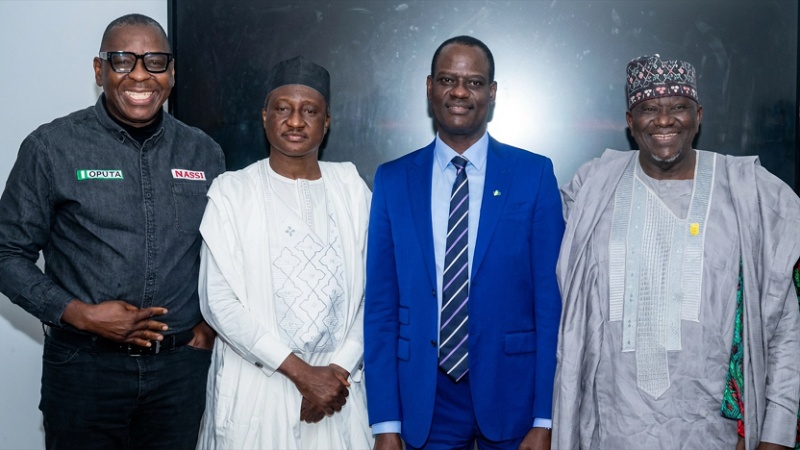
• PHOTO: Director General NASSI, Chris Oputa (left); President of NASME, Dr. Abdulrashi Yerima; Chairman Presidential Tax Committee, Mr Taiwo Oyedele; Chairman OPSN and President NACCIMA, Jani Ibrahim at the Organised Private Sector of Nigeria (OPSN) Strategy Meeting held in Lagos on Friday
Coalition protests NAFDAC’s enforcement of sachet alcohol ban



