ADAD
Updating your news feed...

NEWS EXPRESS is Nigeria’s leading online newspaper. Published by Africa’s international award-winning journalist, Mr. Isaac Umunna, NEWS EXPRESS is Nigeria’s first truly professional online daily newspaper. It is published from Lagos, Nigeria’s economic and media hub, and has a provision for occasional special print editions. Thanks to our vast network of sources and dedicated team of professional journalists and contributors spread across Nigeria and overseas, NEWS EXPRESS has become synonymous with newsbreaks and exclusive stories from around the world.



















Loading banners
Loading banners...

Switzerland’s foreign ministry has confirmed that the woman who tested positive for Ebola in Nigeria is the wife of a Swiss diplomat, as health authorities continue investigations into the source of her infection.
The 42-year-old Ugandan-born woman, who lives in Abuja, tested positive for the virus on October 20, becoming Nigeria’s first confirmed Ebola case in more than a decade.
According to the Swiss foreign ministry, the woman and her husband travelled to Uganda earlier this month. Her husband is currently in isolation but has not developed any symptoms.
The ministry said the woman had spent about a week at a private clinic in Abuja experiencing symptoms before her diagnosis. She is receiving treatment in isolation and is showing signs of improvement, according to the World Health Organization (WHO).
The Swiss foreign ministry added that all 25 employees at its embassy in Nigeria, comprising eight Swiss nationals and 17 local staff, were in good health and did not need to isolate. The decision was taken in consultation with Nigeria’s Ministry of Health and the WHO.
The embassy remains open and operational, with health and safety measures in place.
The woman returned to Nigeria on October 3 after spending approximately two and a half weeks in Uganda. However, the source of her infection remains unclear.
The Swiss government told Reuters that the patient did not travel to the Democratic Republic of Congo, contradicting earlier accounts from Ugandan officials. The WHO said it was too early to determine where she contracted the virus.
Health authorities are also investigating whether she may have crossed paths with a Kenyan man who died from Ebola after travelling through Uganda’s main airport on the same day.
The Africa Centres for Disease Control and Prevention said investigators were examining whether the two patients could have been exposed through shared equipment or other contact. However, no link has been established.
The WHO said investigators were still reconstructing the woman’s travel and exposure history, noting that limited opportunities to interview her while she remained in hospital had complicated the process.
Nigeria’s Centre for Disease Control and Prevention is conducting genomic sequencing to determine whether her infection is linked to other cases. Authorities have confirmed that she has the Bundibugyo strain of Ebola, the same strain responsible for the outbreak in the Democratic Republic of Congo.
Ugandan officials had previously said the woman travelled to eastern DR Congo for business. However, the WHO, Africa CDC and Nigeria’s health ministry said they had not received verified information confirming that she visited the country.
Uganda maintains that it has no confirmed active Ebola cases and says the woman’s travel through the country does not necessarily mean she contracted the virus there.
Meanwhile, Nigerian health authorities are tracing additional people who may have been exposed to the patient beyond the 44 contacts initially identified.
The developments come amid a wider regional outbreak. The Democratic Republic of Congo has recorded thousands of deaths in its deadliest Ebola outbreak, while Kenya has confirmed nine cases, including the first patient who died after travelling from DR Congo through Uganda.
Kenya’s Health Director-General, Patrick Amoth, said all nine infections were linked to the initial patient, with no evidence of wider community transmission. He added that the eight surviving patients remained in isolation and were responding well to treatment.
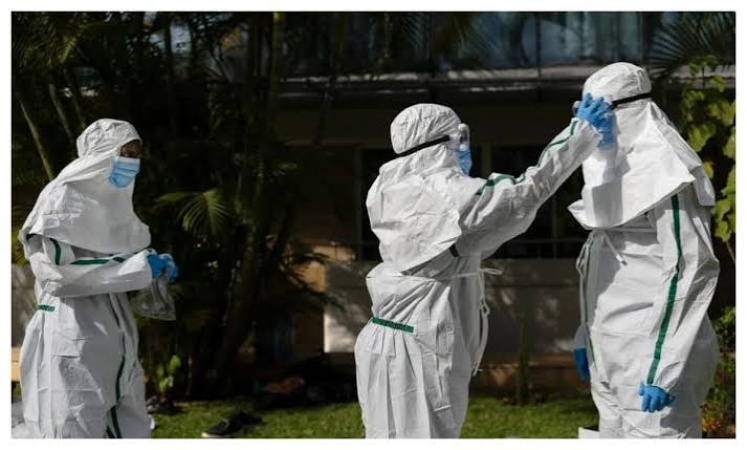
The WHO’s regional director for Africa, Mohamed Janabi, has called for increased regional vigilance, urging countries to strengthen surveillance, investigate infections and protect frontline health workers.
Ebola spreads through direct contact with the blood or other bodily fluids of an infected person, or contaminated objects. Symptoms can include fever, severe weakness, vomiting and diarrhoea.
Health authorities say rapid contact tracing, isolation of suspected cases and early treatment remain critical to preventing further transmission. (AriseNews TV)