ADAD
Updating your news feed...

NEWS EXPRESS is Nigeria’s leading online newspaper. Published by Africa’s international award-winning journalist, Mr. Isaac Umunna, NEWS EXPRESS is Nigeria’s first truly professional online daily newspaper. It is published from Lagos, Nigeria’s economic and media hub, and has a provision for occasional special print editions. Thanks to our vast network of sources and dedicated team of professional journalists and contributors spread across Nigeria and overseas, NEWS EXPRESS has become synonymous with newsbreaks and exclusive stories from around the world.





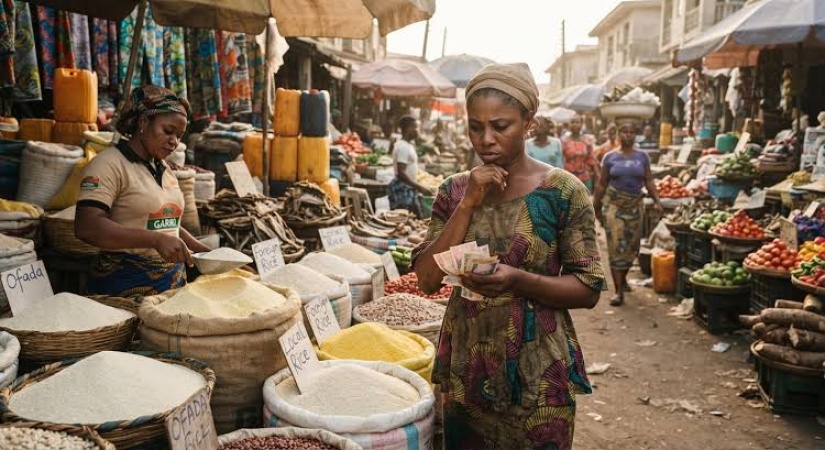
Different food items in a Nigerian market
Despite the Federal Government’s interventions meant to cushion the prices of farm inputs and ultimately reduce the prices of food items in the country, food prices have remained high even during the ongoing harvest season.
Meanwhile, farmers, agribusiness groups, traders and consumers have attributed several factors, including the high cost of transportation, delayed and uneven distribution of farm inputs, inadequate storage systems and insecurity in some farming communities, to the factors keeping food prices high in Nigeria.
They warned that increasing production alone would not guarantee affordable food if farmers could not preserve their harvests, move produce efficiently to markets or obtain inputs early enough for the planting season.
Renewed Hope Agenda
President Bola Tinubu’s Renewed Hope Agenda promised to strengthen food security, increase local production, support farmers and reduce Nigeria’s dependence on food imports.
In 2023, the Federal Government declared a state of emergency on food security and announced plans to invest N200 billion in cultivating 500,000 hectares of farmland, alongside the distribution of fertiliser, seedlings and other farm inputs.
The measures were intended to boost production and ease pressure on food supply.
The administration has since announced further initiatives, including mechanisation support and fertiliser distribution.
In June 2026, the National Agricultural Development Fund launched a programme to distribute 515,720 bags of fertiliser to 128,930 smallholder farmers across 25 states and the Federal Capital Territory.
The government also outlined measures to support local fertiliser production, improve access to farm inputs and expand agricultural productivity.
But farmers’ groups are questioning the impact of government interventions, saying the support does not always reach genuine farmers or translate into more affordable food.
What NBS says
Data obtained from the National Bureau of Statistics’ Consumer Price Index report for September 2026 show that, on a year-on-year basis, food inflation stood at 19.59 per cent in September 2026, slightly higher than the 19.57 per cent recorded in August but below the 20.16 per cent recorded in September 2025.
The bureau attributed the movement to price changes in guinea corn flour, sold loose; white maize flour, sold loose; local short-grain rice; eggs; fresh onions; palm oil; fresh green beans; Irish potatoes; okra; fresh tomatoes; dried green peas; plantain; among others.
On a month-on-month basis, the food index fell by 1.55 per cent in September, compared with an increase of 1.02 per cent in August.
The breakdown of food inflation by state shows that Lagos recorded the highest food inflation, at 34.40 per cent, on a year-on-year basis, followed by Imo at 33.79 per cent and Ondo at 31.49 per cent.
On the other hand, three northern states recorded the slowest rises in food inflation on a year-on-year basis, with Taraba recording a negative 7.47 per cent, Yobe a negative 0.37 per cent and Borno a negative 2.18 per cent.
A Vanguard market survey carried out at Mile 12 International Market, one of the biggest foodstuff markets in Lagos, on some food items between August, September and October reflects price swings in items such as tomatoes, fresh onions, fresh pepper, beans, yam, plantain and sweet potatoes, while the prices of rice, horse mackerel (Titus), palm oil and guinea corn remained the same.
In August, a big basket of tomatoes sold for between N65,000 and N80,000 and later settled at N60,000 at the end of September, but has since risen to N70,000 in October.
In the same period, a big sack of fresh onions sold for N130,000 in August, rising to N150,000 at the beginning of September and later to N250,000 at the end of the same month. Currently, a sack of fresh onions sells for N350,000 at Mile 12 International Market, one of the biggest foodstuff markets in Lagos.
Meanwhile, a small bag of fresh pepper, which sold for N40,000 in August, dropped to N25,000 in September and is currently sold for N12,000. Also, a tuber of yam dropped to N4,000 in September from N7,000 recorded in August. The price drop was a result of the new yam harvest witnessed during the period. Prices of beans fluctuated between N6,000 and N7,000 in the same period.
Farmers’ groups react
Deputy National President of the All Farmers Association of Nigeria (AFAN), Mr. Daniel Okafor, blamed the high cost of fuel and poor roads, which he said had increased transportation and logistics expenses.
Speaking with Vanguard AgroBiz, Okafor, who is also the National President of the Potato Farmers Association of Nigeria (POFAN), also blamed insecurity in some farming communities, which he said affects cultivation and disrupts the movement of produce from farms to markets.
Okafor called for better rural roads, improved security, irrigation, timely farm inputs and training, saying agricultural support must be delivered in line with the farming calendar.
On her part, the Acting National President of the Smallscale Women Farmers Organisation in Nigeria (SWOFON), Mrs. Florence Ojo, said farm inputs were often inadequate or distributed too late to meet farmers’ needs.
Ojo said inputs intended for farmers should be distributed early enough for the relevant planting season and should reach genuine smallholder farmers, particularly those in rural communities.
According to her, the government must work with farmers’ organisations to identify genuine smallholders and monitor distribution intended to improve production.
She also called for more accessible extension services, better storage facilities and rural roads, as well as measures to reduce insecurity and post-harvest losses.
Why onion prices are high — NOPPMAN
The National President of the National Onion Producers, Processors and Marketers Association of Nigeria (NOPPMAN), Aliyu Maitassamu Isah, blamed the 2024 poor-quality seed crisis, fire incidents in many warehouses and heavy post-harvest losses as major factors contributing to the rise in onion prices.
He noted that onion prices rose from N25,000 and N30,000 per 120kg bag in March and April, respectively, to about N300,000 due to the crisis in the sector.
Explaining the crisis, Isah said a seed introduced into Nigeria from Algeria during the 2024–2025 growing season was unsuitable for the country’s farming system.
He noted that NOPPMAN had reported the problem to the government and sought intervention to cushion the losses, which were estimated at nearly N100 billion.
According to the account, the sector received a grant of about N2 billion from the Nigerian Agricultural Development Fund, an amount described as inadequate compared with the reported losses.
According to him, the current scarcity could have been avoided or reduced if the government had responded promptly to the seed crisis that disrupted production during that period.
He said the problem was compounded by inadequate storage facilities and fires that destroyed onions kept in local storage centres, leaving less produce available to meet demand.
Isah, explained that the price increase was not necessarily because Nigeria had failed to produce enough onions, but because a significant proportion of the harvest was lost before the next season.
“It’s not that we did not produce enough for the country, but we lost more than 51% from the month of April to October,” he said.
Isah said swift government intervention was necessary when a crisis affected an agricultural subsector, warning that failure to address such problems could lead to further damage.
He said the Minister of Agriculture had held discussions with the Bank of Agriculture and the Nigerian Agricultural Development Fund on support for the onion subsector, particularly seed supply and other farm inputs.
Maitassamu said onion supplies from Sokoto were expected around November and December, followed by Aliero in Kebbi State from late December to January while the main harvest season is expected around March and April next year.
He expressed optimism that the incoming harvest would help bring prices down, while stressing the need for timely intervention and better storage to prevent a recurrence of the crisis.
For the tomato sector, the current price surge is due to seasonal transition and low production.
The National Secretary of the National Tomato Growers, Processors and Marketers Association of Nigeria (NATPAN), Sani Danladi Yadakwari, said farmers were almost out of the wet-season harvest, while dry-season cultivation had just commenced.
However, he said many farmers had cut down on production this year after suffering huge losses last year when prices failed to appreciate.
He said: “We are almost out of the wet-season harvest period and the dry season has just started. Farmers are doing land preparation and putting seeds now. Hopefully, around the end of December, January, new harvest will start coming out. That is why the price is going up.
“Even from our end, the price has changed. That is why you see even onion price, pepper, almost everything. People are afraid because last year the produce price did not appreciate all through the year. Some people lost as much as 100 per cent of their investment. That is why some people are backing out to reserve what they have, otherwise they will invest all and lose all,” he said.
He said the price of tomatoes at the farm gate had changed, with a crate now selling for N16,000 to N17,000, depending on freshness, compared with N20,000 last week.
Yadakwari, who has in the past attributed the high cost of tomatoes partly to the lack of industry off-takers, said: “There are still no new off-takers. The only thing is production is down. Farmers did not produce up to how they used to produce because of last year’s experience of poor market price,” he added.
The Emir of Kano, Muhammadu Sanusi II, also warned that government responses to rising food prices must not undermine local production.
Speaking recently at an event in Lagos, he recalled that opening the market to rice imports from countries including Thailand and India had brought prices down but hurt domestic rice mills and left some investors in the agricultural value chain with bad debts.
He said that although imports could lower prices in the short term, they could undermine local mills, investors and domestic production if policy failed to protect productive capacity.
Nigeria, he said, could not continue relying on food imports from countries such as Thailand, India and China instead of strengthening its own production.
Traders blame high transportation costs, others
Traders in various areas in Lagos attributed the rising prices of food items to higher transportation expenses, spoilage and supply constraints, which they said were putting pressure on their businesses.
Founder of Food Drum and foodstuff seller, Caroline Ani, who buys from the North to sell in Lagos, said the foodstuff business was a good business, but the high cost of moving the goods within Lagos greatly affected the prices at which they were eventually sold.
She said: “Foodstuff business is quite lucrative, but doing it in a place like Lagos is crazy. I experienced a very bitter side of business during my first order. I got the foodstuff cheaper, but by the time it got to Lagos, the transportation from Oyinbo to Lagos Island was the exact fee I paid from Kaduna to Lagos.”
Adeola Adeoye, a tomato seller, faulted inadequate storage systems in Nigeria, which she said caused most of the tomatoes to spoil while in transit.
She said: “Tomatoes are more expensive because our suppliers sell them to us at higher prices, and transportation costs have also increased because of fuel prices. Some tomatoes get spoiled before we sell them, so we lose money. We cannot sell at last year’s prices because we also need to make a profit.”
An onion seller, Shukurat Eniola, said higher supply costs and limited availability had also affected the trade, leaving consumers to adjust the quantities they could afford.
She said: “When we go to buy onions from our suppliers, we spend more money than we did last year. Fuel prices have also increased, affecting transportation. Sometimes, onions are not available in large quantities, and customers who used to buy a bag now buy smaller quantities because of the high price.”
A trader dealing in melon seeds and African wild mango seeds (ogbono) said the cost of labour, processing and transportation also contributed to the prices of the commodities.
The trader said: “When our suppliers increase their prices, we have no choice but to increase ours. The money someone used to buy a reasonable quantity last year cannot buy the same quantity now.”
For consumers, however, the rising prices mean spending more on food while getting less in return.
Amina Bunu complained to our reporter at Ijeh Market, located in Ikoyi, that the N5,000 she spent on onions could not provide enough for two pots of food, describing the prices as the highest she had experienced.
She said that after buying the onions, her employer complained repeatedly that the quantity was too small for the amount spent.
According to her, she had to explain that food prices had risen so much that N5,000 could no longer buy the quantity people were accustomed to.
Bunu added that tomatoes were also expensive, making it increasingly difficult to buy the quantities needed for household cooking.
Another consumer, Nelson Oche, said the cost of food had made it difficult for him to stock up his home, even with N50,000.
Oche, a bachelor who lives with his younger brother, said that in the past, N50,000 would have enabled him to buy food items to stock the house. However, he said the same amount could no longer cover even two days’ worth of meals.
He showed Vanguard the bag of food items he had purchased for more than N50,000, including tomatoes, onions, melon seeds, pepper and other ingredients.
Stakeholders call for investment in solar-powered storage systems, others to address challenges
For agribusiness stakeholders, there was a need to increase investment in cold storage, aggregation centres and logistics infrastructure to reduce post-harvest losses and limit sharp seasonal increases in food prices.
They said Nigeria needed a coordinated cold chain that could preserve perishable produce after harvest and move it to markets when needed, rather than allowing large quantities of food to be lost while consumers faced high prices.
Speaking at a recent event in Lagos, the Managing Director of Mystrose Agro Commodities Limited and Novachill, Mr. Babatunde Niran-Aluko, said Nigeria faced a major gap in long-term storage for perishable produce.
According to him, this opportunity should attract private investment.
He added that cold-chain logistics were equally important because produce could still be lost after leaving an aggregation centre.
Founder of Century 21 Foundation, Princess Kemdi Chika-Okafor, advocated decentralised cold-storage facilities located near aggregation centres and markets, rather than concentrating investment in large warehouses.
She said solar-powered storage hubs could allow farmers and traders to pay for the space they used, making the facilities more accessible to small-scale operators.
She added that partnerships with non-governmental organisations and public institutions could help private operators access cheaper financing and keep services affordable.
Other stakeholders said costs beyond the farm gate were also contributing to high food prices.
Founder and Chief Executive Officer of City Distro, Olamide Olabisi, said multiple levies imposed during the transportation of goods increased distribution costs, ultimately affecting prices paid by consumers.
Olabisi said moving commodities from the North to the South in trucks meant having to settle touts in each local government area before the goods finally reached Lagos State.
He called for better enforcement of a uniform levy system to reduce the burden on traders and distributors. Olabisi also identified farmer-herder clashes and inadequate irrigation as challenges affecting production. (Vanguard)