Updating your news feed...
NEWS EXPRESS is Nigeria’s leading online newspaper. Published by Africa’s international award-winning journalist, Mr. Isaac Umunna, NEWS EXPRESS is Nigeria’s first truly professional online daily newspaper. It is published from Lagos, Nigeria’s economic and media hub, and has a provision for occasional special print editions. Thanks to our vast network of sources and dedicated team of professional journalists and contributors spread across Nigeria and overseas, NEWS EXPRESS has become synonymous with newsbreaks and exclusive stories from around the world.











Loading banners
Loading banners...

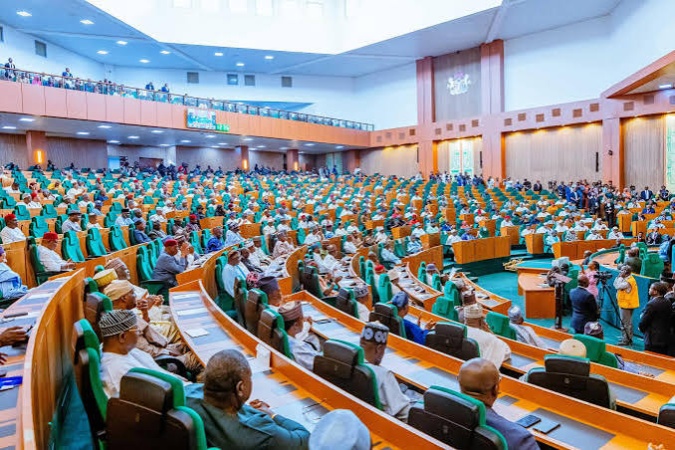
Members of the National Assembly during plenary
The National Assembly on Wednesday confirmed that it has transmitted the Constitution of the Federal Republic of Nigeria, 1999 (Sixth Alteration) Bill, 2026, to the 36 state assemblies for consideration and approval.
Clerk to the National Assembly, Kamoru Ogunlana, who disclosed this in a statement, said the bill was transmitted in accordance with Section 9 of the 1999 Constitution, which requires a constitutional amendment to secure the approval of at least two-thirds of the 36 State Houses of Assembly.
The statement said the state legislatures were requested to consider the bill in line with their respective legislative procedures and communicate their resolutions to the National Assembly after completing their consideration.
The National Assembly said the Constitution does not prescribe a specific period within which state assemblies must communicate their resolutions on a constitutional alteration bill.
However, it said the state assemblies were expected, in the interest of an orderly and timely conclusion of the process, to consider the bill and communicate their resolutions within 30 days of receiving it.
The National Assembly clarified that the 30-day period was an administrative timeframe and not a constitutional deadline.
It also acknowledged the constitutional responsibility and independence of the state legislatures in considering the bill, saying the transmission was intended to facilitate the orderly discharge of their role in the amendment process.
It added that upon receiving the resolutions of the State Houses of Assembly, the National Assembly would proceed with the necessary steps in accordance with the Constitution.
Meanwhile, further findings by Daily Trust yesterday indicated that only the State Police Bill was transmitted to the state assemblies for consideration and not the entire items contained in the 2026 constitution amendment bills under consideration.
A source in the office of the Clerk to the National Assembly told Daily Trust that the other constitution amendment bills under consideration are yet to be passed by the National Assembly.
No fewer than 37 constitution amendment bills had undergone various legislative stages including public hearings at state, zonal and national items, waiting for voting by both chambers of the National Assembly for onward transmission to the states for concurrence.
Provisions in State Police Bill
The State Police Bill, which was sent to the National Assembly by President Bola Ahmed Tinubu, was expeditiously considered and passed by the Senate on June 24, 2026 while the House of Representatives passed the same bill on July 23, 2026.
The passage of the executive bill officially sets the stage to dismantle the decades-old unitary structure of the Nigeria Police Force (NPF) and replace it with a dual model, comprising the Federal Police Service and State Police Services.
Under the newly substituted Section 214 of the Constitution, the Federal Police Service retains absolute monopoly over major security sectors, ensuring that the federal government remains the ultimate custodian of the nation’s territorial integrity. The Federal Police will maintain exclusive jurisdiction over National security, terrorism, and cybercrime; inter-state crimes, arms-trafficking, and international crime syndicates.
The bill clarifies that while state police will manage domestic public safety, they are completely barred from cross-border law enforcement. A State Police Service shall not exercise police powers outside the borders of the state for which it is established, except as specifically authorised by an Act of the National Assembly.
One of the most intensely debated aspects of the bill centres on the federal government’s veto power to override state control. The legislation empowers the president to bypass state governors and temporarily assume direct operational command of any State Police Service under strict exceptional metrics.
The conditions under which a federal takeover can occur are explicitly detailed to prevent arbitrary federal interference, while ensuring that rogue or incapacitated state police forces are quickly brought to heel.
These triggers include “where there is an actual or imminent breakdown of public order or public safety which the State Police Service is unable or unwilling to contain; where the State Police Service is unable to function by reason of serious administrative, financial, operational or other incapacity; where there is substantial evidence that the State Police Service is being used for egregious or systematic violation of fundamental rights, partisan or electoral intimidation, ethnic, religious or sectional persecution, or unlawful obstruction of this Constitution…”
The bill stipulates that such federal interventions must be authorised in writing by the president, stating the grounds, targeted territory, and expected duration of the takeover. Furthermore, a formal notice of the intervention must be transmitted to the affected State Governor, the Speaker of the State House of Assembly, the National Police Council, and the National Assembly within 48 hours of execution.
The Federal Police Service will be headed by an Inspector-General of Police appointed by the President on the advice of the National Police Council, subject to Senate confirmation.
Pending constitutional amendment bills
Besides the State Police Bill, which has recorded progress, several other critical constitutional amendment bills are still stalled in the National Assembly.
No fewer than 37 bills seeking alterations to different provisions of the 1999 Constitution were listed under the ongoing constitution review exercise, but only the State Police Bill has been passed and transmitted by the National Assembly to the state Houses of Assembly.
In June 2026, the House of Representatives released the final list of the 37 harmonised constitution amendment bills ahead of planned voting by members.
However, the lawmakers did not carry out the voting exercise until the National Assembly proceeded on its annual recess.
With electioneering already on ahead of 2027 polls, the pending constitution amendment proposals may not sail through before the life of the 10th National Assembly comes to an end in June 2027.
The pending proposals cover major areas of Nigeria’s political and governance system, including electoral reforms, judicial administration, legislative procedures, citizenship, women’s representation, human rights, traditional institutions, security, devolution of powers and local government autonomy.
The development places the proposed establishment of state and community police at the centre of the next phase of the constitution alteration process, as the state legislatures are required to consider the bill after its passage by the National Assembly.
Another security-related bill seeks to provide the Armed Forces of the Federation with direct and constitutionally guaranteed financial independence through a first-line charge from the Consolidated Revenue Fund.
Also, one seeks to reform State Independent Electoral Commissions by introducing additional requirements for the appointment of their members and expanding their functions to include voter education and campaign monitoring.
Another seeks to introduce independent candidacy, allowing Nigerians to contest presidential, governorship, National Assembly, State Assembly and local government elections without sponsorship by political parties, subject to prescribed requirements.
A separate proposal seeks the establishment of an Electoral Offences Commission with powers to investigate and prosecute electoral offences independently of the Independent National Electoral Commission.
The judicial proposals seek significant changes to the administration and financing of the courts.
One of the bills proposes to reduce the period for determining pre-election and post-election cases at the trial level from 180 days to 60 days. It also proposes changes to the jurisdiction of the Supreme Court and Court of Appeal in election-related matters.
Another seeks to regulate the jurisdiction of the Supreme Court and Court of Appeal, including a Court of Appeal division in every state and a 360-day timeline for Supreme Court appeals.
Other judicial proposals seek direct funding of federal and state courts through the National Judicial Council, changes to the appellate jurisdiction of the Supreme Court, safeguards for the succession and removal of judicial officers, changes to the composition of the National Judicial Council and improved pension and remuneration for judicial officers.
There is also a proposal to expand the jurisdiction of the Federal High Court, High Court of the Federal Capital Territory and state High Courts over electoral offences, while giving the National Industrial Court jurisdiction over minimum wage matters across all levels of government.
On the legislature, one of the proposals seeks to formally recognise the National Assembly Service Commission and State Houses of Assembly Service Commissions in the Constitution.
It also seeks to establish the offices of Clerk of the National Assembly and clerks of the state Houses of Assembly as heads of the legislative services of the federation and states.
Another proposal seeks a constitutional deadline for the presentation of annual appropriation bills, requiring them to be laid before the National and State Assemblies at least 60 days before the end of the preceding financial year.
The proposals also include provisions on the inauguration of lawmakers elected through bye-elections, safeguards for the removal of presiding officers of state Houses of Assembly and the removal of the executive’s transitional law-making powers under Section 315 of the Constitution.
On citizenship and representation, one proposal seeks to give foreign spouses of Nigerian women the same constitutional route to citizenship by marriage available to foreign spouses of Nigerian men.
Another proposes citizenship by investment for foreign nationals who meet specified investment thresholds or invest in strategic sectors.
There is also a proposal for special seats for women in the National and State Houses of Assembly as a temporary measure to address the under-representation of women in elective offices.
The human rights proposals include a bill seeking to expressly recognise the public parade or display of arrested persons by law enforcement agencies as torture, inhuman or degrading treatment.
Another seeks protection for unborn children carried by women sentenced to death, while a separate proposal seeks to make the right to a clean, safe and healthy environment a fundamental constitutional right.
Several of the proposals seek to alter the structure and powers of government institutions.
There is also a proposal to separate the office of the Attorney-General from that of the Minister or Commissioner of Justice at federal and state levels.
Another seeks to ensure that the disqualification or removal of a deputy governor does not automatically invalidate the office of the governor.
Traditional institutions also feature in the proposed amendments, with one bill seeking the establishment of State Councils of Traditional Rulers and another proposing constitutionally guaranteed funding for traditional institutions.
Three proposals focused on devolution of powers
One seeks to move the construction and maintenance of non-federal roads to the Concurrent Legislative List, allowing both federal and state governments to legislate and fund such infrastructure.
Another seeks to place tourism on the Concurrent List, while a third proposes moving quarantine from the Exclusive Legislative List to the Concurrent List to enable states to play a greater role in managing public health emergencies.
The constitution review proposals also contain measures aimed at strengthening financial accountability and local government administration.
One seeks to compel government agencies, commissions and statutory corporations to submit annual financial statements to the Auditor-General within a specified period.
Another seeks mandatory public disclosure of Auditor-General reports at both federal and state levels.
A separate proposal seeks to constitutionally recognise local governments as the third tier of government, with defined powers, responsibilities and safeguards against undue executive interference.
The final proposal seeks to establish the offices of Auditors-General for local governments and FCT Area Councils to oversee the auditing of their finances.
‘All the proposals should have been transmitted’
Political analyst Jide Ojo described the ongoing constitutional amendment exercise as a waste of public resources, saying the National Assembly should have considered the 37 proposed alterations together rather than transmitting only the State Police Bill to the state Houses of Assembly.
Ojo said millions of naira had already been spent on public hearings, consultations and meetings across the country on the proposed amendments, making the decision to process them separately difficult to justify.
He said the State Police Bill was the only proposal that had secured the required two-thirds majority in both the Senate and the House of Representatives, which explained why it was transmitted to the state assemblies for concurrence.
“But beyond that, it is also the humongous resources that have been spent, all the public hearings, and the consultations, holding meetings,” he said.
Ojo flayed the delay on other proposals, particularly with the 2027 election campaign already underway.
He said the state assemblies could take another two or three months to consider the bill because they would need to study it, consult stakeholders and possibly conduct public hearings, unless the governors prevailed on them to fast-track the process.
According to him, even if the bill secures the required support from the state assemblies, its implementation may not take place until after the 2027 general elections because another piece of legislation would be required to provide the operational framework for state police.
He said such legislation would have to spell out the “guardrails”, parameters and safeguards governing the operation of state police, including how the new security structure would function.
Concerns over state police bill
Meanwhile, a civil society organasisation, Kimpact Development Initiative (KDI), raised concerns over the speed and what it called lack of transparency surrounding the proposed State Police Bill, warning that questions about its implications for elections and state-level security must be addressed before the process is concluded.
The Senior Programme Manager of KDI, Umar Danasebe Muhammad, said the transmission of the bill to the 36 State Houses of Assembly marked a significant stage in the constitutional amendment process but argued that Nigerians should have greater access to the details of the proposal and opportunities to scrutinise it.
Muhammad said civil society organisations working on elections had concerns about the proposed policing structure, particularly the possible role of state police during elections.
“The state police conversation is something that has been at the front burner of political discourse and even developmental discourse in Nigeria. It is something that is here and there is nothing anybody can do about it, because the insecurity in the country has been tied to it,” he said.
However, he said the concerns raised by Nigerians over provisions of the bill and the process leading to its passage needed to be addressed.
Muhammad urged the state assemblies to provide an opportunity for broader engagement as they consider the proposal.
He lamented that delay in considering other proposed reforms could mean that some of them may not be concluded before the 2027 general elections.
He specifically identified electoral reform, local government autonomy, judicial reform and inclusive governance as issues he considered important to the country’s democratic process. (Daily Trust)