ADAD
ADAD
Updating your news feed...
NEWS EXPRESS is Nigeria’s leading online newspaper. Published by Africa’s international award-winning journalist, Mr. Isaac Umunna, NEWS EXPRESS is Nigeria’s first truly professional online daily newspaper. It is published from Lagos, Nigeria’s economic and media hub, and has a provision for occasional special print editions. Thanks to our vast network of sources and dedicated team of professional journalists and contributors spread across Nigeria and overseas, NEWS EXPRESS has become synonymous with newsbreaks and exclusive stories from around the world.














Loading banners
Loading banners...

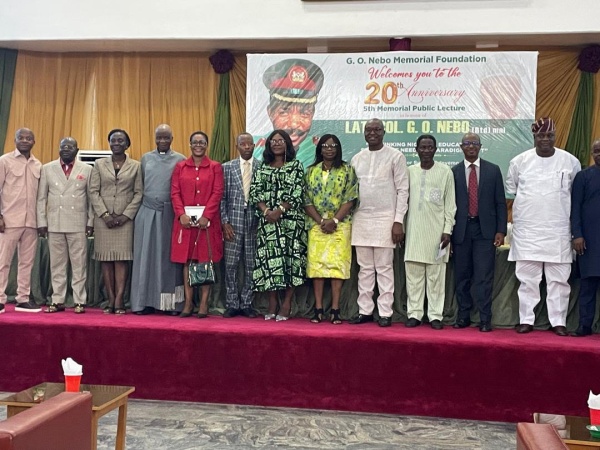
Founder of the Nigerian Teachers Community, Dr. Peter Ogudoro, Wednesday, blamed poor leadership and the failure of Nigeria’s education system for the country’s slow pace of development despite its vast human and natural resources.
Ogudoro made this known at the Geoffrey Nebo 20th anniversary and fifth memorial public lecture in Lagos titled, ‘Rethinking Nigerian Educational System: The Need for Paradigm Shift’.
He emphasised Nigeria’s vast potential, saying that it is one of the most blessed nations in the world with fertile land, abundant mineral resources, and a resilient population capable of driving Africa’s economic transformation.
According to him, Nigeria possesses the capacity to feed the African continent if the nation demonstrates the political will and commitment required to harness its resources effectively.
He noted that projections placing Nigeria among the world’s most populous nations by 2050 should ordinarily be an advantage, but warned that the country’s rapidly growing population could become a liability if citizens are not empowered through quality education.
“The challenge is not population growth itself, but the inability to empower the people through functional education and opportunities,” he said.
Ogudoro stressed that Nigerian youths still possess a strong desire for higher education unlike what obtains in some western countries where many young people are losing interest in university education.
He recalled his academic experience in the United Kingdom, saying that while institutions abroad struggle to encourage students to enrol in universities, Nigerian youths actively seek admission opportunities.
“In Nigeria, young people want to go to school. If they do not get admission, many become depressed because they genuinely desire education,” he stated.
He, however, lamented that the country’s education system has failed to provide the quality and accessibility needed to translate such enthusiasm into national productivity.
Ogudoro, who is also the Managing Consultant at Ogudoro Leadership Trainers, also criticised what he described as excessive dependence on charity instead of sustainable empowerment programmes.
He urged leaders and philanthropists to focus on creating systems that empower citizens economically rather than temporary handouts.
He further described electricity supply as a critical indicator of Nigeria’s underdevelopment, comparing Nigeria’s poor power generation with South Africa’s electricity capacity despite the latter having a significantly smaller population.
According to him, “Inadequate power supply has continued to cripple businesses, healthcare delivery and industrial growth across the country.”
Ogudoro maintained that Nigeria’s biggest challenge remains leadership failure, particularly within the political class.
He cited the transformation of Lagos State under former Governor Babatunde Fashola as evidence that effective leadership can rapidly change society.
Recalling developments in Lagos during his administration, Ogudoro said strategic investments in infrastructure, security and urban renewal significantly improved public safety and economic activities within a short period.
“One good leader can transform society. Political leadership has failed Nigeria for many years,” he stated.
He criticised Nigeria’s political leaders for sending their children abroad for education while neglecting local institutions attended by the masses.
According to him, “Leaders would feel greater pressure to improve the country’s education system if their children attended the same public schools and universities as ordinary Nigerians.”
He therefore advocated policies rooted in equity, fairness and justice, insisting that quality education should not be reserved for the privileged few.
Ogudoro urged stakeholders across government, education and civil society to work collaboratively towards building a functional educational system capable of producing innovative and solution-driven citizens for national development.
In his remarks, the chairman of.tbe occasion, Elder Okoroji Onoh, expressed concern about the rising number of out-of-school children in Nigeria and called for urgent reform increased investment in education to address the crisis.
He lamented that about 18.3 million Nigerian children are currently out of school, with over 66 per cent of them located in northern Nigeria, most of whom are girls.
According to him, the alarming statistics highlight a major disconnect between government efforts, educational policies and the realities on ground across the country.
Onoh, who is the Chairman of The Brains Premier School, Lagos, stressed the need for stakeholders to critically examine the direction of the nation’s education sector and chart a sustainable path for the future.
“There is a disconnect between all the efforts educational experts and government are making and what we are seeing on ground,” he said.
He also raised concerns over funding for education, questioning whether Nigeria was doing enough in budgetary allocations to universities, polytechnics, unity colleges and other educational institutions.
“The country must begin to reassess its priorities if it hopes to build a competitive and inclusive education system capable of driving national development,” Onoh said.
Earlier in her remarks, the Founder of Nebo Foundation, Mrs. Mary Lotachukwu Ohagwasi,
called for an urgent transformation of Nigeria’s educational system, stressing the need for innovative and forward-thinking reforms to prepare young people for future opportunities.
She said the theme of the event was aimed at encouraging policymakers, educators, parents, students, and other stakeholders to reflect on the current state of education and embrace meaningful reforms.
According to her, Nigeria’s progress depends largely on the quality of its educational system, noting that the country faces several challenges that require urgent and innovative solutions.
“It is with this belief that we must rethink and reshape our educational system to serve as a catalyst for positive change in Nigeria,” she said.
Ohagwasi described the memorial lecture as a platform designed to ignite fresh perspectives, challenge outdated educational models, and inspire practical strategies capable of repositioning Nigeria’s education sector for excellence, inclusivity and relevance.
Quoting former South African President Nelson Mandela, she said: “Education is the most powerful weapon which you can use to change the world,” adding that education remains central to national development and social transformation.
The founder urged stakeholders to ensure that educational practices in the country remain equitable, relevant and responsive to the demands of a rapidly changing world.
She stressed the importance of positioning Nigerian youths for emerging opportunities by equipping them with the right knowledge, skills and values needed to thrive in the future.
In his remarks, the guest lecturer and Professor of Curriculum Studies and Physics Education, University of Lagos, Adeniyi Adeyemi, who emphasised the theme, stressed the need for reforms that would make education more functional and impactful.
He expressed concern that unemployment remains one of the major challenges confronting the country, adding that improving the welfare of teachers would significantly enhance the quality of education.
“If teachers are well paid, things will go well,” he said.
He further explained that education should go beyond academic learning and certificates, noting that it must positively shape individuals from within and influence their contribution to society.
“Education needs to help you from inside to your outside. To be happy for a lifetime, you need to educate someone,” he stated.
The don, however, acknowledged the continued importance of certificates in achieving functional education and societal relevance and urged Nigerians, particularly young people, to develop a positive mindset towards themselves and the country.
“Changing perceptions about Nigeria is critical to national development,” Adeyemi stated. (This Day)