 ADAD
ADAD
Updating your news feed...
NEWS EXPRESS is Nigeria’s leading online newspaper. Published by Africa’s international award-winning journalist, Mr. Isaac Umunna, NEWS EXPRESS is Nigeria’s first truly professional online daily newspaper. It is published from Lagos, Nigeria’s economic and media hub, and has a provision for occasional special print editions. Thanks to our vast network of sources and dedicated team of professional journalists and contributors spread across Nigeria and overseas, NEWS EXPRESS has become synonymous with newsbreaks and exclusive stories from around the world.




.webp)









Loading banners
Loading banners...

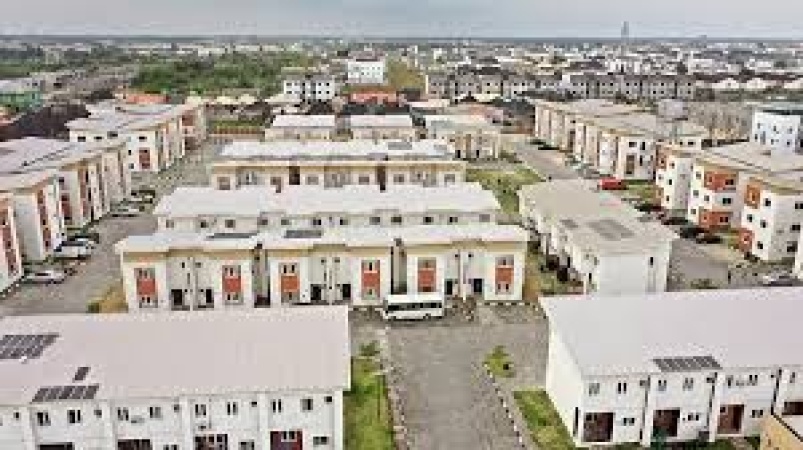
AERIAL VIEW OF A HOUSING ESTATE
The minimum wage is no longer meeting the needs of many Nigerians. The cost-of-living crisis is making a nonsense of the wage, which is further compounded by the high cost of rent in many cities.
For many Nigerians who earn the current minimum wage, affording decent accommodation in many of the city centres across Nigeria is becoming a tall order as demand outstrips supply.
As demand outstrips supply, the high cost and demand for decent living is pushing up prices beyond the affordability of many citizens – this is on the back of the country’s population explosion, fingered as one of the critical factors responsible for the current rental chaos.
Another factor is Nigeria’s housing deficit, estimated at about 14.9 million units, which continues to widen amid rapid urbanisation. The country’s housing deficit exposes and places many Nigerians at the mercy of landlords, who arbitrarily increase rent in line with personal lifestyle.
Reports have it that the income-to-rent ratio rises over 70percent against 30percent UN benchmark, a situation observers have described as unfortunate.
This is coupled with the market gap occasioned by the industry’s focus on the high-end premium market, thereby neglecting the bottom end of the housing pyramid.
While professionals and investors in the Nigerian built ecosystem argue about access to finance and the need for return on investment (ROI), stakeholders argue that the neglected bottom end of the market holds greater potential for discerning investors.
Accordingly, it is argued that the housing crisis in the country persists because developers are not focused on areas with the housing demand, while fully developed accommodation lies waste with little or no rental value to developers.
The surge in rent is driven by a mix of structural and economic pressures. At the same time, rising prices of building materials such as cement and steel have slowed new construction, while inflation and naira depreciation have pushed landlords to increase rents.
“What we are seeing is a supply-demand imbalance worsened by macroeconomic instability. Developers are facing rising construction costs, multiple taxation, and regulatory bottlenecks, all of which ultimately drive up rents,” said Martin Gregory, CEO, Baron Properties Lagos, adding that the crisis reflects deeper inefficiencies in the housing market.
Gregory also highlighted the role of intermediaries in the housing sector. According to him, agency practices in the country need urgent reform. “In many cases, commissions are inflated, creating additional pressure on tenants who are already overstretched.”
However, the rising rental costs across Lagos, Abuja, and Port Harcourt are pushing millions of Nigerians into financial distress, with tenants now spending between 40 and 70 percent of their annual income on housing well above the United Nations’ 30 percent affordability benchmark.
For many of these workers, securing accommodation has become increasingly difficult, as steep upfront payments, often including agent and agreement fees of up to 50 percent of annual rent, compound the burden.
This has forced many tenants to either relocate to distant suburbs with higher transport costs or remain in substandard living conditions. “I literally emptied my bank account to pay my rent in March,” said Chris Ibe, a middle-aged Lagosian, residing in the Amuwo-Odofin area of the state.
Ibe disclosed that his rent was increased from N400, 000 to N700, 000 for a self-contained room & parlour, a few weeks before he was to renew his rent. According to him, the Increase was negotiated downward after much talk with the landlord.
Adeyemi Ayo, a property consultant based in Wuse, Abuja, stated that rent surge outpaces salaries of many Nigerians as inflation and high building costs bite harder. According to him, rental prices surge by as much as 60 to 90 percent across Nigerian cities, while wages remain largely stagnant.
Ayo noted that concerns are mounting over housing affordability and the government’s role in easing the burden, highlighting that private ownership limits the government’s direct control over pricing, even as existing laws caution against outrageous rent increases.
“Properties are owned by private individuals, not the government, so authorities cannot directly dictate rental prices. However, the law is clear that rent increases should not be excessive,” Ayo stated, attributing the sharp rise in rents primarily to inflation, which continues to drive up the cost of living and property development.
“Inflation is rising daily, and landlords are also part of the same economy. The cost of building materials has gone up significantly; cement alone is about N12, 000 per bag. With such high development costs, rental prices are bound to increase,” Ayo stated.
According to him, new developments are particularly affected, as developers factor in the high cost of construction, energy, and maintenance when setting rental prices. Despite these economic pressures, Ayo acknowledges that greed also plays a role in some cases.
“Some landlords want to recoup their investment almost immediately. There are personal financial pressures too, family responsibilities, lifestyle choices which sometimes push rents beyond reasonable levels,” Ayo said.
He added that while the government may have limited influence over privately-owned properties, it still has a critical role to play in addressing the housing crisis.
“The most effective intervention is for the government to invest in low-income housing. By increasing supply, especially for ordinary Nigerians, it can help stabilise rental prices,” Ayo added.
With inflation persisting and housing supply failing to meet demand, analysts warn that without targeted policy action, the widening gap between incomes and rent could further strain urban households.
Government lapses
While governments over the years have admittedly agree to the country’s housing deficit – there is, however, a mismatch between intent and actions taken to address the issue.
Tensions between landlords and government agencies further complicate the situation, as property owners cite multiple taxes and costly land title processes, which are often transferred to tenants.
For instance, there is currently no dedicated platform that captures end-to-end the requirements needed for building approvals in the country. Hence, developers grow at the mercy of government officials who arbitrarily charge property owners fees that are, in turn, passed over to tenants.
Also, there is concern over weak enforcement of tenancy laws, which many Nigerians argue enable some landlords to demand multiple years of rent upfront, while some agents also make demands that further push the cost of rent beyond the average salary earners.
Experts warn that the crisis poses a broader economic threat, eroding disposable income and weakening the middle class. They also posited that without urgent intervention, the pressure on Nigerian households is expected to intensify.
FG’s efforts to urban housing
The Federal Government (FG), through the Federal Ministry of Housing and Urban Development, recently disclosed that the government is working to advance efforts to institutionalise housing data, adding that the approximately 15.2 million housing units across Nigeria are structurally inadequate, highlighting a critical dimension of the country’s housing challenge beyond the construction of new homes.
The disclosure was made by Ahmed Musa Dangiwa, the minister of housing and urban development, during the recent presentation of the National Housing Data Initiative (NHD) by the National Housing Data Technical Committee at the ministry’s conference room in Abuja.
The Committeee was established in August 2024 to develop a harmonised national framework for housing data to support evidence-based housing policy, planning, and investment.
According to Dangiwa, the findings confirm that Nigeria’s housing challenge is both quantitative and qualitative, with national housing deficit estimates varying depending on data sources and methodological approaches.
“Beyond headline deficit figures, the application of harmonised and internationally recognised methodologies now allows us to state with clarity and confidence that Nigeria currently faces a housing inadequacy problem affecting approximately 15.2 million housing units nationwide.”
Dangiwa stated that the 15.2 million inadequate housing units are homes that exist physically but fall below acceptable standards of safety, habitability, access to basic services, infrastructure, and durability.
He noted that the findings were derived from the application of the Household Crowding Index, the Adequate Housing Index, and a Composite Index Methodology, supported by datasets from the National Population Commission (NPC), the National Bureau of Statistics (NBS), the Central Bank of Nigeria (CBN), and other housing sector institutions.
“These findings clearly demonstrate that Nigeria’s housing challenge is not only about building new houses, but equally about upgrading existing housing stock, regenerating deteriorated neighbourhoods, improving basic services and infrastructure, and ensuring dignity, safety, and adequacy in housing outcomes.”
The Minister emphasised that housing inadequacy represents only one dimension of Nigeria’s broader housing deficit. He stressed the need to sustain the same level of analytical clarity across other critical areas, including absolute housing shortages, affordability gaps, access to land and secure tenure, availability and cost of housing finance, infrastructure and service deficits, regional and urban–rural disparities, as well as population growth rates. (BusinessDay)



