Updating your news feed...
NEWS EXPRESS is Nigeria’s leading online newspaper. Published by Africa’s international award-winning journalist, Mr. Isaac Umunna, NEWS EXPRESS is Nigeria’s first truly professional online daily newspaper. It is published from Lagos, Nigeria’s economic and media hub, and has a provision for occasional special print editions. Thanks to our vast network of sources and dedicated team of professional journalists and contributors spread across Nigeria and overseas, NEWS EXPRESS has become synonymous with newsbreaks and exclusive stories from around the world.







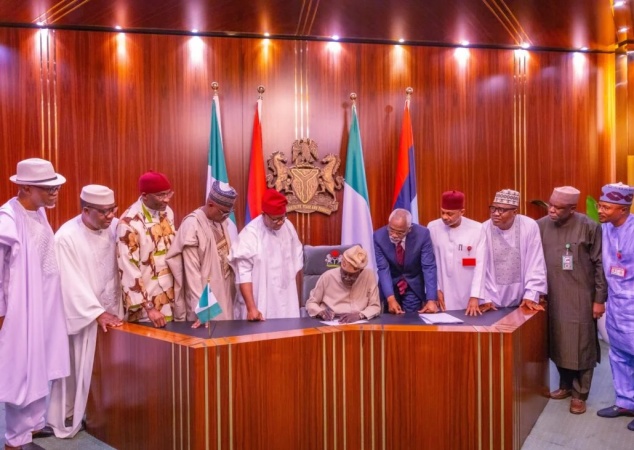
President Tinubu, surrounded by top aides and lawmakers, signing the new Electoral Act on Wednesday
Some opposition members of the National Assembly yesterday cried blue murder over the decision of the National Assembly not to make the electronic transmission of election results to the IReV mandatory.
They were livid with anger, accusing the leadership of the National Assembly of betraying the generality of Nigerians who earnestly yearned for real-time mandatory electronic transmission of election results to give them confidence that their votes would count.
How to make votes count in 2027 — Abaribe
And now that the ruling All Progressives Congress, APC, has had its way with the manual transmission of election results, former Minority Leader of the Senate, Senator Enyinnaya Abaribe, APGA, Abia South has advised Nigerians how to make their votes count during the 2027 general elections.
He said Nigerians should guard their votes by ensuring that they get party agents who are properly motivated and trained and who will not be afraid to confront the election riggers at the polling stations. Abaribe noted that Nigerians can resist any attempt to steal their votes.
According to him, “Nigerians can defeat any attempt to rig their votes. All we need to do is to get properly motivated and trained agents who will not be afraid to confront sabotage at the polling stations.”
The House of Representatives had in December passed its version of the Bill providing for mandatory electronic transmission of election results. The Senate on its part, opted for manual transfer of results until uproar and protests by Nigerians forced it to convene an emergency session to hurriedly insert the provision for both electronic and manual transmission of election results should there be network failure. The House of Representatives at an emergency session later caved in and aligned itself with the position of the Senate which President Bola Tinubu immediately signed into law within a few hours of being passed into law.
Disappointed by this turn of events, some opposition lawmakers who spoke on the matter said the ruling party may have had its way, but the battle for the country’s redemption has just begun.
Hon Afam Ogene speaking on behalf of Labour Party Caucus in the House of Representatives said, “It is quite interesting that, even before the ink with which the parliament crossed the t’s and dotted the i’s on the clean copies of the Electoral Reform Amendment Bill dried up, the President has gleefully put his imprimatur on the bill, leaving Nigerians to wonder if, indeed, the executive had ample time to look through the document. Gone with the signing are the genuine concerns of apprehensive Nigerians regarding what the new Act portends to the integrity of the country’s future elections.
“In fact, Nigerians and indeed the world must now begin to see the clear difference between campaign promises and actual motives of political players. While it was convenient outside the confines of power to oppose incremental increase in the price of petroleum products, it is convenient to pronounce ‘subsidy gone’ when they have the opportunity. While it was right to advocate electronic voting in 2013, it has become obtuse, 13 years after, to even canvass a fragment of it: electronic transmission of results. While it was convenient to ask a sitting administration to quit on account of an alleged inability to halt the spread of insecurity, today, under their watch and allure of office, insecurity of multivarious forms has become an insistent byword.
“For emphasis, on January 13, 2013, the National Publicity Secretary of the defunct Action Congress of Nigeria (ACN), Alhaji Lai Mohammed, had in a statement said, ‘We assure INEC of our full support towards using electronic voting in 2015. We also appeal to all other political parties, civil society organisations and indeed all Nigerians to join us in pushing for a system that will eliminate the role of thugs and sideline vote thieves during our elections, in addition to making our elections free, fair and credible.’
“Today, 13 years afterward, neither Mohammed, who moved on to become Nigeria’s Minister of Information and Culture for eight years, nor his principal, who is now our country’s current leader, sees anything worthy in electronic transmission of results, much more electronic voting. Now that they have had their way, we call upon Nigerians not to despair. On the contrary, the battle for our country’s redemption has only just begun.”
Hon. Kingsley Chinda, who spoke on behalf of Minority Caucus in the House said, “We are against any clause that would give room for micro-manipulation, rigging, or leeway for any untoward act. Those positions were turned down. And we are aware that they were turned down by members of the APC, not on grounds of patriotism, but on grounds of political party affiliation. For us, after what happened on the floor, we felt it was better to register our position with Nigeria, which is the court of public opinion. So we had to leave the plenary. We had to walk out to address Nigerians.
“Our position remains that the method of selection of candidates should be an internal party affair. Political parties should be allowed to determine what method they want to adopt in selecting candidates that will represent them. We support that parties should be allowed to adopt the method best suited for them whether direct primaries, indirect primaries, or consensus primaries,” he added.
On his part, Hon. Ikwechegh Alexander Mascot, representing the Aba North/Aba South Federal Constituency of Abia State under the platform of the All Progressives Grand Alliance (APGA) in the House said, “We need to do the right thing for our country to move forward. And let me also add that it is not just the parliament that will make these things to happen. Nigerians need to stand up the same way people converge any time they say they are having Christian crusades, the same way people converge when they say they are having any form of Islamic programme.
People need to come out in their numbers and kick against this political anomaly. This is wrong. We do not support it. What we are saying is let us just do the right thing. The people in government today will soon leave. And they will remember that when they had the opportunity to do the right thing, they didn’t do it. Nigerians must come out on the day of voting.
Everybody must come out in their numbers. We must vote. We will sit there and we will protect the votes. Come out with your tools. All the tools that will help you to make sure that your votes are protected. Come out and do it. Power is not given, it is taken. You cannot go to church or go to the mosque and be praying every day while some people are destroying your country. Let us do the right thing”.
Rep. Peter Uzokwe, representing Nnewi North, Nnewi South, and Ekwusigo of Anambra State, said, “I am angry. Why will a few people continue to rape Nigerians? Nigerians applauded us on what we did with the bill. But our leaders went behind us when they were called to Aso Rock. And when they came back they started changing what we agreed on. Do we have any reason to come to any emergency Plenary? Do we have any reason to come back to change what we agreed before? They have not paid the contractors but they could call an emergency meeting to come and change what Nigerians like. They talk about network failure, let the Federal Government do the right thing and it won’t fail.
If you send a message by 11am and it is not delivered because you don’t have network, by the time you have network by 3pm, that message will be delivered and the original time of sending that message will be 11am. Why are we deceiving Nigerians? Is it not enough? We have borrowed money three times in order to pay contractors but on the three occasions we have diverted the money to other things and contractors are dying. And you have the heart to call an emergency plenary for you to smuggle in what we have passed before. How can the federal government of Nigeria be telling us of network failure. What will fail?”
Defending the position of the House however, Rep. Akin Rotimi, Spokesperson of the House said, “I like to emphasize that the quest for free, fair and credible elections is not a partisan request. It is something that all Nigerians of good faith who want the best for our democracy, want free, fair and credible elections. So, the ruling party wants free, fair and credible elections as much as opposition members. So it’s not a partisan thing that the opposition wants this while the ruling party wants something else.
It’s simply the parliament working through its processes to ensure that whatever we do reflects what it is that the majority wants. Every single thing was done in keeping with the Constitution, the House Rules, and the Senate Rules. Democratisation is a process. What we have may be imperfect, but it was done in the best interest of Nigerians.
“For the first time, the law expressly mandates and recognises the IReV and electronic transmission of Form EC8A. The presiding officer shall mandatorily transmit results. Only if that fails does the manual process come in as a fallback. It was bipartisan — APC, PDP, Labour Party, APGA, 12 members from each chamber. What emerged was a new wording, not a simple adoption of one side.
“Walking out of plenary is part of expressing dissent. But majority decision prevails. The process was credible. With electoral timelines already announced by INEC, it was important to avoid gaps that could undermine the process. Certainty is critical in electoral matters. Let’s test it, identify gaps, and fix them. I do not believe yesterday was the darkest moment. I believe it was a step towards free, fair, and credible elections. It is not always those who are loudest that represent the full spectrum of views. We received diverse feedback”. (Saturday Vanguard)