























Loading banners


NEWS EXPRESS is Nigeria’s leading online newspaper. Published by Africa’s international award-winning journalist, Mr. Isaac Umunna, NEWS EXPRESS is Nigeria’s first truly professional online daily newspaper. It is published from Lagos, Nigeria’s economic and media hub, and has a provision for occasional special print editions. Thanks to our vast network of sources and dedicated team of professional journalists and contributors spread across Nigeria and overseas, NEWS EXPRESS has become synonymous with newsbreaks and exclusive stories from around the world.
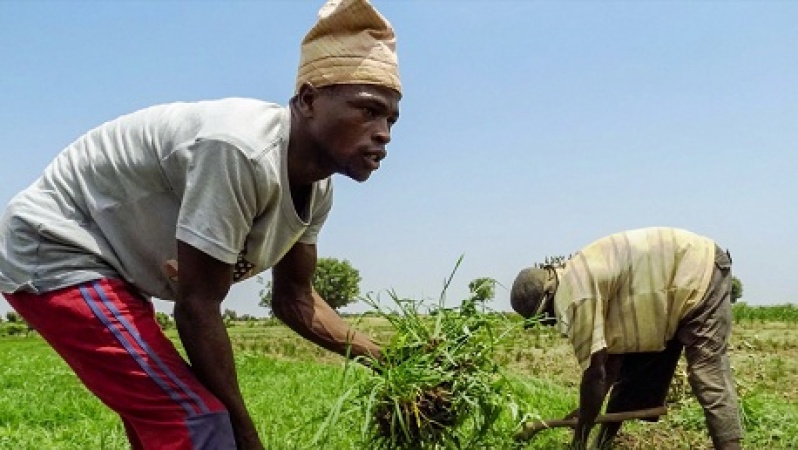
Farmers
There is no hope yet for farmers who had expected that the steady drop in food prices will reverse early in 2026, as the National Bureau of Statistics (NBS) reports that food inflation continued its downward trend to 8.89 per cent in January 2026.
The January 2026 food inflation report released yesterday by the NBS, shows that food inflation for the month dropped to 8.89 per cent on a year-on-year basis. On a month-on-month basis, the food inflation rate in January 2026 dropped heavily to –6.02 per cent, down by -5.66 per cent compared to December 2025 when it was -0.36 per cent.
The report shows that headline inflation also maintained its downward slide, hitting 15.1 per cent on a year-on-year basis in January 2026. This figure is 0.05 per cent and 12.51 per cent lower when compared to 15.15 per cent and 27.61 per cent recorded in December 2025 and January 2025 respectively.
Analysis of the consumer price index (CPI) report, shows that though food prices are going down, food and non-alcoholic beverages remain the most dominant contributors to headline inflation in January, with 6.04 per cent, while restaurants and accommodation services, and transport contributed 1.95 per cent and 1.61 per cent respectively.
Data from the National Bureau of Statistics (NBS) shows that Nigeria spent N5.27 trillion on food and beverage imports in the first nine months of 2025.
The result is that food prices have become cheap, but the agrochemicals and other inputs for farming remain alarmingly high, eroding the farmers’ income.
Whilst consumers have applauded the sharp decline in food prices and the notable moderation in food inflation, a great relief from their cost of living crisis, investors and producers in the agricultural sector are lamenting heavy losses arising from the collapse in prices of key commodities.
At a recent function, the Emir of Kano, Alhaji Lamido Sanusi, pleaded with the federal government to stop food importation because it is hurting local producers.
According to him, “Our farmers are suffering, they spend so much to produce and now they cannot even recover their costs because their produce cannot compete with the imported commodities.”
The Chief Executive Officer, of the Centre for the Promotion of Private Enterprise (CPPE), Dr Muda Yusuf, has also called for a clear rules-based and market-friendly Farm Price Stabilisation and Farmer Income Protection Framework.
He said such a framework should prevent import-induced price crashes, reduce harvest-time price collapse, discourage distress sales, protect farmer livelihoods, strengthen value chains, and provide stable supply conditions for processors and consumers.
He also suggested the introduction of Minimum Guaranteed Prices (MGP) or price floors for selected strategic commodities including maize, rice paddy, Sorghum, and Soybeans.
“This is a global best practice for protecting farmers against severe price collapses”, it noted, adding that the MGP system should not become an open-ended government purchase programme.
“Rather, it should operate strictly as a stabilising backstop. When market prices fall below the support price, government can intervene through licensed agencies and aggregators to purchase at the support price.”
President of Nigeria Agribusiness Group (NABG) Arc. Kabir Ibrahim said the cry over the pervading insecurity and high imput prices by Nigerian Small holder farmers (SHFs) and Small Scale producers (SSPs) call for decisive action by government and the organized private sector to avoid imminent severe stresses in the food system in 2026 and beyond. Ibrahim said a good model to safe-guard this from happening is to calibrate cost of production on a global basis to ensure security of investment in all its ramifications. He said, “Yes, it is true that Nigerian consumers are now a lot happier with food prices generally but it should be clearly noted that the producers are groaning due to insecurity preventing them from seamlessly accessing their farms and the ever rising costs of imports like fertilizers etc., that they use for production.”
He said the country should initiate a mechanism to make government the buyer of last resort by resuscitating the guaranteed minimum price (GMP), and thereby buying off excess produce directly from farmers and reselling same to consumers when inflation rears its head. (The Guardian)