ADAD
ADAD
Updating your news feed...
NEWS EXPRESS is Nigeria’s leading online newspaper. Published by Africa’s international award-winning journalist, Mr. Isaac Umunna, NEWS EXPRESS is Nigeria’s first truly professional online daily newspaper. It is published from Lagos, Nigeria’s economic and media hub, and has a provision for occasional special print editions. Thanks to our vast network of sources and dedicated team of professional journalists and contributors spread across Nigeria and overseas, NEWS EXPRESS has become synonymous with newsbreaks and exclusive stories from around the world.


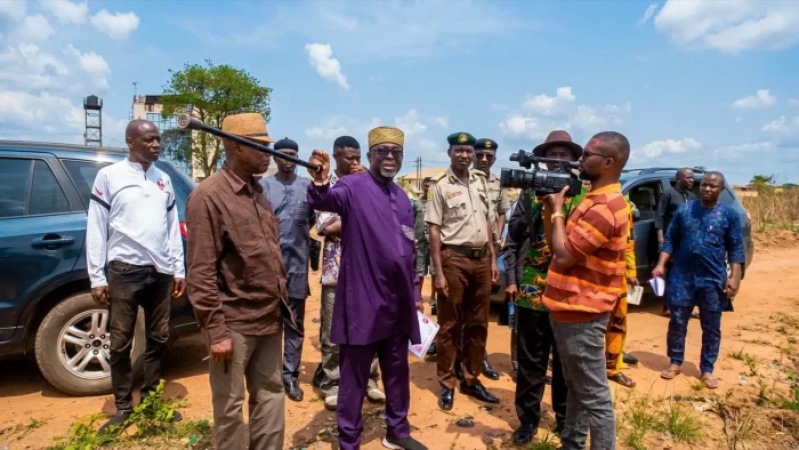
Authorities of the Correctional Service and landowners in Avu community, Imo State, have condemned persistent land grabbing in the state, calling on the government to return 38.76 hectares forcefully taken from them by suspected agents of the state.
The land, originally 61 hectares, was allocated to the Prisons Service under the 1977 master plan of Imo State.
Speaking to journalists, Chief Sam Anokam, attorney for the Corrections Service and affected allottees, decried the encroachment:
“I am protecting the MoU the government signed with the Prisons and their compensatory rights. They broke the Correctional Service fence and demolished houses under the pretext of chasing criminals. This is not how you chase criminals. Our demand is clear: restore the land immediately, or all allottees and the Correctional Service will occupy it.”
Anokam also warned that individuals illegally buying land in Owerri West, originally excised to host communities by the Federal Government, risk losing their purchases.
Deputy Controller of Corrections, I. Stanley Chima, representing the Controller, Mike Okorie, confirmed the service had reported the encroachment to relevant government agencies. “This is their land. Any demolition without due process is unacceptable,” he said.
Elder Vincent Njoku, PRO of the Avu Elders Council, added: “Some persons, accompanied by security agents, broke fences and demolished structures. Land grabbing is a serious problem here. If nothing is done, the community risks losing its land entirely. The intimidation must stop.”
In response, Imo State Commissioner for Lands, Chief Enyinnaya Onuegbu, said Governor Hope Uzodimma ensures due process in land administration.
“The Ministry handles all documentation appropriately, ensuring lawful allocation and compensation where necessary,” he stated. (The Guardian, but headline reworked)
•Corrections Service attorney Sam Anokam addressing journalists on the encroached land
Senate defends decision on e-transmission of election results, says action backed by data
By NAOMI SHARANG
The Senate has reeled out empirical data that guided its decision to make the electronic transmission of election results discretionary rather than mandatory in the ongoing reform of the country’s electoral governance framework.
The upper chamber stated that the decision was based on the stark realities of the country and not on emotion or sentiment, after due consultation and engagement with principal actors in the country’s communications and power sectors, among others.
Senate Leader, Sen. Opeyemi Bamidele, clarified the position of the upper chamber through a statement issued by his Directorate of Media and Public Affairs in Abuja on Sunday.
According to him, lawmaking comes with huge obligations globally and the senate cannot discharge such responsibilities to the detriment of the citizenry.
The News Agency of Nigeria (NAN) reports that the senate had resolved against Clause 60(3) of the Electoral Bill, 2026.
In specific terms, the clause stipulates that the presiding officer “shall electronically transmit the results from each polling unit to INEC Result Viewing Portal (IReV) in real time…”
NAN also reports that the senate subsequently reviewed the contentious clause to further strengthen the electronic transmission of results, in response to public demand, though with a caveat that in the event of internet failure, Form EC8A would serve as the primary means of result collation.
Bamidele, however, described Clause 60(3) of the Electoral Bill, 2026 as an initiative that any legislature or parliament globally would have embraced ordinarily.
He cited its potential to deepen trust in the democratic institutions, especially the National Assembly and INEC.
The senate leader explained that the senate looked at the other side of Clause 60(3) of the Electoral Bill 2026, revealing that the country’s communication and power infrastructure would not guarantee the real-time electronic transmission of election results as envisaged by some stakeholders.
Citing data from the Nigerian Communications Commission (NCC), Bamidele said Nigeria had only achieved about 70 per cent broadband coverage in 2025 while it’s internet user penetration was only 44.53 per cent of the population within the same timeframe.
He also cited the Speedtest Global Index, which ranked Nigeria 85th out of 105 countries in mobile network reliability and 129th out of 150 countries in fixed internet broadband reliability.
He further said: “Based on the Speedtest Global Index, Nigeria’s mobile network reliability was 44.14 megabits per second.
“This is extremely low compared with UAE that has 691.76 mbps; Qatar with 573.53 mbps; Kuwait’s 415.67mbps; Bahrain’s 303.21 mbps and Bulgaria’s 289.41 mbps. The Index placed Nigeria far below global average.
“Nigeria’s fixed internet broadband rating is quite low by the global standard. Out of 150 countries, Nigeria occupied 129th position with only 33.32 mbps.
“In this rating, Singapore came first with 410.06 mbps, followed by UAE’s 382.35 mbps; France’s 346.25 mbps, Chile’s 348.41 mbps and Hong Kong’s 345.25 mbps.”
The senator equally cited official data that revealed the state of the power infrastructure, indicating that, at least, 85 million Nigerians “still lack access to grid electricity. This figure amounts to about 43 per cent of the population.
“This shortfall speaks to the state of our power infrastructure. Even though our generation capacity hovers roughly between 12,000 and 13,500 megawatts, our distribution and transmission capacity is acutely limited.
“As we all know, it can only deliver 4,500 megawatts to households nationwide. But with the Electricity Act, 2025, our power sector will record significant growth from this financial year.”
With the conditions of the country’s communication and power infrastructure, Bamidele expressed doubt over the practicability of the real-time electronic transmission of election results, noting that making such a provision mandatory could plunge the country into crisis.
“In democracy, lawmaking sits at the heart of public governance. Indeed, it is its lifeblood that freely flows in the veins of all public institutions.
“It does not respond to mere emotion or sentiment, but to facts, proofs or realities that can define or distort the future of our political system.
“If our law does not capture the realities of the federation, then it is a script for anarchy or a ploy for instability.
“This deduction guided the decision of the senate to redraft Clause 60(3 & 5) with a caveat, while at the same time addressing the concerns of our people nationwide substantially.
“The caveat, in this case, is the outright deletion of ‘real time’ from the clause so that we will not end up with an electoral governance framework that cannot respond to the stark realities of our fatherland,” he said. (NAN)