Updating your news feed...
NEWS EXPRESS is Nigeria’s leading online newspaper. Published by Africa’s international award-winning journalist, Mr. Isaac Umunna, NEWS EXPRESS is Nigeria’s first truly professional online daily newspaper. It is published from Lagos, Nigeria’s economic and media hub, and has a provision for occasional special print editions. Thanks to our vast network of sources and dedicated team of professional journalists and contributors spread across Nigeria and overseas, NEWS EXPRESS has become synonymous with newsbreaks and exclusive stories from around the world.

























Loading banners
Loading banners...

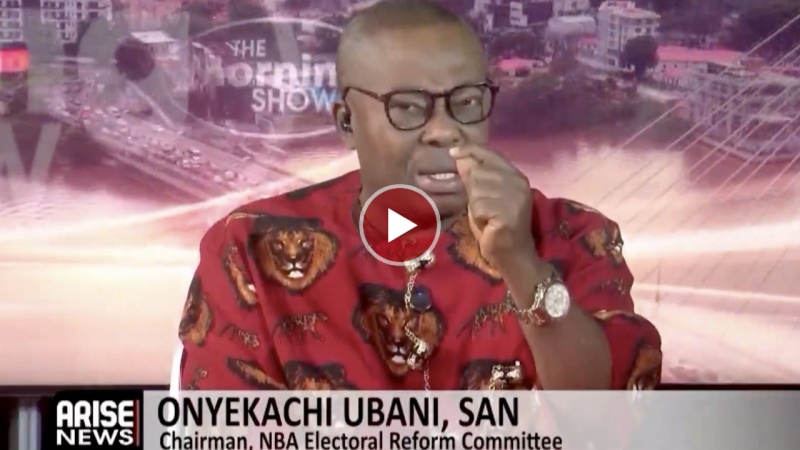
Chairman of the NBA Electoral Reform Committee, Onyekachi Ubani, has urged the Senate to clearly define what constitutes “communication failure” in the proposed amendment to the Electoral Act, warning that any ambiguity could create loopholes capable of undermining the credibility of the 2027 general elections.
Speaking during an interview on ARISE News on Saturday, Ubani said while both the House of Representatives and the Senate have passed their respective versions of the amendment bill, key grey areas must be addressed during harmonisation to avoid fresh disputes and prolonged litigation.
“The issue of communication failure that the Senate has introduced. Please, can we define it properly? Who determines it? What constitutes communication failure and all that? That should be properly defined to avoid issue of prolonged litigation without arriving at a solution.”
Ubani explained that the House version explicitly provides for mandatory and real time electronic transmission of results, including specific reference to IREF.
“The version of the House of Reps, and let me say it here, is that they agreed with issue of mandatory transmission. The House of Reps agreed with issue of mentioning specifically IREV in the law. The House of Reps also agreed. And the third one is that it’s going to be real time, meaning that immediately the result is announced at the polling unit, it will be transmitted in the presence of all the polling unit agent and all the people that came to vote, that it will be done in the presence of everyone there. That is the real time.”
By contrast, he noted that the Senate version does not expressly use the term real time, a difference that has fuelled public suspicion.
“Now, in the case of the senate, the senate said, look, you transmit when the presiding officer has signed and can’t assign either by the person that is contesting the election or his agent. It did not say when that transmission will take place. So it gives room for people now to say maybe they didn’t use the word real-time. Maybe it will be two or three days later or three hours later that the presiding officer will upload. That is the difference.”
He urged lawmakers to eliminate any room for delay.
“Can we use the word that it must be done immediately after the results have been announced and signed? Why do we have to wait, you know, to do it another two hours or one week later? So let’s put the word immediately that result has been announced. The next thing is to transmit it.”
Ubani acknowledged that the Senate introduced a fallback provision allowing manual processes where electronic transmission is not feasible.
“But what we are saying is that in case transmission is not feasible because of issue of some problem that may occur in the process, in the time of election, we will allow the physical form to be used in the coalition center and it will form the primary source of information for coalition.”
However, he stressed that under the current legal framework, collation remains manual despite electronic transmission.
“But mind you, both electronic transmission that everyone is clamoring for and the manual, it is still manual coalition in our law. Nothing has changed.”
He argued that reform efforts must go further to strengthen safeguards at collation centres, proposing electronic collation alongside transmission.
“So collation must be done by IREV too.”
Ubani also emphasised the critical role of political party agents in protecting votes, saying only educated and knowledgeable individuals should be deployed.
“Whoever is going to be the coalition agent of any politician must be educated and know the law.”
He added that agents must retain polling unit results to challenge discrepancies.
“If you know the law, make sure you keep a copy of your polling unit result, which you will give to your coalition agent who will be at the local government or at the world level in order to make sure that whatever they are collecting, whatever they’re adding is what happened at the polling unit.”
Ubani maintained that Nigeria’s push for technology in elections is largely driven by the need to curb human interference.
“We’re not clamoring for technology in Nigeria because we want the efficiency level to be improved. We are clamoring because of the fact that we are very corrupt and we do not want things to be done properly.”
Looking beyond 2027, he called for broader reforms, including electronic voting and electronic collation.
“For future election, for future electoral framework, let’s begin to look towards issue of electronic voting. It is possible. There is nothing that is impossible.”
As the harmonisation committee prepares to reconcile differences between both chambers, Ubani insisted that clarity and precision in the law are essential to restoring public confidence.
“Please, they should address it because it will reduce the level of anxiety on the part of Nigeria.” (Arise News)