ADAD
ADAD
Updating your news feed...
NEWS EXPRESS is Nigeria’s leading online newspaper. Published by Africa’s international award-winning journalist, Mr. Isaac Umunna, NEWS EXPRESS is Nigeria’s first truly professional online daily newspaper. It is published from Lagos, Nigeria’s economic and media hub, and has a provision for occasional special print editions. Thanks to our vast network of sources and dedicated team of professional journalists and contributors spread across Nigeria and overseas, NEWS EXPRESS has become synonymous with newsbreaks and exclusive stories from around the world.






.webp)

.webp)













Loading banners
Loading banners...

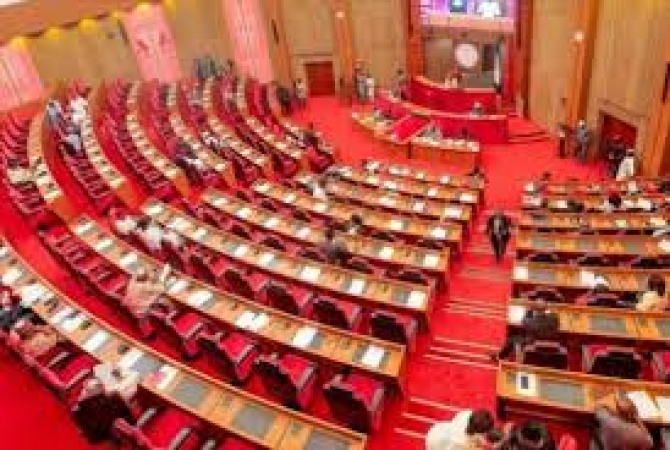
The Senate has clarified that the electronic transmission of election results in real time does not translate to e-voting as being peddled in some quarters, adding that the Independent National Electoral Commission (INEC) currently lacks the capacity to conduct e-voting.
The upper chamber further clarified that the INEC Result Viewing Portal (IReV) “is not an e-voting platform, but a platform for when the election results that have been manually counted and declared at the polling units are uploaded and publicised.”
Chairman, Senate Ad-hoc Panel to Review the 2026 Electoral Bill, Adeniyi Adegbonmire, made the clarifications on Arise News Channel yesterday, explaining the difference between the electronic transmission of election results in real time and the e-voting system.
The Senate had constituted the ad hoc panel to review the report of its Committee on Electoral Matters, harmonise divergent views and address grey areas identified during the exercise. It also appointed Adegbonmire to lead the seven-man panel.
Speaking on the decision of the Senate, Adegbonmire explained that Nigeria had not transitioned to an e-voting system, contrary to what some people had insinuated or what some media platforms had reported.
He said, “People need to understand what real-time means. Real-time transmission can only happen if the INEC adopts an e-voting system. For now, INEC does not have the capability for e-voting. Maybe in two or three years, we can adopt e-voting. But as of today, INEC has not put an e-voting system in place.”
“This is the misconception that the media has brought into play. The provision you keep emphasising says the presiding officer will first fill in the result manually in Form EC8A. It is the Form EC8A that has been filled manually and will be transmitted to IReV. If we change ‘transmit’ to ‘upload’ in the Electoral Bill, 2026, will it change anything? The answer is No.
Adegbonmire, a Senior Advocate of Nigeria and Chairman, Senate Committee on Judiciary, Human Rights and Legal Matters, further explained the misconception about IReV, which, according to him, should be corrected considering its implications for the country’s peaceful co-existence.
The lawmaker, therefore, pointed out that IReV “is not a voting platform. Rather, it is a platform meant to publicise election results already declared by the presiding officers at polling units across the federation.
“It is important, first of all, to understand what IReV does because there is a lot of misconception about it or deliberate misrepresentation of what it stands for. The Senate never said INEC should not use IReV for the 2027 elections. So, what is IReV? It is software developed by INEC to publicise the results.
“This is not an emotional argument. I heard people say the version of the House of Representatives should be adopted. It is a sheer misconception. What does the version say? It simply says the presiding officer shall electronically transmit the result from each polling unit to the IReV portal in real time and such transmission shall be done after Form EC8A has been signed by the presiding officer and countersigned by the candidate or polling agent at the polling unit…”
He also explained that IReV, as an electronic platform to display election results, had “a pattern of working, and the National Assembly cannot change the software by mere legislation. It was a sheer misconception to conclude that the Senate declined the use of IReV for the transmission of election results.”
“Whether we call it ‘upload, transfer, or transmission,’ as far as it says IReV must be used, it will be used in the manner it was configured. That is the point I am making. You must first manually write out the figure. After you have written out the figure at the polling unit, you can upload, transfer or transmit, depending on the nomenclature we want to use.
“When you have not complied with the proper filling of Form EC8A, you cannot transfer, transmit or upload it. That is what people must understand. When you talk about transmission, it has nothing to do with the sanctity of the voting process. If you are given a ballot paper to thumbprint, it is counted manually after the election. It is not IReV or BVAS that counts ballots. The vote count is manually done.
“In my own case, for instance, I come from Akure. I vote in Akure. All the electoral materials are brought into Akure two to three days before the election. They are kept in the Central Bank of Nigeria (CBN). The night before, they start transporting them to different locations across the state. In Ondo State, there are places where one has to travel for eight hours to get there. In some cases, they have to use boats to get to the riverine areas.
“This means voting cannot start at the same time nationwide. In Akure, voting can start at 10:00 a.m. In other parts of the state, voting may not start until 2:00 p.m., or even some at 4:00 p.m. in some cases. Most likely, they will finish the vote count by 10:00 p.m.
“In Akure, for instance, the presiding officers will upload election results at polling units at 4:00 p.m. because voting is concluded as scheduled. In Arugbo Ijaw, however, voting kicks off at 4:00 p.m. This is the reality in the country, and we must consider it in our reforms. The truth of the matter is that you are not going to see how you voted on the IReV because it is not an e-voting platform.”
E-transmission: Lawmaker reveals difference between Senate, Reps’ versions
Also, the Chairman, House of Representatives Committee on Electoral Matters, Adebayo Balogun, says the only difference in the electoral reform bill between the House of Representatives and the Senate is the real-time clause.
Balogun made this known on Arise Television’s ‘Morning Show’ yesterday.
He stated that none of the versions of the Senate or House backs IREV for election results collation.
According to him, it is still the Form EC-8A that would be used at the collation centre, adding that electronic transmission was agreed to by both chambers of the National Assembly.
“The only difference in the electoral reform bill between the House and the Senate is the real-time clause. From the two versions, neither said that the results of the iReV will be the one to be used.
“The Presiding Officer shall, after counting the vote at the polling unit, enter the vote scored by each candidate on the form to be prescribed by the Commission. The form shall be signed and stamped by the presiding officer and countersigned by the agent available at the polling unit.
“The Commission shall electronically transmit the results from each polling unit to the iReV portal in real time. That’s the difference between ours and theirs,” he said.
Balogun said INEC cannot use real-time election results transmitted to its IReV portal for collation under the Electoral Act Bill.
He noted that none of the bill versions passed by both the upper and lower legislative chambers allows INEC to collate from results uploaded on the IReV portal.
Balogun maintained that the INEC’s Form EC8A, also known as the manual statement of the poll results from polling units, would remain the only means to collate from, a clause that could render results uploaded to IReV unusable in case of discrepancies if passed into law.
“From the two versions, there is none of it that says that the results of the IReV would be one to be used. It is still the form EC8A,” Balogun said.
He added that the difference between the versions of the bill passed by the Senate and the House of Representatives would be rectified by “a committee made up of all the parties and not just the ruling party.”
Clause 60(3) of the version passed by the House of Representatives stated that “The Commission shall electronically transmit the results from each polling unit to the IReV portal in real-time and such transmission shall be done simultaneously with the physical collation of results.”
The Senate also okayed mandatory transmission of election results electronically in its version, but made room for Form EC8A use to collate election results in cases where electronic transmission fails due to network glitches.
PFN warns against early 2027 politicking, urges focus on insecurity, governance
Meanwhile, the Pentecostal Fellowship of Nigeria (PFN) has warned political actors against what it described as premature politicking ahead of the 2027 general elections, saying governance is being sidelined at a time Nigerians are grappling with insecurity and economic hardship.
Speaking at a press briefing yesterday in Lagos, the PFN President, Bishop Wale Oke, said attention appears to have shifted from governance to electioneering across various levels of government, even though the Independent National Electoral Commission (INEC) has not officially signalled the commencement of campaigns.
“For goodness’ sake, let’s govern. Let INEC blow the whistle. When INEC says it is time to campaign, go ahead and campaign. But to use the time we should be providing basic support for Nigerians who are suffering from politicking is not fair to the people,” Oke said.
The fellowship stressed that leaders should prioritise tackling insecurity and delivering basic services rather than engaging in early political contests.
On electoral matters, PFN said it does not support calls for the removal of the INEC Chairman over his views on national issues, maintaining that he has the right, as a citizen, to contribute to national discourse.
The body also backed real-time electronic transmission of election results, insisting that credible elections are essential to strengthening Nigeria’s democracy.
“Nigeria has developed to a point where we must trust our electoral system. One of the ways to do that is to make sure that the votes of Nigerians count,” the fellowship said.
PFN urged the Federal Government to ensure that the 2027 elections are free and fair and conducted on a level playing ground for all political parties, noting that democracy thrives on healthy opposition.
“It should not be seen that opposition is being withdrawn. In a competition, somebody will win and somebody will lose. But where there is only one contender, that is no longer democracy,” the body stated.
Reaffirming its non-partisan stance, the fellowship said it would not allow church pulpits to be used as campaign platforms or for endorsing any political party.
“We are not going to allow our pulpits to be used for campaigns or to give support to any political party. Our members are in all parties,” it said.
Beyond electoral concerns, PFN highlighted the need to urgently address insecurity across the country. It disclosed that it has provided relief materials, including food supplies, to internally displaced persons and supported orphans affected by insurgency through its national office and member churches.
The fellowship also condemned any attempt to change the government through unconstitutional means, describing coup plotting as unacceptable in a democratic society.
“In Nigeria today, a coup is not acceptable at all. The people of the nation will decide who governs them,” PFN said, urging that anyone found guilty of plotting a coup should face the full weight of the law.
While offering prayers for the President, governors, lawmakers, the judiciary and security agencies, the body urged leaders not to take Nigerians for granted but to ensure that the dividends of democracy reach ordinary citizens. It called for policies that are more people-friendly, improved infrastructure such as roads and electricity, and measures to address hunger and strengthen security.
“We want to jubilate when elections are credible and the right people emerge as leaders. We will not jubilate for coup plotting,” Oke said.
PFN also weighed in on the ongoing constitutional review, calling for a new constitution that reflects the will of the people. The body described the current constitution as a “patch up and unbalanced” document and urged the National Assembly to initiate a process that would produce a people-driven constitution beginning with the phrase, “we the people of Nigeria have given ourselves this constitution,” rather than one handed over by the military.
“So, we cannot say we, the people of Nigeria, have given ourselves that constitution. Our faith is not mentioned, and the other faith dominates the page as though Nigeria is an Islamic nation,” Oke said.
He added: “Give us a constitution that does not play religious game, where no religion is mentioned and it is fair to all, or give us a constitution where the religions that we practice are equally emphasised, not that one is overemphasised and the other is ignored as though the church is a minority.
“We make bold to say that the church is not a minority at all. The church is approximately 50 per cent plus of the population of Nigeria and the constitution that does not take into consideration our feelings, our passion, our faith, it’s not fair… We, the church in Nigeria, reject it totally. We want a neutral constitution that does not even play the game of religion at all. Or a constitution that emphasises all religions equally.” (Guardian)