 ADAD
ADAD
Updating your news feed...
NEWS EXPRESS is Nigeria’s leading online newspaper. Published by Africa’s international award-winning journalist, Mr. Isaac Umunna, NEWS EXPRESS is Nigeria’s first truly professional online daily newspaper. It is published from Lagos, Nigeria’s economic and media hub, and has a provision for occasional special print editions. Thanks to our vast network of sources and dedicated team of professional journalists and contributors spread across Nigeria and overseas, NEWS EXPRESS has become synonymous with newsbreaks and exclusive stories from around the world.



.webp)
.webp)

Loading banners
Loading banners...

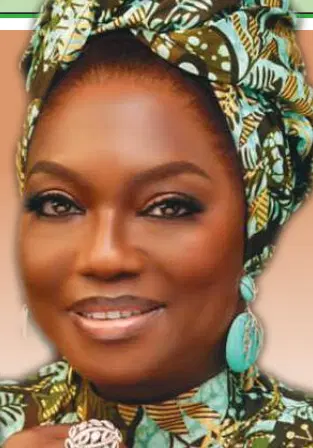
AISHA Muhammed Oyebode is the first daughter of late General Murtala Ramat Muhammed, the former military head of state who was assassinated on Friday, February 13, 1976.
In this interview, she speaks about family, the Murtala Muhammed Foundation, MMF, governance and her career — she is a lawyer, entrepreneur, author, activist and philanthropist.
She is currently the Group chief executive officer of Asset Management Group Limited and the CEO of Murtala Muhammed Foundation. She attended Queens College, Lagos, after which she “studied law at the University of Buckingham, UK, and holds an LLB Honors degree. Her Master’s in Law degree is in Public International Law from King’s College, University of London, and she also has an MBA in Finance from the Imperial College, London. She has a doctorate degree from the SOAS University of London.
For a 12-year old girl to lose her father the way she did, the experience was harrowing. But with the strength of divine guidance and abundant grace, she and her siblings overcame. Blessed with a woman of virtue as her mother (Madam Ajoke Muhammed), Aisha, as well as her siblings have made a success of their lives — no controversies, no scandals, just successes.
Excerpts:
50 YEARS AFTER, what was life like as a young girl growing up without a father?
It was deeply disorienting. I described it recently as feeling as though my legs had been cut off at the knees and I had to learn to walk again, with half a compass, though I had my mother and I really missed my father’s guidance. I was twelve when he was killed, and in the wake of his death the world became very quiet and very sad in some ways, and unbearably loud in others.
Please, expatiate?
There was the silence of absence — no more voice, no more presence. But there was also the noise of expectation, of responsibility. I had to grow up quickly. And eventually, there was the politics of maintaining his legacy.
How?
My father stood for so many things — strong leadership, discipline, clarity of purpose, and a fierce sense of his Nigerianness and Africanness that, strangely enough, some still find unsettling, or at the very least uncomfortable.
In hindsight, I don’t think I fully understood then what we had lost not just as a family, but as a nation. And yet, life had to continue. My mother had six children to raise, the youngest of which was 6 months old, and we all had futures to find. But grief like that, especially when it’s sudden, the public never really leaves you. You don’t move past it. You grow around it.
What would you say you, or the family missed most about him?
His protection. His presence. The feeling that someone strong, loving, and unflinching was always standing behind us. As children, we knew we were safe. My father was not just a soldier or a statesman, he was our hero at home. Loving, warm, and hands-on, he was deeply committed to his children.
He loved animals, plants, gadgets (he was quite techy), and books and us, most of all. Every Sunday, rain or shine, he would take us out. If the weather was good, we would swim at the Federal Palace Hotel. If it rained, we would go out and buy fruit together or go grocery shopping. And even when he was away on duty, as soon as he returned, no matter how late he would come to pick us up from wherever we were.
Sometimes we would have relatives visiting from Kano so they would invite us over. Despite my mother’s entreaties that it might offend them; he would come and pick us up himself. He was fun, protective, forward-thinking. He encouraged us to explore, to ask questions, to dream big. He believed all of his children, including his daughters deserved the very best education.
And while he was a man of discipline and clarity, he also had a softness that came through in everyday gestures. He was our compass, and when we lost him, it felt like learning to walk again without legs.
So yes, I missed having him through my teenage years. I missed the steadying force he would have been, including for my siblings. I missed his voice during key milestones of my life. I miss that our children (his grandchildren wouldn’t know him).
But I also grieve what Nigeria lost: a leader of vision, principle, and compassion, one who belonged to the people, and was admired by them. Even now, I wonder how different our country might have been if he had lived.
This may be harrowing: Do you have a recollection of where you were or what you were doing when the news hit you?
I was in Form 2, in secondary school. The news didn’t arrive all at once, it came in fragments, broken and confusing. My mother was away at the time, and I remember the air thick with uncertainty.
When you say the news didn’t arrive all at once but in fragments?
At first, I didn’t fully grasp what had happened. I heard murmurs, whispers. Then it became clear. My father had been killed. But it wasn’t until we travelled to Kano and saw for ourselves, not only that he had died, but that he had already been buried, that the sorrow truly set in. It was then that the finality struck. The loss became real.
How were the days that followed?
The days that followed were a blur: of tears, disbelief, and a grief that settled over everything like a shadow. But I also remember the extraordinary way Nigerians responded. There were protests, tributes, and monuments renamed. People cried in the streets.
I remember the music; how the great musicians of that time poured their heartbreak into their art. I was told that Salawa Abeni sold a million records of her tribute song. A family friend shared that his neighbour played Ogunde’s eulogy for my father every single day in the shower for three months straight and wept each time.
It was harrowing, yes. But it also showed me something profound: the impact his death had on the nation. That collective mourning became part of our own.
Do you sometimes harbour a sense of resentment towards the Nigerian State, that dad was killed like that — especially for a gallant war hero that he was?
Never. That doesn’t mean there wasn’t pain. Or moments of confusion and deep disappointment, especially as a child watching promised educational support evaporate, or as a teenager wondering why the weight of legacy had to be carried alone. But resentment? No.
My father did not raise us that way. He believed in Nigeria profoundly, unwaveringly, and without condition. His service, his sacrifice, his vision, they were all grounded in hope, not bitterness.
I have never been resentful. In fact, it never even occurred to me that I could be resentful. Anyway, I was too focused on surviving, and in later years, on honouring his name, and on forging a path forward. I chose a purpose. I chose to build. To honour him by continuing to believe in the possibility of this country, and the African continent, he served with conviction.
That belief has been tested, yes. But it has never been abandoned.
How did you overcome the pain?
The sadness? Through my mother’s strength. Through education. Through the steady comfort of people who showed up again and again. And through my own work, advocacy, writing, raising children of my own. Every step forward was a kind of quiet defiance against what was taken from us.
There is no manual for healing. But you find a way. You build a life around the loss, and with time, it becomes part of your architecture.
Your mum demonstrated a deep sense of virtue and commitment to family values in bringing you up in the aftermath of that cruel event, what would you say about her place as a stabilising factor?
My mother was the spine of our family. After my father’s assassination, she bore the weight of our world, supported by her mother Alhaja Sariyu Kekere Ekun. Widowed young, raising six children, navigating a patriarchal society, and managing businesses that faltered under economic pressure. And she did it with grace, even when she was afraid.
She never let bitterness make a home in her heart. She believed fiercely in discipline, in faith, in hard work. It’s because of her that we were able to dream beyond survival. She taught us to stand with dignity, even when life was challenging. She passed on her resilience, tenacity and enterprising spirit to all of us.
We sent our correspondent to the grave site of the former head of state in Kano and it didn’t look too verdant in its simplicity. It looked bare?
My father never sought grandeur. His life was one of duty, not display. The simplicity of his resting place reflects the kind of man he was, humble, and focused on substance, not symbols.
That said, I understand the sentiment. For someone who gave so much, perhaps more could be done to reflect that sacrifice, so after 50 years of the authorities not doing anything about his grave at the Murtala Muhammed Mosque, we, the children have taken a decision to refurbish his grave as well as that of our brother Zack who is buried beside him.
I must emphasize though, in the end, a grave does not hold a legacy, people do. We, his children have chosen to carry that forward. The real monument to his memory is in how we choose to live, and in the kind of Nigeria we are willing to build.
The MMF Foundation
Murtala Muhammed Foundation has been consistent in its passion for the education of young Nigerians. In some northern states, more than 50% of girls are out of school with the North-East and North-West regions having female primary net attendance rates as low as 47.7%, and 47.3%, respectively; and illiteracy levels amongst young women as high as 70.8%.
In your informed opinion, what are the best measures that ought to be taken in order to close the gap?
The statistics are sobering, but they are not irreversible. From our experience, the problem is not simply about schools — it is about poverty, culture, security, and trust all intersecting at once. So the solutions must be equally holistic.
First, we must remove the economic barriers. Conditional cash transfers, school feeding programmes, and scholarships specifically for girls have proven globally to keep families invested in education.
Second, we must address safety and access. In many communities, parents simply will not send their daughters to school if they feel unsafe. Secure school environments, community policing, and closer-to-home learning centres matter just as much as infrastructure.
Third, we need community ownership. When traditional rulers, religious leaders, and mothers become champions of girls’ education, enrolment rises naturally. Change cannot feel imposed from Abuja; it must be locally led.
And finally, we must make education relevant. Families must see that education leads to livelihoods. When a girl’s schooling clearly translates into opportunity, the value becomes undeniable.
At MMF, we believe educating a girl is not charity, it is nation-building. You educate a girl, you stabilise a family. (Vanguard)



