ADAD
ADAD
Updating your news feed...
NEWS EXPRESS is Nigeria’s leading online newspaper. Published by Africa’s international award-winning journalist, Mr. Isaac Umunna, NEWS EXPRESS is Nigeria’s first truly professional online daily newspaper. It is published from Lagos, Nigeria’s economic and media hub, and has a provision for occasional special print editions. Thanks to our vast network of sources and dedicated team of professional journalists and contributors spread across Nigeria and overseas, NEWS EXPRESS has become synonymous with newsbreaks and exclusive stories from around the world.






.webp)


.webp)














Loading banners
Loading banners...

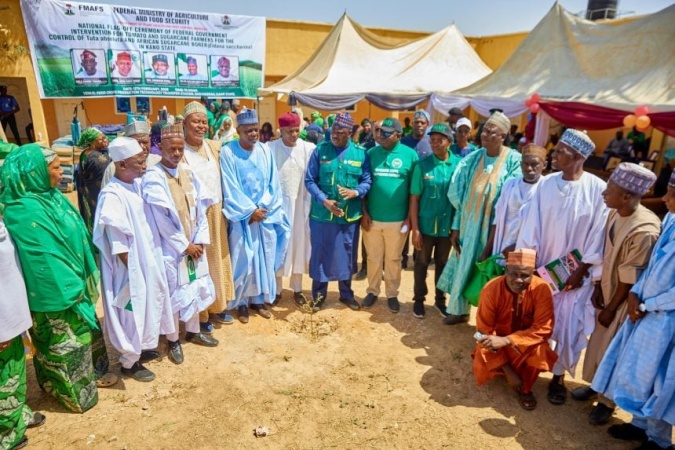
The Federal Government has launched an emergency intervention programme to curb the spread of Tuta absoluta and the African Sugarcane Borer, two destructive pests threatening tomato and sugarcane production across Nigeria.
The Minister of State for Agriculture, Senator Aliyu Sabi Abdullahi, disclosed this during the flag-off ceremony held at the Federal Crop Production Technology Transfer Station in Dan Hassan, Kano State.
He said the initiative is designed to sensitise farmers and extension workers, provide approved pest control inputs and offer technical guidance on integrated pest management, while deploying emergency response measures to contain ongoing infestations.
According to the minister, the programme reflects the government’s commitment to food security, farmer welfare, agricultural resilience and sustainable pest management, especially in frontline agricultural states such as Kano.
“Tomato is not only a widely grown and consumed vegetable in Nigeria but also a major source of income for smallholder farmers,” Abdullahi said, noting that the country ranks among Africa’s top tomato producers, supporting millions of jobs across production, processing, transportation and marketing value chains.
He added that persistent post-harvest losses and pest attacks, particularly from Tuta absoluta, have continued to undermine farmers’ productivity and income.
Similarly, he noted that while sugarcane production has generated employment, reduced imports and supported by-products such as ethanol and bioenergy, the African Sugarcane Borer remains a major threat to output.
The minister described the pest outbreaks as a national agricultural emergency affecting harvests, farmer earnings and agro-industrial investments, stressing that prompt government action, farmer sensitisation and strong federal-state collaboration are critical to tackling the crisis.
Abdullahi also highlighted recent agricultural research progress, noting that in April 2025, the National Horticultural Research Institute released two improved tomato varieties, HORTITOM4 and HORTITOM5, adapted to Nigeria’s climate, as part of efforts supporting the government’s food security drive.
He assured farmers that ministry officials would work closely with state governments and farmer associations to ensure that agricultural inputs reach genuine beneficiaries.
He also announced the upgrade of the Pest Control Division into a full-fledged Federal Department of Plant Health and Pest Control Services, aimed at strengthening farmer protection, safeguarding strategic crops and promoting climate-smart and environmentally responsible agriculture.
The minister commended the Kano State Government under Governor Abba Kabir Yusuf for prioritising agriculture, describing the state as a key pillar of Nigeria’s agricultural production, particularly in tomato cultivation and irrigated farming systems.
He urged beneficiaries to use the distributed free agricultural inputs responsibly, follow expert guidance and avoid reckless pesticide use that could harm human health and the environment.
In his remarks, Kano State Governor Abba Kabir Yusuf, represented by the Commissioner for Agriculture, Dr Danjuma Mahoud, praised the Federal Government’s agricultural reforms, noting that they align with the state’s agricultural transformation agenda aimed at economic diversification and food sovereignty.
Earlier, the Permanent Secretary of the Ministry of Agriculture, Dr Marcus Ogunbiyi, described the intervention as a major step towards safeguarding Nigeria’s agricultural productivity and strengthening farmers’ capacity to manage pest threats.
He explained that Kano was deliberately selected for the launch because of its strategic role as a hub for irrigated agriculture, horticulture and agro-processing in Nigeria.
The event featured farmer sensitisation sessions focusing on early pest detection, safe and approved control methods, and best agronomic and field hygiene practices.
Farmers and stakeholders also received approved pest control inputs, practical guides, personal protective equipment and technical support from trained extension and plant protection officers to minimise crop losses and prevent the spread of infestations to neighbouring farming communities and states. (TRIBUNE)