 ADAD
ADAD
Updating your news feed...
NEWS EXPRESS is Nigeria’s leading online newspaper. Published by Africa’s international award-winning journalist, Mr. Isaac Umunna, NEWS EXPRESS is Nigeria’s first truly professional online daily newspaper. It is published from Lagos, Nigeria’s economic and media hub, and has a provision for occasional special print editions. Thanks to our vast network of sources and dedicated team of professional journalists and contributors spread across Nigeria and overseas, NEWS EXPRESS has become synonymous with newsbreaks and exclusive stories from around the world.

























Loading banners
Loading banners...

Woman test for anaemia
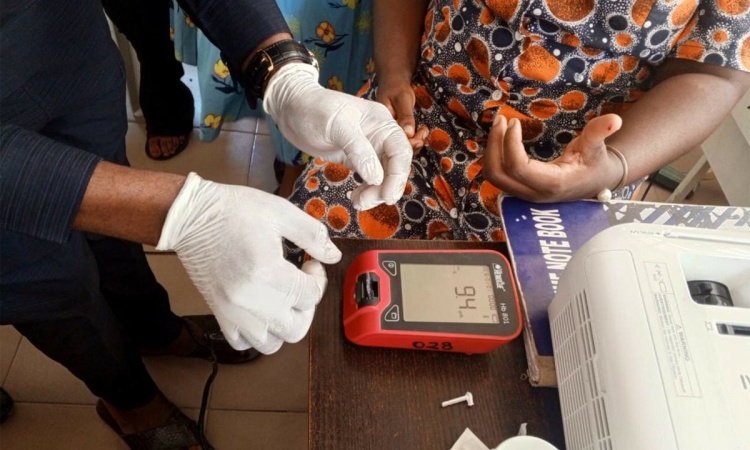
Nigeria is grappling with a widespread but largely preventable nutrition crisis, with 58 per cent of women of reproductive age living with anaemia, according to the 2023 Nigeria Demographic and Health Survey (NDHS).
The scale of the challenge was highlighted on Tuesday at the CS-SUNN Capacity Building on Strengthening Media Role for Anaemia Prevention in Nigeria.
The Assistant Director in the Nutrition Department of the Federal Ministry of Health and Social Welfare, Helen Achimugu, in her presentation, warned that anaemia and other micronutrient deficiencies continue to undermine the health, productivity and survival of millions of Nigerians.
She said, fifty-eight per cent of women of reproductive age in Nigeria are currently anaemic, citing findings from the 2023 NDHS, adding that this means more than half of our women are living with a condition that is largely preventable and treatable.
She added that the crisis extends to children, noting that Nigeria now ranks first in Africa and second globally in the number of stunted children.
“We have about 35 million stunted children, over 14 million wasted children and roughly 24 million children who are anaemic. This is not just a health issue, it is a development emergency.”
Achimugu explained that micronutrient deficiencies, often referred to as “hidden hunger” are widespread, particularly among children under five and women of reproductive age.
“They are called hidden hunger because the signs are not always visible, but their impact on health, learning ability and productivity is profound,” she said.
According to her, poor dietary diversity, food insecurity and socio-economic factors are driving the trend, with higher prevalence recorded in northern Nigeria. “The burden is heavier in the northern regions, largely due to dietary patterns and access to nutritious foods,” she said.
She identified key micronutrients such as iron, iodine, zinc, folate and vitamin A as essential for growth and immunity.
“These nutrients are needed in small quantities, but when they are lacking, or even taken in excess, the body cannot function properly,” Achimugu said, linking deficiencies to stunting, wasting, underweight and impaired cognitive development.
The health official also stressed that malnutrition underlies most childhood illnesses.
“In developing countries, diseases like pneumonia, diarrhoea, malaria and measles are common, but malnutrition contributes to about 60 per cent of these cases. If we do not address nutrition, we will keep treating symptoms rather than the root cause.”
Focusing on anaemia, Achimugu described it as a condition marked by insufficient haemoglobin levels, often caused by iron deficiency.
“Anaemia affects oxygen transport in the body and disrupts physical and neurological development. It increases the risk of maternal death, low birth weight and poor child growth.
She outlined government strategies to tackle the problem, including food fortification, supplementation and dietary diversification, with particular emphasis on Multiple Micronutrient Supplements (MMS) for pregnant women.
“MMS contains 15 essential vitamins and minerals, compared to iron and folic acid supplements which have just two. For pregnant women, MMS should be taken daily. It is as essential as water.”
Achimugu disclosed that MMS has been included in Nigeria’s Essential Medicines List and is being provided free of charge in public health facilities.
“One bottle can last a woman for about six months if taken daily, and it significantly reduces the risk of anaemia and other deficiencies during and after pregnancy,” she said.
She, however, stressed that success would depend on public awareness and sustained advocacy. “If the media is not there to raise their voices, we cannot take this message to every household,” Achimugu said. “That is why this engagement with journalists is critical.”
Earlier in his welcome address, the Executive Secretary of the Civil Society-Scaling Up Nutrition in Nigeria (CS-SUNN), Sunday Okoronkwo, described anaemia as one of the country’s most persistent yet preventable public health challenges.
“The most affected are women and children, and they cannot speak for themselves. They depend on the media to speak up on what they go through and to keep these issues on the front burner.”
He said anaemia continues to take a heavy toll on maternal mortality, child development and national productivity, despite being preventable and treatable.
He noted that addressing this burden requires more than policies and programmes, saying that it requires awareness, advocacy, accountability and sustained public engagement.
Okoronkwo, therefore, urged journalists to go beyond statistics and tell human-centred stories that can drive policy action.
“Your stories have the power to move those in authority to do what they ought to do. The prevention through adequate nutrition remains more cost-effective than emergency interventions. (Nigerian Tribune)



