ADAD

Updating your news feed...
NEWS EXPRESS is Nigeria’s leading online newspaper. Published by Africa’s international award-winning journalist, Mr. Isaac Umunna, NEWS EXPRESS is Nigeria’s first truly professional online daily newspaper. It is published from Lagos, Nigeria’s economic and media hub, and has a provision for occasional special print editions. Thanks to our vast network of sources and dedicated team of professional journalists and contributors spread across Nigeria and overseas, NEWS EXPRESS has become synonymous with newsbreaks and exclusive stories from around the world.
























Loading banners
Loading banners...

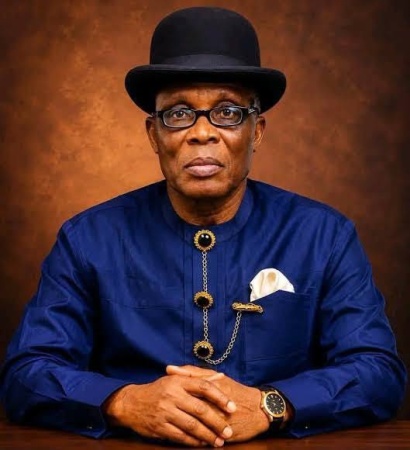
Former AfDB President, Adesina
•Former African Development Bank President proposes $5 billion initial capitalisation of Africa Space Future Fund, urges Presidents Tinubu of Nigeria, Paul Kagame of Rwanda and Abdel Fattah el-Sisi of Egypt to provide founding political leadership for continental space revolution.
Former President of the African Development Bank, Dr. Akinwumi A. Adesina, has called on President Bola Ahmed Tinubu to lead an ambitious continental initiative to mobilise $50 billion for Africa’s space economy, positioning Nigeria to spearhead a new era of African investment, technological innovation and industrial transformation.
Adesina, who is Chairman of the Global Africa Investment Summit and Chairman of the Diamonds for Development Fund of Botswana, made the call while delivering a keynote address titled “Financing Africa’s Space Future: Mobilising Capital for Space Science, Innovation and Technology” at the Africa Space Economy, Innovation and Communication Conference in Abuja on Tuesday.
The conference was organised by the Nigerian Space Research and Development Agency (NASRDA) and attracted leaders of space agencies from across the world, astronauts and representatives of space businesses, bringing together key stakeholders in the global space ecosystem to explore opportunities for investment, innovation, technological advancement and international cooperation.
Making the case for a major continental investment initiative, Adesina noted that Africa’s commercial space industry was emerging, with 321 active commercial space companies across 36 African countries generating approximately $373 million in revenue in 2024. However, he cautioned that the continent’s ambitions were not matched by its investments.
Drawing comparisons with major global space powers, he observed that National Aeronautics and Space Administration (NASA), the United States’ space agency, received approximately $24.4 billion in enacted funding in 2026, while Africa’s combined government space allocation stood at approximately $828 million. Although the figures were not perfectly comparable, he said they illustrated the enormous investment gap confronting the continent, with NASA alone receiving almost 30 times Africa’s combined public space allocation.
Adesina argued that Africa could not expect to compete effectively in a trillion-dollar global space economy while investing so little in the infrastructure, research and technological capabilities that would determine who captures its value. He called for a coordinated continental investment effort to mobilise the capital required to build these capabilities and position Africa to participate more meaningfully in the global space economy.
In a direct appeal to President Tinubu, Adesina proposed that Nigeria provide the political leadership for a continental initiative to mobilise up to $50 billion in long-term investments for space science, innovation, technology and infrastructure.
He particularly commended Tinubu’s ambition to build a $1 trillion Nigerian economy and his approval of four new Nigerian satellites, describing the decision as a powerful demonstration of the administration’s recognition of science, technology and innovation as critical drivers of economic transformation.
“I particularly commend your commitment to Nigeria’s space programme. Your approval of four new Nigerian satellites sends a powerful message. It demonstrates your conviction that science, technology and innovation must drive our economic transformation,” Adesina said.
He noted that the foundations being laid under Tinubu’s leadership could create opportunities for generations of Nigerians, stressing that the country’s economic transformation must be supported by structural reforms, sustainable growth and strategic investments in technological capabilities.
Adesina expressed confidence in Nigeria’s economic prospects under President Tinubu’s leadership, emphasising the importance of continuity, consistency and a bold vision for the future.
“I have no doubt that, under your leadership, and with continuity, consistency and a bold vision for the future, Nigeria will achieve sustained economic growth, broad-based prosperity and a position of greater strength and influence in the global community.
“Knowing you, Mr. President, I am confident that you will sustain and drive this vision forward.
“Let there be renewed hope on the ground, and renewed hope in space as well!” Adesina said.
A $50 BILLION FUND TO FINANCE AFRICA’S SPACE FUTURE
At the centre of Adesina’s proposal is the establishment of a $50 billion Africa Space Future Fund, with a proposed initial capitalisation target of $5 billion and a long-term ambition to mobilise up to $50 billion in cumulative investments over 10–15 years.
The proposed Fund would bring together African governments, sovereign wealth funds, development finance institutions, pension funds, insurance companies, private investors, international partners and the African diaspora.
It would focus on three principal investment priorities.
The first is commercial space infrastructure, including satellite communications, African low-Earth orbit (LEO) broadband capabilities, Earth observation, ground stations, gateways and data infrastructure. These investments would expand satellite connectivity and provide the infrastructure needed to support a growing continental space economy.
The second is science and research, encompassing scientific missions, university research, advanced technologies and international research partnerships. This would strengthen Africa’s scientific capabilities and support the development of indigenous space technologies.
The third is innovation and enterprise, supporting African startups, satellite component manufacturers, artificial intelligence, robotics, sensors and emerging space businesses. This would stimulate entrepreneurship, create skilled employment and help build globally competitive African space enterprises.
Across all three priorities, the proposed Fund would place particular emphasis on African ownership, intellectual property development, technology transfer, indigenous innovation and local manufacturing capacity. Its ambition would be to ensure that Africa develops the technological capabilities, enterprises and industrial ecosystems required to create and capture value from the global space economy.
Adesina emphasised that the Fund must operate under independent governance, professional investment management, rigorous due diligence and transparent accountability, rather than become an instrument of political patronage.
“This is not a request for charity. It is an investment proposition,” he declared.
He argued that Africa’s growing demand for connectivity, agricultural intelligence, climate information, geospatial services and digital infrastructure presented commercially viable opportunities capable of attracting substantial private and institutional capital.
According to him, the priority must be to transform Africa’s development needs into bankable projects, sustainable enterprises and indigenous technological capabilities.
He maintained that governments must use public investment strategically to unlock private capital, while commercially viable projects and long-term service contracts create sustainable revenue streams for investors.
TINUBU, KAGAME AND EL-SISI TO ANCHOR CONTINENTAL SPACE INITIATIVE
In a major proposal for continental cooperation, Adesina called on President Tinubu, President Paul Kagame of Rwanda and President Abdel Fattah el-Sisi of Egypt to provide the founding political leadership for the proposed Africa Space Future Fund.
He proposed that the three leaders convene a Founding Presidential Summit on Financing Africa’s Space Future to secure political endorsement for the initiative, mobilise initial investment commitments and establish the institutional framework required to implement the continental programme.
The proposed partnership would draw on Nigeria’s ambition and growing commitment to space technology, Rwanda’s experience in technology-driven development and innovation, and Egypt’s established space infrastructure and role as host of the African Space Agency.
Adesina stressed that the initiative must move beyond declarations of goodwill to secure concrete commitments, strategic partnerships and an actionable implementation roadmap.
He also proposed the establishment of a high-level continental task force, working with the African Union and the African Space Agency, to develop the legal, institutional and financial framework for the Fund, identify founding investors and prepare a roadmap for mobilising the initial $5 billion.
The task force would provide the institutional foundation for translating the proposed presidential initiative into an actionable continental investment programme.
AFRICA LINK: BUILDING A CONTINENTAL SATELLITE CONNECTIVITY NETWORK
A central component of Adesina’s vision is Africa Link, which he proposed as the flagship continental programme of the Africa Space Future Fund.
The initiative would aggregate demand across African markets, develop shared ground infrastructure and establish strategic partnerships with international satellite operators to expand affordable and reliable satellite connectivity across the continent.
By pooling demand and coordinating infrastructure investments, African countries could achieve economies of scale, reduce costs and expand access to satellite services, while strengthening their participation in the global space economy.
However, Adesina warned against a future in which Africa remained entirely dependent on satellite networks owned and controlled by foreign companies.
While acknowledging the importance of international partnerships, he insisted that such collaborations must facilitate technology transfer, skills development and greater African participation in satellite network operations and management.
“We must move from renting the infrastructure of the digital future to owning a meaningful share of it,” he said.
Adesina stressed that Africa did not need to immediately replicate existing global satellite constellations but must begin building the capacity to compete, collaborate and secure a meaningful stake in the emerging space economy.
“Africa must have its own Africa Link!” he declared.
SPACE TECHNOLOGY: AN UNTAPPED ENGINE OF AFRICA’S ECONOMIC TRANSFORMATION
Adesina highlighted the enormous economic potential of space technology in agriculture, food security, telecommunications, climate resilience, disaster management, infrastructure development and natural resource management.
Drawing on his experience as Nigeria’s Minister of Agriculture in 2012, he recounted how satellite imagery, remote sensing and vegetation data helped the government assess the impact of devastating floods and develop a national dry-season agricultural programme that helped avert a predicted food crisis.
He explained that space-generated information enabled the government to make evidence-based decisions at a critical moment, demonstrating how investment in space technology can protect livelihoods, strengthen food security and improve economic stability.
He called for a fundamental transition from fragmented national space programmes towards an integrated continental space economy in which countries pool resources, develop complementary capabilities and share infrastructure.
According to him, greater regional coordination would enable African countries to overcome the limitations of individual national markets, reduce duplication and create the scale required to attract global investment.
FROM CONSUMING SPACE TECHNOLOGY TO CREATING SPACE WEALTH
Adesina maintained that Africa’s ambition must extend beyond launching satellites to building the industries, businesses and technological capabilities that will generate long-term economic value from space.
He identified satellite manufacturing, sensors, communication equipment, ground systems, artificial intelligence, robotics, software development and data analytics as strategic areas in which African companies must develop indigenous capabilities.
He emphasised that Africa must deliberately invest in research, innovation, advanced manufacturing and intellectual property development to ensure that the economic benefits of its growing space economy translate into industrial growth, skilled employment and new business opportunities.
To finance this transformation, he advocated blended finance, African Space Bonds, public-private partnerships, venture capital and international development finance as mechanisms for mobilising the substantial capital required to develop the sector.
He argued that governments should deploy public capital strategically to unlock private investment, while long-term contracts for agricultural monitoring, disaster management and connectivity could create predictable demand and make space infrastructure projects commercially viable.
For Adesina, the ultimate objective is to build a competitive African space industry capable of developing technologies, creating globally competitive enterprises and exporting space-related products and services to international markets.
“MR. PRESIDENT, YOU CONQUERED THE ATLANTIC. NOW, CONQUER SPACE!”
In a stirring appeal, Adesina urged President Tinubu to extend his ambition and bold vision to Africa’s aspirations in space science, technology and innovation.
Drawing inspiration from former United States President John F. Kennedy’s historic commitment to landing a man on the Moon, he encouraged the Nigerian President to demonstrate similar ambition in positioning Nigeria and Africa for the future of space exploration and technology.
“Mr. President, like John F. Kennedy, dare to dream big,” he said.
He concluded with an inspiring message to President Tinubu:
“Mr. President, you conquered the Atlantic! With your vision and boldness, why stop there? Now, Mr. President, conquer space!”
Adesina expressed optimism that an African would one day walk on the Moon, adding that he hoped that historic achievement would be made by a Nigerian.
He called for sustained investment in universities, scientific research institutions, young innovators and the technological infrastructure required to develop a globally competitive African space industry.
His message was that Africa must move beyond consuming space technology to creating space wealth; beyond importing technologies to developing and exporting them; and beyond fragmented national programmes to building an integrated continental space economy.
He encapsulated this ambition in three powerful words: OWN. CREATE. EXPORT.
“THE SKY MUST BE OUR STARTING POINT,” Adesina declared, insisting that the time for Africa to invest, collaborate and build its future in space is now.