 ADAD
Updating your news feed...

NEWS EXPRESS is Nigeria’s leading online newspaper. Published by Africa’s international award-winning journalist, Mr. Isaac Umunna, NEWS EXPRESS is Nigeria’s first truly professional online daily newspaper. It is published from Lagos, Nigeria’s economic and media hub, and has a provision for occasional special print editions. Thanks to our vast network of sources and dedicated team of professional journalists and contributors spread across Nigeria and overseas, NEWS EXPRESS has become synonymous with newsbreaks and exclusive stories from around the world.
























Loading banners
Loading banners...

By BONIFACE AKARAH
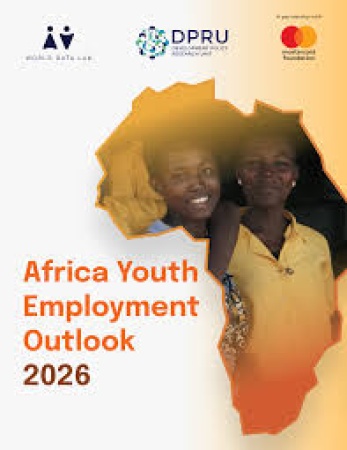
About 132 million young people aged 15 to 35 are expected to be added to Africa's population between 2020 and 2030, while an estimated 107 million young Africans are currently not in employment, education or training, according to a new employment data tool launched by World Data Lab and the Mastercard Foundation.
The two organisations unveiled the Africa Youth Employment Clock in Abidjan, Côte d'Ivoire, on November 3, 2026, to provide policymakers, employers and development partners with data on youth employment trends and projections across the continent.
The tool estimates that Africa will have about 556 million young people aged 15 to 35 in 2026, representing 35 per cent of the continent's total population. Of this number, 318 million, or 57 per cent, are employed, while 107 million, representing 19 per cent, are not in employment, education or training. Another 131 million, or 24 per cent, are pursuing their studies.
The organisations said the continent's rapidly growing youth population presented both an opportunity and an urgent need to invest in education, skills development and pathways to dignified and fulfilling work.
In Côte d'Ivoire, the tool estimates that young people aged 15 to 35 number about 11.2 million in 2026, representing 37 per cent of the country's population.
Of this figure, approximately 6.3 million, or 56 per cent, are employed, while 1.8 million, representing 18 per cent, are not in employment, education or training. Another 3.1 million, or 26 per cent, are pursuing education or training.
The data also highlight significant gender inequalities in access to employment and income in the country.
According to World Data Lab, 25 per cent of young women aged 15 to 25 in Côte d'Ivoire are not in employment, education or training, compared with 13 per cent of young men in the same age group.
Among those aged 26 to 35, the proportion stands at 17 per cent for women and six per cent for men. The organisation also reported that young women earn less than men across every sector, with the widest income gap in services, where women's earnings are 37 per cent lower.
Commenting on the findings, Dr Reshma Sheoraj, Senior Vice President of World Data Lab, said the figures revealed substantial differences in how young women and men access economic opportunities.
“In Côte d'Ivoire, the youth employment situation reveals significant differences in how young women and young men access economic opportunities. While young men are more likely to be employed, young women face greater barriers to entering the labor market,” Sheoraj said.
She added that the disparities extended beyond access to jobs to include differences in earnings and opportunities for career progression.
“These findings underscore the importance of looking beyond job creation alone to ask who gets access to opportunities, the quality of those opportunities, and young women's ability to take part and progress on an equal footing,” she said.
The Africa Youth Employment Clock is a publicly accessible digital platform available at www.africayouthjobs.io. It provides estimates of youth labour market outcomes across African countries, with projections extending to 2040.
The tool allows users to examine employment data by sex, age, location, education level and economic sector. It also provides information on formal and informal employment, income, in-work poverty, urban and rural employment, and reasons for inactivity.
Using the African Union's definition, the platform classifies young people as those aged 15 to 35, while allowing users to filter data for different age groups to accommodate varying national definitions of youth.
World Data Lab said the tool draws on surveys and datasets from national statistical institutes, the International Labour Organization and the International Institute for Applied Systems Analysis. Its methodology is designed to produce consistent estimates that can be compared across countries.
Elisee Kamanzi, Acting Country Director for the West African Economic and Monetary Union (WAEMU) at the Mastercard Foundation, said the platform would help stakeholders make better-informed decisions on youth employment.
“The Africa Youth Employment Clock provides valuable, data-driven insights into youth employment trends across Africa, including the evolving realities and dynamics facing young people in Côte d'Ivoire,” Kamanzi said.
He said making the information accessible would help policymakers, development partners and other stakeholders build stronger partnerships, align investments and develop solutions that respond to young people's aspirations.
“At the Mastercard Foundation, we believe that young people, and young women in particular, must be at the heart of efforts to shape the future of work in Africa. Tools like the Clock are essential to guiding our programs and advancing our shared ambition: enabling young people to access dignified and fulfilling work,” he said.




