 ADAD
Updating your news feed...

NEWS EXPRESS is Nigeria’s leading online newspaper. Published by Africa’s international award-winning journalist, Mr. Isaac Umunna, NEWS EXPRESS is Nigeria’s first truly professional online daily newspaper. It is published from Lagos, Nigeria’s economic and media hub, and has a provision for occasional special print editions. Thanks to our vast network of sources and dedicated team of professional journalists and contributors spread across Nigeria and overseas, NEWS EXPRESS has become synonymous with newsbreaks and exclusive stories from around the world.




















Loading banners
Loading banners...

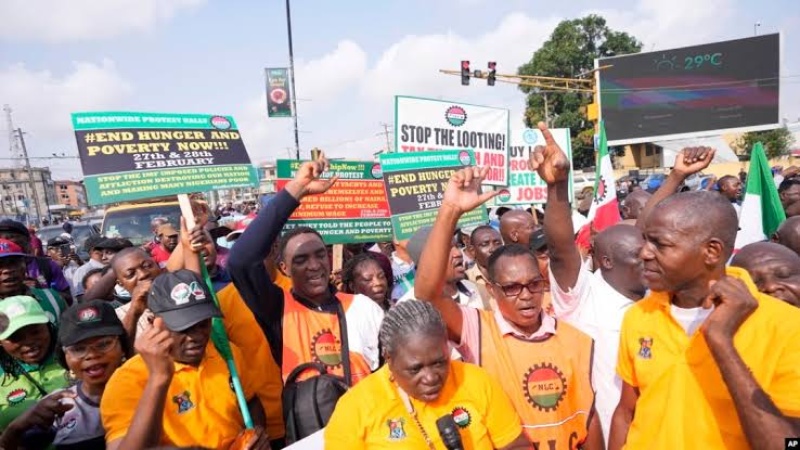
Nigerian workers during a protest march
Emenike Ikedichi Ubani, a lecturer in the Mass Communication Department of Abia State University, in this interview with CHRISTIAN APPOLOS, spoke on the recent open confrontation between the Nigeria Labour Congress (NLC) and the Trade Union Congress of Nigeria (TUC).
How do you assess the ongoing disagreement between the NLC and TUC over the Federal Government’s N70,000 transport allowance, particularly its implications for the unity and bargaining strength of organised labour?
I consider the disagreement unfortunate, particularly because of its timing and the broader economic circumstances confronting Nigerian workers. We must, however, distinguish between legitimate differences in negotiating positions and unnecessary public confrontation.
The TUC is entitled to question the adequacy of the N70,000 transport intervention and advocate a more sustainable improvement in workers’ remuneration. Similarly, the NLC has the right to defend an agreement it negotiated with the Federal Government. The problem is not necessarily that they hold different positions; it is how those differences are being managed.
Organised labour derives much of its strength from solidarity, collective action and the ability to present a common front when negotiating with government and employers. When its leadership becomes publicly divided, it creates uncertainty about the movement’s capacity to coordinate its demands and sustain pressure.
We must remember that the ultimate beneficiaries of trade union struggles are workers. Therefore, whatever differences exist between the two centres must be managed in a manner that does not undermine the collective interests they are established to protect.
Could the NLC and TUC have managed their differences through internal consultations rather than public exchanges? What does their disagreement communicate to the government and employers?
Absolutely. I believe the disagreement could have been managed more constructively through dialogue and internal consultations. Trade unionism does not require absolute agreement on every issue. In fact, disagreements are natural in democratic institutions, particularly where different organisations have their respective constituencies, interests and negotiating strategies.
However, responsible leadership requires the ability to manage disagreements without allowing them to become public spectacles. The NLC and TUC are not adversaries. They are sister labour centres whose responsibilities and interests substantially converge around the protection of workers.
When labour leaders engage in public exchanges, they risk creating the impression that organised labour is more concerned about institutional differences than the welfare of workers.
The government and employers are also watching these developments. A divided negotiating environment can complicate labour’s ability to sustain pressure and secure concessions. The two centres must understand that there is a difference between defending their institutional positions and allowing disagreements to weaken the collective bargaining capacity of the labour movement.
Do you suspect there are underlying issues beyond the transport allowance controversy fuelling the disagreement? If so, why should such differences be allowed to degenerate into public confrontation?
It is difficult to establish whether there are underlying issues without hearing directly from the leadership of both organisations. However, where disagreements appear to extend beyond the immediate subject matter, it becomes necessary to interrogate the possibility of unresolved institutional, leadership or strategic differences.
If such issues exist, they should be addressed through appropriate channels of dialogue and reconciliation.
The labour movement has a responsibility to demonstrate a higher level of institutional maturity. Whatever personal disagreements, competing interests or differences in leadership perspectives may exist should not be allowed to overshadow the collective responsibility of defending workers.
There is no justification for turning internal disagreements into public confrontations that could embarrass the labour movement and undermine workers’ confidence.
You cannot be fighting for the dignity of workers while simultaneously subjecting the institution representing them to avoidable public embarrassment. Leadership is not demonstrated by winning public arguments against one another. It is demonstrated by the ability to manage differences, build consensus and protect the interests of the people one represents.
Do you agree that disunity within organised labour could weaken workers’ bargaining power and potentially work to the government’s advantage, particularly as negotiations for a new national minimum wage approach?
Certainly, a divided labour movement risks weakening its negotiating position. Collective bargaining derives its effectiveness not merely from the strength of individual unions but also from their ability to aggregate interests, coordinate demands and sustain collective pressure.
The government and employers are negotiating institutions with their own interests, priorities and strategies. When organised labour approaches negotiations with conflicting positions, it becomes more difficult to build consensus around common demands.
I would not necessarily suggest that the government deliberately engineered the present disagreement. However, the government could benefit from a situation in which labour’s attention and energy are diverted from collective demands to internal disagreements.
This is particularly important now that discussions on a new national minimum wage are approaching. The minimum wage is not simply about the lowest amount an employer should pay a worker. It has implications for purchasing power, income distribution, productivity, industrial relations and the general welfare of the working population. The NLC and TUC must therefore understand that the forthcoming negotiations require preparation, strategic coordination and a common understanding of workers’ economic realities.
The government should be negotiating with a labour movement united by common objectives, not one distracted by avoidable disagreements among its leadership.
What institutional mechanisms should the NLC and TUC put in place to resolve differences, improve cooperation and sustain a common front on issues affecting Nigerian workers?
I think the two labour centres need to strengthen their existing channels of inter-organisational consultation and establish a more structured mechanism for resolving disagreements. They could institutionalise regular meetings between their leaderships, particularly whenever issues of national importance affecting workers arise. Such meetings should provide opportunities for exchanging positions, identifying areas of convergence and resolving differences before they become public controversies.
They should also consider establishing a joint consultation or coordination platform comprising representatives of both centres. This would help harmonise positions on common national issues, particularly minimum wage negotiations, workers’ welfare, social protection and employment conditions.
However, such cooperation must respect the institutional independence of both organisations. Unity should not mean that one centre must surrender its identity or automatically endorse every position taken by the other. Rather, it should mean recognising that despite their differences, they share a common responsibility to Nigerian workers.
The objective should be to institutionalise cooperation so that the relationship between the two centres does not depend solely on the personalities occupying leadership positions at any particular time.
What is your advice to the leadership of both labour centres on resolving the current disagreement, avoiding public confrontations and rebuilding workers’ confidence in their leadership?
My advice is that both leaderships should immediately embrace dialogue and put the present disagreement behind them. They should convene a high-level meeting, review their respective positions and identify a mutually acceptable way forward.
The NLC should appreciate that the TUC has a legitimate responsibility to express concerns about the adequacy of any intervention affecting workers. Similarly, the TUC should recognise that the NLC has the right to negotiate and defend agreements it believes will benefit workers.
Neither organisation should allow the present disagreement to become a source of permanent institutional distrust.
They must also recognise that Nigerian workers are already confronted with enormous economic difficulties. Workers need improved wages, affordable transportation, better working conditions, effective social protection and policies that protect their purchasing power. They cannot afford a labour movement preoccupied with internal disagreements.
I also want to remind both leaderships that the credibility of organised labour rests substantially on the confidence workers have in their ability to defend their interests.
The NLC and TUC must understand that their differences are secondary to the collective interests of Nigerian workers. They may disagree on the road to take, but they must not lose sight of the destination.
Ultimately, the strength of organised labour is not measured by how loudly its leaders disagree with one another but by how effectively they unite to secure better conditions for workers. (Nigerian Tribune)




