ADAD
Updating your news feed...

NEWS EXPRESS is Nigeria’s leading online newspaper. Published by Africa’s international award-winning journalist, Mr. Isaac Umunna, NEWS EXPRESS is Nigeria’s first truly professional online daily newspaper. It is published from Lagos, Nigeria’s economic and media hub, and has a provision for occasional special print editions. Thanks to our vast network of sources and dedicated team of professional journalists and contributors spread across Nigeria and overseas, NEWS EXPRESS has become synonymous with newsbreaks and exclusive stories from around the world.





















Loading banners
Loading banners...

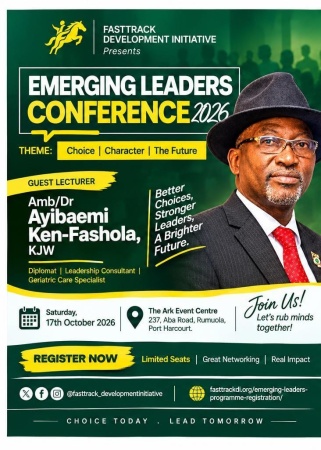
Emerging leaders have been challenged to take personal responsibility for their future, cultivate integrity, develop marketable skills, overcome the paralysis of indecision, and translate their ambitions into measurable action.
The challenge was delivered by Amb/Dr Ayibaemi Ken-Fashola, KJW, Guest Speaker at the Emerging Leaders Conference 2026, held on Saturday, 17 October 2026, at The Ark Event Centre.
Speaking on the theme, “Choices: Shaping Your Future by the Choices You Make,” Dr Ken-Fashola delivered a thought-provoking lecture on personal responsibility, character development, self-leadership, ethical decision-making, and the role of young people in shaping their individual and collective futures.
He urged participants to move beyond the pursuit of inspiration, recognition, and public validation to embrace the discipline, competence, and consistent action required to achieve meaningful and sustainable progress.
According to him, the future is not merely something people wait to experience; it is also something they actively participate in creating through their everyday decisions, habits, and conduct.
“The future is not merely something that happens to us. It is also something we participate in creating,” he declared, emphasising that although individuals cannot control every circumstance, they retain responsibility for how they prepare, respond to challenges, acquire knowledge, pursue opportunities, and conduct themselves.
THE WHEELBARROW PRINCIPLE: A CALL TO SELF-LEADERSHIP
One of the central highlights of the lecture was the speaker’s Wheelbarrow Principle, a practical illustration of the difference between possessing potential and taking initiative.
Using the familiar image of a wheelbarrow that remains stationary until someone pushes it, Dr Ken-Fashola challenged participants to examine whether they were waiting for government employment, influential connections, wealthy relatives, or external circumstances to initiate their progress.
He stressed that while mentorship, institutional support, networks, and fair opportunities remain important, emerging leaders must not surrender their personal agency to external circumstances.
“A leader must, however, learn to take responsibility for initiating constructive action,” he stated.
He encouraged young people to develop useful skills, identify practical opportunities, offer valuable services, explore realistic business ideas, build professional relationships, and take deliberate steps towards their goals, irrespective of their starting points.
The speaker further cautioned against romanticising poverty or suggesting that individual effort alone can overcome every structural obstacle. Rather, he advocated a balanced approach in which personal initiative works alongside supportive institutions and equitable opportunities.
His message was clear: leadership begins before the acquisition of a title, appointment, office, or position of authority. It begins with the ability to govern oneself, solve problems, take initiative, and create value.
CHOICES, HABITS, AND THE ARCHITECTURE OF THE FUTURE
Dr Ken-Fashola explained that seemingly insignificant decisions, when repeated over time, influence a person’s competence, relationships, reputation, and opportunities.
He observed that choices concerning the use of time, financial management, learning, relationships, personal discipline, and professional development can accumulate into patterns that either support or undermine long-term aspirations.
Drawing on concepts from behavioural science, economics, and leadership studies, he highlighted the relationship between habits, opportunity costs, self-regulation, and accountability.
He urged participants to recognise that their past decisions may explain their present circumstances but need not dictate their future.
According to him, mistakes should become opportunities for learning rather than permanent sources of shame or excuses for inaction.
“A mistake can become a classroom, or it can become a prison. The difference often lies in what you choose to do after recognising it,” he said.
He also warned that success is not guaranteed by discipline alone and that difficult outcomes do not necessarily indicate poor decisions. He encouraged participants to assess their decisions through the quality of their reasoning, ethical principles, available evidence, and willingness to learn from experience.
A WARNING AGAINST DISTRACTION, PEER PRESSURE, AND FALSE SUCCESS
Addressing the challenges confronting young people in an increasingly connected and competitive world, the guest speaker cautioned against allowing social media trends, the pursuit of online approval, instant gratification, and the pressure to appear successful to undermine sound judgement.
He noted that visibility should not be confused with achievement, popularity with dependability, or influence with integrity.
He maintained that digital platforms can provide valuable opportunities for education, enterprise, creativity, and collaboration when used purposefully. The danger, he argued, arises when individuals allow online culture and peer pressure to determine their priorities and values.
“It takes courage to make the right choice when the wrong choice is fashionable,” he declared.
He urged emerging leaders to develop the courage to reject dishonest opportunities, walk away from destructive influences, acknowledge their limitations, seek assistance when necessary, and remain committed to worthwhile goals even when their choices attract little public recognition.
He further emphasised that the ability to say no to distractions is often necessary to say yes to opportunities for growth.
INDECISION: THE SILENT COST OF LOST OPPORTUNITIES
Another critical issue addressed during the lecture was the danger of prolonged indecision.
Dr Ken-Fashola observed that while major decisions require adequate information, consultation, reflection, and risk assessment, fear, perfectionism, and the desire for absolute certainty can cause people to postpone necessary action indefinitely.
He warned that opportunities can expire, skills gaps can widen, and aspirations can remain unrealised when individuals continually delay beginning the work required to achieve them.
“Never give life the power to choose for you. That is what indecision does: it gives life permission to choose for you,” he cautioned.
He recommended a practical decision-making approach that requires individuals to identify what they know, determine what they still need to learn, assess potential risks, consider the cost of waiting, and identify a manageable step they can take immediately.
He stressed that responsible leadership is not about acting recklessly or eliminating uncertainty, but about making informed decisions, learning from feedback, and adjusting strategies when circumstances or evidence require a change of direction.
CHARACTER AND INTEGRITY MUST UNDERPIN SUCCESS
The speaker placed considerable emphasis on the ethical responsibilities of leadership, warning that professional advancement and material success are inadequate measures of achievement when they come at the expense of character.
He challenged participants to consider whether their decisions reflect honesty, fairness, accountability, respect for others, and a willingness to honour commitments even when nobody is watching.
He cited examples such as refusing to falsify reports, rejecting examination malpractice, honouring business agreements, acknowledging mistakes, and refusing to abuse positions of authority.
According to him, these seemingly ordinary decisions establish the trust upon which credible institutions, productive relationships, and sustainable leadership depend.
“Do not build a future that requires you to destroy your conscience to maintain it,” he admonished.
He urged the emerging leaders to pursue substantial ambitions while ensuring that their principles remain stronger than their appetite for achievement.
SIX PRACTICAL STEPS FOR PERSONAL AND PROFESSIONAL GROWTH
Moving beyond motivation, Dr Ken-Fashola presented a six-step framework designed to help participants translate the conference’s message into practical outcomes.
The framework comprises:
1. Conduct an honest audit: Examine how time, money, attention, and energy are being used, identifying habits that support progress and those that undermine it.
2. Define a meaningful destination: Replace vague aspirations with specific, achievable objectives and clear indicators of progress.
3. Build the required capacity: Acquire relevant skills, strengthen communication, improve financial literacy, seek feedback, and develop professional competence.
4. Take one measurable step: Convert intentions into concrete actions, such as completing a course, submitting an application, contacting a mentor, testing a business idea, or completing a project.
5. Establish boundaries and accountability: Protect time from avoidable distractions, identify non-negotiable ethical principles, and seek people who can provide constructive guidance and accountability.
6. Review, learn, and adjust: Regularly evaluate progress, identify shortcomings, and modify strategies where necessary.
To illustrate the practical application of these principles, he discussed how an unemployed graduate could develop employable skills and build a portfolio, how an aspiring entrepreneur could test a business idea before committing substantial capital, and how an aspiring leader could establish credibility by becoming dependable in existing responsibilities.
He emphasised that consistent, measurable action offers a more reliable foundation for progress than ambitious declarations unsupported by implementation.
PERSONAL RESPONSIBILITY MUST BE MATCHED BY INSTITUTIONAL RESPONSIBILITY
In extending his argument beyond individual achievement, Dr Ken-Fashola highlighted the relationship between personal choices and national development.
He maintained that the quality of a society is influenced by the decisions of its citizens, entrepreneurs, professionals, public servants, and political leaders.
However, he cautioned against placing the entire burden of progress on young people without recognising the importance of quality education, accessible skills training, public safety, reliable infrastructure, fair recruitment, and an environment that enables honest enterprise to thrive.
“We cannot reasonably demand initiative from young people while dismissing the importance of quality education, accessible skills training, fair recruitment, public safety, reliable infrastructure, and an environment where honest enterprise can thrive,” he stated.
He argued that individual responsibility and institutional accountability must reinforce each other.
He called on employers to create environments where people can develop and be rewarded fairly, public servants to treat public office as a trust, entrepreneurs to create genuine value, and professionals to use their knowledge to solve societal problems.
He further urged individuals who acquire influence to use it to open doors for others rather than merely consolidate their personal advantages.
According to him, the highest expression of leadership is not simply personal advancement, but the ability to make that advancement beneficial to other people.
A 48-HOUR CHALLENGE TO EMERGING LEADERS
In a direct challenge to conference participants, the guest speaker urged them to ensure that the event became a turning point rather than another gathering that generated temporary excitement without lasting change.
He asked each participant to leave with three specific commitments:
Identify one unproductive or destructive habit to stop.
Identify one important skill or personal capacity to develop.
Identify one meaningful action to complete within the next 48 hours.
He encouraged participants to make their commitments specific, realistic, time-bound, and, where appropriate, known to a trusted person who could help hold them accountable.
He cautioned against attempting to transform every aspect of life at once, recommending instead a sustained pattern of deliberate decisions and incremental progress.
He also urged participants to avoid unhealthy comparisons, recognise that individuals have different starting points and responsibilities, remain teachable, and seek help when necessary.
CONCLUSION: THE FUTURE IS WAITING FOR PARTICIPATION
Concluding his lecture, Dr Ken-Fashola urged emerging leaders to align ambition with preparation, confidence with competence, influence with integrity, and success with service.
He reminded participants that although individuals cannot choose every circumstance surrounding their beginnings, they can often influence how they prepare, what they learn, how they respond to setbacks, and what principles they refuse to compromise.
He challenged them to stop waiting for perfect opportunities, external recognition, or the approval of the crowd before beginning the work required to develop their potential.
“The future is not waiting for your applause. It is waiting for your participation,” he declared.
He concluded by urging participants to make their choices consciously, courageously, and ethically, while remaining mindful of the people affected by their decisions.
He expressed the hope that their lives would ultimately demonstrate not merely what they aspired to become, but what they chose to do, what they had the courage to change, and what became better because of their contributions.
The lecture reinforced a central message for emerging leaders: the future is shaped not by ambition alone, but by the quality of the choices, the consistency of the actions, and the integrity of the people making them.