Updating your news feed...

NEWS EXPRESS is Nigeria’s leading online newspaper. Published by Africa’s international award-winning journalist, Mr. Isaac Umunna, NEWS EXPRESS is Nigeria’s first truly professional online daily newspaper. It is published from Lagos, Nigeria’s economic and media hub, and has a provision for occasional special print editions. Thanks to our vast network of sources and dedicated team of professional journalists and contributors spread across Nigeria and overseas, NEWS EXPRESS has become synonymous with newsbreaks and exclusive stories from around the world.



.webp)








.webp)






Loading banners
Loading banners...

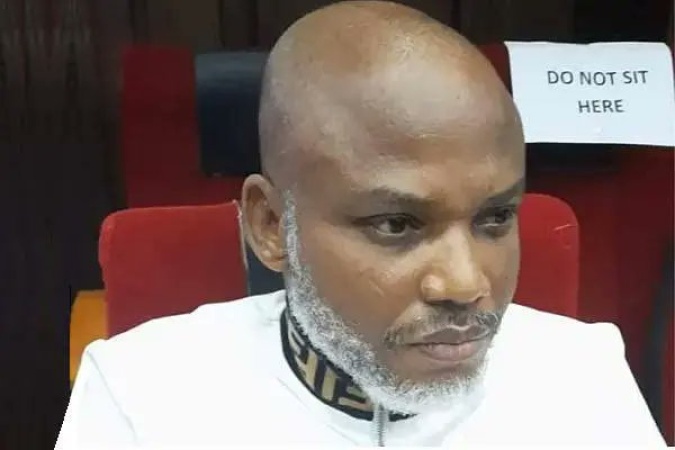
Nnamdi Kanu
By CHARLES IWUOHA
A lawyer, Onyedikachi Ifedi, has declared that the Nigerian government has abandoned the appeal filed by the IPOB leader to challenge his conviction.
Ifedi, a member of the Mazi Nnamdi Global Legal Consortium, in a statement on Tuesday, said the time for the government to file a response to the appeal had already expired.
It would be recalled that Kanu's family and members of his defence team had accused the Nigerian government of running from the courtroom after reports emerged that the appeal had not been listed for hearing. IPOB has threatened a boycott of the 2027 election in the South-East if the appeal was not listed and heard.
However, in an update on the matter, Ifedi said the appeal had already been abandoned.
He said, "Nigeria has abandoned the appeal. The Federal Government filed nothing. Time expired. No brief. No substantive defence to the appeal. That silence speaks volumes."
Offering his views on why the government, allegedly, abandoned the appeal, the lawyer said, "Because once this appeal is heard, the first question is not whether Mazi Nnamdi Kanu was guilty. It is whether the Federal High Court was ever lawfully seized of the case."
He further claimed that Justice James Omotosho, who presided over Kanu's trial, committed over 150 grave errors in the IPOB leader's trial and conviction.
Arguing the charge on which Kanu was prosecuted was defective, and as a result, the court lacked the jurisdiction to try him, the lawyer said, "Before a judge can convict a man, he must first have lawful authority to try him. Before he can receive evidence, he must first be lawfully seized of the case.
"Before he can take a plea, there must first be a valid criminal process before the court. On 21 March 2025, Justice James Omotosho resumed the criminal proceedings against Mazi Nnamdi Kanu. He took a plea. He proceeded with the trial. But the jurisdictional gateway had not been crossed."
Ifedi stressed that the statutes under which Kanu was tried were not valid and subsisting laws when the Federal High Court "purported" to resume the trial on 21 March 2025.
According to him, the principal terrorism statute stated in the charge had already been repealed.
"The statutory foundation pleaded in the charge therefore failed the very threshold the Supreme Court directed the trial court to examine. That was the jurisdictional failure. The charge was dead on arrival.
"The charge invoked the Terrorism (Prevention) (Amendment) Act 2013. The Terrorism (Prevention and Prohibition) Act 2022 had already come into force on 12 May 2022 and repealed the earlier terrorism legislation.
"Therefore, on 21 March 2025, the 2013 terrorism legislation stated in the charge was no longer a subsisting terrorism statute. It is a question of the legal foundation of the charge itself and the Supreme Court had already directed the trial court to examine precisely that foundation," he added.
Insisting that jurisdiction comes first in any legal proceeding, Ifedi declared that the Abuja Federal High Court presided by Justice Omotosho never had jurisdiction to prosecute Kanu.
"The criminal case had to come before the Federal High Court through a lawful process capable of invoking its jurisdiction. The judge did not create that process. The judge could not manufacture the missing foundation. The court could not become lawfully seized simply because it began acting as though it was," he said.
Describing the charge against Kanu as "dead", the lawyer stated that nothing that happened later could retrospectively make the Federal High Court lawfully seized of a case whose jurisdictional foundation had already failed.
Acknowledging that the judge took Kanu's plea, conducted the trial, received evidence, moved through the criminal process and ultimately convicted Kanu and imposed a life sentence, Ifedi stressed, "But none of those later acts created the jurisdiction that was absent at the beginning. They came after the jurisdictional failure."
According to him, the decisive question remains "where was the jurisdiction".
He added, "Where is the determination that the statutes actually stated in the charge were valid and subsisting laws providing for the offences charged? There is none."
Further faulting the trial, Ifedi argued that a perfectly conducted trial cannot cure a failure of jurisdiction.
"A thousand witnesses cannot cure it. A mountain of documents cannot cure it. Months of proceedings cannot cure it. A meticulously written judgment cannot cure it. A life sentence cannot cure it," he added.
The lawyer pointed out that jurisdiction is the first question for the Court of Appeal to determine.
He said, "The statutory foundation pleaded in the charge was not a valid and subsisting foundation for the offences charged on 21 March 2025. That means the Federal High Court was not lawfully seized of the criminal case on that date. That means jurisdiction never attached. And that means the proceedings that followed cannot be treated as though they began upon a valid jurisdictional foundation."