Updating your news feed...

NEWS EXPRESS is Nigeria’s leading online newspaper. Published by Africa’s international award-winning journalist, Mr. Isaac Umunna, NEWS EXPRESS is Nigeria’s first truly professional online daily newspaper. It is published from Lagos, Nigeria’s economic and media hub, and has a provision for occasional special print editions. Thanks to our vast network of sources and dedicated team of professional journalists and contributors spread across Nigeria and overseas, NEWS EXPRESS has become synonymous with newsbreaks and exclusive stories from around the world.

.webp)







Loading banners
Loading banners...

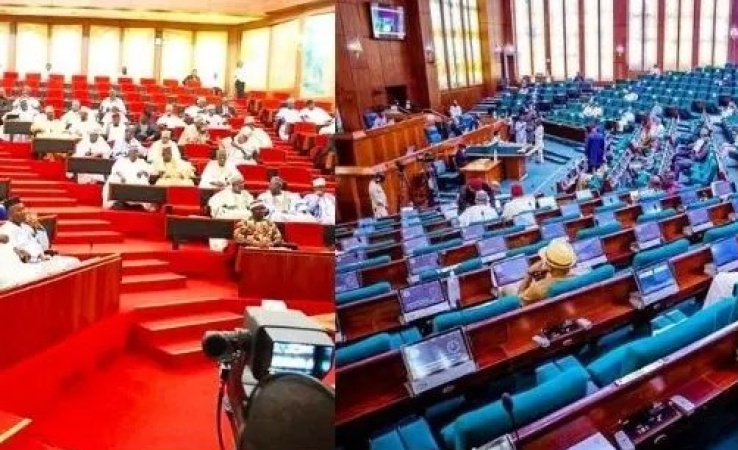
A joint session of the National Assembly
Economic and financial experts have disclosed that overlapping budgets of 2024 and 2025 have made it difficult for the Federal Government to implement new capital projects that would have created employment and build infrastructure that will benefit the ordinary Nigerian.
It is reported that the Budget Office of the Federation concluded the draft 2027–2029 Medium-Term Expenditure Framework (MTEF) and Fiscal Strategy Paper in July 2026 to target a September submission, but it has faced delays due to overlapping fiscal cycles, administrative reviews, and MDA submission bottlenecks.
The National Assembly few days ago extended the implementation of the capital component of the 2025 Appropriation Act to December 31, 2026, via a fourth amendment signed by President Bola Tinubu on September 30, 2026.
Speaking to the Nigerian Tribune on the extension of the implementation of the 2025 budget to the end of 2026, an economic expert, Terhemen Ayua, stated that major parts of 2026 budgets would be rolled over to 2027, and the cycle continues.
“Implementing budget means following the plan on economic and social welfare of the citizens per year but if you don’t follow the plan, how can you do the things you promised to do?” he questioned.
Another expert, Mr Eric Igulla, called on the federal government to improve the speed of budget implementation to enable the spread of developmental projects that will further impact the economy.
“The government has disclosed that there is increase in revenue mobilisation, which means there is more money; let this translate into the economy so that the ordinary Nigerian who is not working for government can also feel the dividends of the financial growth in the country.”
Analysts explained that budget overlaps force the 2025 capital budget to run concurrently alongside the active 2026 cycle. Adding that lack of fiscal discipline undermines annual budgeting norms and weakens legislative oversight/audit trails, warning that it sets a poor precedent for administrative efficiency.
While extending the implementation of 2025 budget to December 2026, Lawmakers noted that several capital projects remained unfinished due to funding bottlenecks and economic pressures.
Also speaking to Nigerian Tribune, the Lead Director of the Centre for Social Justice (CSJ), Eze Onyekpere, explained that “what is being extended is 30 percent of the 2025 capital vote. New capital projects were prohibited as Ministries, Departments and Agencies of government were directed to roll over 70 percent of the 2025 capital vote, which formed the foundation of the 2026 capital vote.
“For the avoidance of doubt, the capital budget is the vote for ammunition and equipment for our security forces fighting insurgency and infrastructure, including schools, hospitals, roads, bridges, electricity, agriculture, water resources, all manner of construction and practical aspects of public service delivery.”
Onyekpere noted that the state of fiscal affairs in Nigeria is «unconstitutional, unconscionable and illegitimate, a clear state of fiscal rascality and an incestuous conspiracy by the Executive and NASS to deny the people their entitlements to infrastructure, service delivery and good governance.
Analysts believe that government must increase funding into key economic sectors to improve the benefits of budgeting to Nigerians. (Nigerian Tribune)