Updating your news feed...

NEWS EXPRESS is Nigeria’s leading online newspaper. Published by Africa’s international award-winning journalist, Mr. Isaac Umunna, NEWS EXPRESS is Nigeria’s first truly professional online daily newspaper. It is published from Lagos, Nigeria’s economic and media hub, and has a provision for occasional special print editions. Thanks to our vast network of sources and dedicated team of professional journalists and contributors spread across Nigeria and overseas, NEWS EXPRESS has become synonymous with newsbreaks and exclusive stories from around the world.










Loading banners
Loading banners...

The largest sportswear brand on the planet, named after the ancient Greek goddess of victory, has been losing of late. Losing sales, losing customers and losing ground to its rivals.
The one-time industry disruptor is now the establishment and in the middle of a tricky turnaround plan aimed at clinging on to market dominance.
Nike's latest financial results show signs a turnaround strategy put in place by company veteran Elliott Hill, who was coaxed out of retirement two years ago to lead the firm, is working - but the pace of change is more of a marathon than a sprint.
However, its recovery has been dented by the loss of football star Kylian Mbappé, who ended his 20-year association with the brand last week to join fast-growing Swiss rival, On.
The Real Madrid striker's departure raises the question of whether Nike can remain the top logo for not just elite athletes, but also the fans that idolise them.
To be clear, Nike is still a mega brand and popular the world over. But missteps have seen hundreds of billions of dollars wiped off its stock market value as its share price tumbled by 75% over five years.
Last month, Nike was ejected from the S&P 100 stock market index of the biggest blue-chip firms in the US.
So what's gone wrong? And can Hill turn things around?
Matt Powell, a veteran analyst and adviser in the sports retail industry, reckons Nike has made "several strategic errors" which have been difficult to reverse, including cutting ties with retailers to sell only direct to customers online and making limited editions items more available.
"The more broadly available those shoes became, the fewer people were interested," Powell says.
Other self-inflicted wounds he suggests include spending research and development cash on digital operations rather than new products.
"They really shut down their innovation on product. Someone jokingly said they were trying to turn Nike into eBay."

That jibe was aimed at John Donahoe, the former eBay boss behind Nike's online direct-to-consumer sales pivot, before he made way for Hill.
Donahoe's four years at Nike coincided with the company's share price plunge.
His tenure saw sales initially soar, driven by pandemic restrictions that boosted online shopping, but subsequent cost-of-living pressures curbed customer spending.
As demand weakened overseas in key markets like China, Nike announced cost cuts and redundancies.
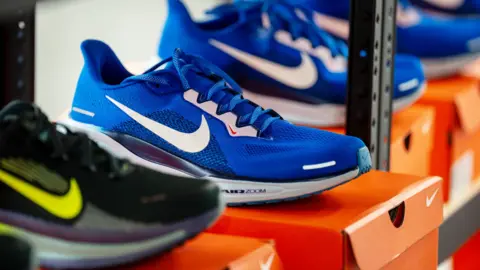
Its digital distraction allowed newer footwear firms on top of the trends to snap at its heels. Shop shelf space previously occupied by Nike was replaced by brands such as On and Hoka.
This was a stark warning to a company that prided and built itself on innovation.
Nike was the firm that signed a deal with a rookie called Michael Jordan in the mid-1980s at a time when the company wasn't a major player in basketball and still mostly known for its running trainers.
The gamble - spending its entire basketball budget on Jordan before he had even competed in the NBA - made Nike what it is today.
The company built a shoe brand around him - Air Jordan. The red and black colours broke NBA rules, but Nike used it as a marketing stunt and paid the fines.
In years that followed Nike partnered with generational talents Tiger Woods, Serena Williams and Cristiano Ronaldo, who all donned the Swoosh on their way to golf, tennis and football greatness.
While the brand retains partnerships with long-retired Jordan, plus Williams and Ronaldo - Woods ended his association in 2024.
"[I'm] not saying that what they did wasn't great, but it was in the past," said Tim Derdenger, an academic in marketing and strategy. "It's not the future and it's not the current and that is what drives apparel sales today."
Nike's books still boast top athletes, ranging from Rory McIlory to Vinicius Junior.
However, it has now lost its biggest footballing star in Mbappé, who had been with Nike since he was nine years old, along with World Cup winner Lamine Yamal.
Yamal suggested his move to Adidas gave him the chance to stand out from Nike's star-studded roster, while Mbappé said On would see him "surrounded by innovators who dream of the same things I do".
Was that a parting dig at Nike?
Derdenger suggests Mbappé's move had parallels to Jordan's decision decades earlier to choose Nike over Converse and Adidas due to the opportunity for the athlete to become synonymous with one brand.
"Athletes have egos and those egos want them to be a part of something big and that they're the ones that are helping drive that change, that growth."
Nike boss Hill said the brand has had "some great moments" with Mbappé over two decades.
"We wish him much success as he makes the move," he said during Nike's earnings call, adding that the brand still has a "great stable of athletes".
For all the "doom and gloom", Nike will stay number one, according to Powell - millions worldwide, including young people, remain loyal - but its mistakes have dented its dominance.
"Will Nike be the gorilla they once were? I don't think so. Can the brand come back to growth and profitability? Yes," Powell says.
"When you shut down innovation, you don't turn it back on and it goes right back to full speed," he adds.
Powell thinks Nike's turnaround plan, called "Sport Offense", will start to show positive signs next year.
Hill said Nike had "more work to do" on its sportswear, Jordan brand and in China as the company announced quarterly revenues of $11bn (£8.3bn), which undershot analysts' expectations.
Notably, the company cited "headwinds" in China, where revenue declined by 26%.
Sales of its Jordan brand were also down globally. Hill said the firm had been "oversupplying" the iconic retro shoe and will now reduce the volume and frequency of products under the brand.
Nike said it expected revenues to decline by "high-single digits" in the financial year ahead, adding that it planned to make savings of $2.5bn by 2031, some of which will result in job losses.
Nike's chief financial officer Dave Denton said: "Our results are below both our expectations and our potential, and we are focused on closing this gap."
The company's shares fell by more than 8% in extended trading in New York after the earnings were announced.
Last year the company launched a spin-off campaign to its iconic "Just Do It" slogan aimed at younger generations with the line "Why Do It?"
Young people, and future sporting stars, may ask themselves: Why Nike? (BBC)