
Updating your news feed...
NEWS EXPRESS is Nigeria’s leading online newspaper. Published by Africa’s international award-winning journalist, Mr. Isaac Umunna, NEWS EXPRESS is Nigeria’s first truly professional online daily newspaper. It is published from Lagos, Nigeria’s economic and media hub, and has a provision for occasional special print editions. Thanks to our vast network of sources and dedicated team of professional journalists and contributors spread across Nigeria and overseas, NEWS EXPRESS has become synonymous with newsbreaks and exclusive stories from around the world.
.webp)







Loading banners
Loading banners...

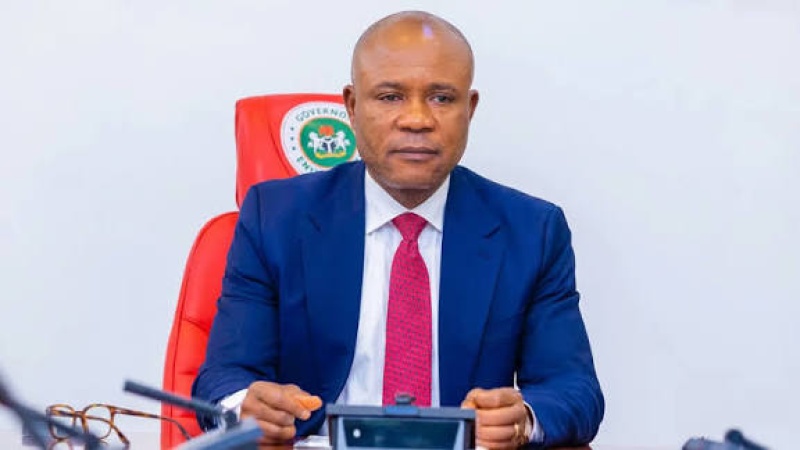
Gov Mbah
By VITUS OZOKE, PhD
Some announcements require analysis. Some require calculators. The Enugu State Government announced yesterday that Governor Peter Mbah has appointed 101 new Special Advisers, Senior Special Assistants, and Special Assistants. Not 10. Not 20. Not 50. One hundred and one. In one announcement.
The breakdown is seven Special Advisers, six Senior Special Assistants, and eighty-eight Special Assistants. The operative word is new. These are not all the governor’s aides. They are being added to an administration that already includes Special Advisers, Senior Special Assistants, Special Assistants, and other political appointees. Indeed, only last month, the government announced another batch of 23 Special Advisers and Senior Special Assistants.
So, perhaps the most obvious question is also the simplest: How many assistants does one governor need? Enugu State has a State Executive Council. Commissioners head ministries. Each commissioner has a permanent secretary. Beneath them are directors, deputy directors, and an established civil service staffed by professionals employed to carry out the business of government.
Yet apparently that machinery is not enough. We now need a Special Assistant on Public Enlightenment. Another on Public Awareness and Sensitization. Another on Public Advocacy. Another on Public Engagement. Another on Public Enlightenment and Orientation. Another on Public Communication. Another on Government Communication. Another on Media Relations. Another on Social Media.
There is a Special Assistant on Community Engagement, another on Community Development, another on Community Building, another on Community Enlightenment and Outreach, another on Community Mobilization, and another on Social Welfare and Community Relations.
There is a Special Assistant on Youth Engagement, another on Youth Development, another on Youth Empowerment and Skills Development, another on Youth and Sports, another on Youth Alliance, and another on Youth Mobilization.
Then there is political mobilization, grassroots mobilization, contact and mobilization, inter-party affairs, inter-party relationship and management, political liaison, stakeholder engagement, and party monitoring. At some point, the distinction between administrative specialization and administrative multiplication warrants public explanation.
Consider the scale of the institution the President of the United States occupies – and the populations involved. The United States currently has approximately 343 million people. Enugu State’s 2026 population is estimated at 5.4 million. In other words, the United States has roughly 64 times the population of Enugu State.
But population tells only part of the story. The American president heads the executive branch of a continental nation and oversees a federal government responsible for defense, diplomacy, intelligence, nuclear security, immigration, international trade, economic policy, and relations with governments worldwide.
Given that range of responsibilities, one would naturally expect the White House to employ considerably more than 101 people. It does. According to the White House’s July 1, 2025, personnel report, the entire White House Office had roughly 404 staff members. Read that carefully: the entire White House Office.
Those roughly 404 people were not all presidential advisers or political assistants. The figure includes the broader machinery needed to run the presidency: senior presidential aides, policy staff, lawyers, communications officials, speechwriters, researchers, schedulers, correspondence staff, records personnel, and numerous other employees.
Now return to Enugu. Governor Mbah has just appointed 101 additional advisers and assistants in a single announcement. That one batch alone is equivalent to about one-quarter of the reported White House Office workforce.
Here is the crucial distinction: the roughly 404 constitute the entire reported White House Office staff; Mbah’s 101 are merely the new arrivals. They are joining advisers and assistants already serving in his administration.
The American and Nigerian systems are clearly different. Their governmental responsibilities, institutional structures, and personnel classifications are not identical, so raw headcounts should not be treated as exact equivalents. But that does not make the comparison meaningless. It makes the question of proportionality important.
Government requires people. Executives require advisers. Specialized responsibilities sometimes require specialized expertise. The question is not whether Governor Mbah should have advisers and assistants. The question is whether a state government needs this many advisers and assistants, given this degree of apparent overlap, and what taxpayers receive in return.
The financial comparison sharpens the question. Enugu State’s 2026 budget is approximately ₦1.617 trillion. At an exchange rate of about ₦1,331.20 to one U.S. dollar, that is roughly $1.21 billion. The Congressional Budget Office projects U.S. federal outlays of about $7.4 trillion for fiscal year 2026.
Put those numbers side by side. United States: approximately $7.4 trillion. Enugu State: approximately $1.21 billion. Measured in the same currency, U.S. federal spending is roughly 6,090 times Enugu State’s entire annual budget. Yet Enugu has just appointed 101 additional advisers and assistants.
Again, the White House and the Enugu Government House are not institutionally identical. But proportionality matters. A state managing roughly $1.2 billion annually should be especially attentive to the opportunity cost of an expanding political payroll.
Another way to see the disparity is by looking at population. With roughly 404 employees across the entire White House Office and a U.S. population of approximately 343 million, there is about one White House Office employee for every 849,000 Americans.
Using Enugu’s estimated 2026 population of 5.4 million, Mbah’s 101 newly announced aides alone amount to about one new aide for every 53,500 Enugu residents. Again, the emphasis is on new.
For the United States, we are counting the entire reported White House Office workforce. For Enugu, we are counting only the 101 people appointed in this announcement – not the advisers and assistants already on the government payroll. Based on those figures, this new Enugu batch alone represents a staffing rate nearly 16 times the White House Office staff-to-population rate.
That does not establish an exact institutional equivalence. But it does raise a legitimate question of scale: What public-administration necessity requires the governor of a state of approximately 5.4 million people to add 101 advisers and assistants to the staff he already has?
The announcement gives us 101 names. What it does not give us may be even more important. What salaries are associated with these positions? What allowances? Are official vehicles provided? Drivers? Offices? Administrative support? What travel, accommodation, telephone, and transportation entitlements are provided?
What is the fully loaded annual cost of these 101 appointments? Since they are additional appointments, what is the total annual cost of all Special Advisers, Senior Special Assistants, Special Assistants, and comparable political aides currently serving the administration? These are not hostile questions. They are public-finance questions. The money belongs to the public.
The apparent duplication of portfolios makes those questions even more pressing. There is a Special Assistant on Market Maintenance and Sanitation, another on Market Sanitation, and one on Environmental Protection. There is another on Environmental Management, another simply on Environment, and yet another on Environmental and Sanitation. There is an SA on Rural Development and another on Rural Development and Livelihood. One is on Town Union Co-ordination, and another is on Town Union Matters. One is on Technology and Innovation, and another is on Digital Innovation.
There is an SA on Women Mobilization, another specifically on Women Mobilization in the Enugu-North Zone, and another on Grassroots Women Coordination. There is an SA on Public Enlightenment, one on Public Awareness and Sensitization, one on Public Advocacy, one on Public Engagement, one on Public Enlightenment and Orientation, one on Public Communication, one on Government Communication, and one on Civic Values and National Re-orientation.
Perhaps each has a genuinely distinct job description. If so, publish them. Perhaps each has measurable targets. Publish those as well. Perhaps each fills a demonstrable gap that no existing ministry, department, agency, or civil servant can address. Explain the gap. That is what accountability looks like.
But another question cannot reasonably be separated from the timing. Peter Mbah is no longer merely a sitting governor governing in the ordinary course of his term. He is also the APC candidate seeking another term in the 2027 governorship election. That makes both the timing and the titles of these appointments matters of legitimate public scrutiny.
Why does an administration more than three years into its term suddenly require 101 additional advisers and assistants, only months before voters return to the polls? What urgent administrative deficiency emerged in September 2026 that could not wait until after the election?
Some of the official portfolios make those questions unavoidable: Senior Special Assistant on Inter-Party and Mobilization; Senior Special Assistant on Party Monitoring; Special Assistant on Political and Grassroots Mobilization; Special Assistant on Inter-Party Affairs; Special Assistant on Contact and Mobilization; Special Assistant on Youth Mobilization; Special Assistant on Grassroots Mobilization; Special Assistant on Political Liaison; Special Assistant on Inter-Party Relationship and Management. Critics did not invent these descriptions. They are titles contained in the government’s own announcement.
So, Ndi Enugu are entitled to ask: Are these public servants appointed to perform necessary governmental functions for the people of Enugu State, or are some of these positions substantially political, focused on mobilizing support in their communities and wards ahead of the election? The distinction matters.
Governor Mbah is entitled to campaign for reelection. The APC is entitled to organize, mobilize supporters, build ward structures, communicate with voters, and employ campaign workers. But a political party has its own organization and campaign machinery. If an appointee is paid from public funds, the public is entitled to know what legitimate governmental function that person performs.
Take perhaps the most obvious example: What precisely does a taxpayer-funded Senior Special Assistant on Party Monitoring monitor? Which party? For what governmental purpose? What is the public policy objective? What measurable deliverables does that office produce? And why should Enugu taxpayers bear its cost rather than the political party concerned – Gov. Mbah’s APC?
The same questions arise across portfolios devoted to Inter-Party and Mobilization, Political and Grassroots Mobilization, Inter-Party Affairs, Contact and Mobilization, Political Liaison, and Inter-Party Relationship and Management.
Those titles alone do not establish that public funds are being unlawfully diverted to an election campaign. Establishing that would require evidence of what these appointees actually do, how they are funded, and whether they use public resources for partisan electoral purposes. But the titles and timing raise an accountability question the government should answer. A clear line should separate governing Enugu State from campaigning for the APC.
That points to a larger Nigerian problem. Political appointments can blur the line between public administration and political patronage. Government positions can become tools to accommodate political constituencies, reward allies, balance local interests, or maintain networks of political mobilization. That is precisely why the public-purpose test matters.
A taxpayer-funded position should serve a demonstrable governmental purpose. If its principal function is party organization, electoral mobilization, or strengthening political structures, citizens are entitled to ask why public rather than party resources should finance it. That principle should apply regardless of which political party controls government.
And then comes the opportunity-cost question. Every naira committed to maintaining a political office is a naira unavailable for another public purpose. That does not establish that every one of these appointments is unnecessary. It means the government should demonstrate that each is a worthwhile use of scarce public resources. The real cost is not merely salary. There may be allowances, transportation, official vehicles, fuel, travel, office space, communications, support staff, and administrative overhead.
The relevant number, therefore, is not simply an SA’s monthly salary multiplied by 101. It is the fully loaded annual cost of maintaining these 101 offices – and, ultimately, the entire political-appointee structure surrounding the governor. Ndi Enugu deserve to know that number.
Governor Peter Mbah’s administration may have explanations for these appointments. If so, it should make those explanations public. How many political appointees are currently serving in the administration? What do they collectively cost Enugu State each year? What measurable functions do they perform? Why can apparently overlapping portfolios not be consolidated?
And if some of these appointees are, in practice, political mobilizers whose primary role is to organize voters, strengthen ward structures, or advance a candidate’s reelection, another question becomes unavoidable: Why should Ndi Enugu, rather than Peter Mbah’s APC, pay the bill?
The issue is bigger than Peter Mbah. It is about a broader culture of government in Nigeria, where political office can become surrounded by an ever-expanding constellation of advisers, senior special assistants, special assistants, and assistants with increasingly narrow or overlapping portfolios.
The comparison with the United States is useful not because Washington and Enugu are institutionally identical – they plainly are not – but because it forces us to consider scale. A country of about 343 million people has a reported White House Office workforce of roughly 404. Enugu State, with about 5.4 million people, has just added 101 advisers and assistants to those already serving its governor.
And perhaps that brings me back to where I started.
Government should not measure seriousness by the number of titles it creates, nor effectiveness by the number of people surrounding the governor. The proper measure is what those offices deliver to the people who pay for them. If each of these 101 new appointments is necessary, let the government demonstrate the necessity, publish the cost, define the work, and measure the results. If it cannot, then Ndi Enugu are entitled to ask whether what expanded on September 21 was really the machinery of government – or merely the machinery of politics.
One hundred and one new aides. One announcement. One public purse. The question is no longer simply: How many assistants does one governor need? It is: How many should Ndi Enugu be required to pay for, and for whose benefit are they really working – Ndi Enugu or APC’s Peter Mbah’s reelection?
•Dr. Vitus Ozoke is a lawyer, human rights activist, and public affairs analyst based in the United States. He writes on politics, governance, and the moral costs of leadership failure in Africa.