
Updating your news feed...
NEWS EXPRESS is Nigeria’s leading online newspaper. Published by Africa’s international award-winning journalist, Mr. Isaac Umunna, NEWS EXPRESS is Nigeria’s first truly professional online daily newspaper. It is published from Lagos, Nigeria’s economic and media hub, and has a provision for occasional special print editions. Thanks to our vast network of sources and dedicated team of professional journalists and contributors spread across Nigeria and overseas, NEWS EXPRESS has become synonymous with newsbreaks and exclusive stories from around the world.

















Loading banners
Loading banners...

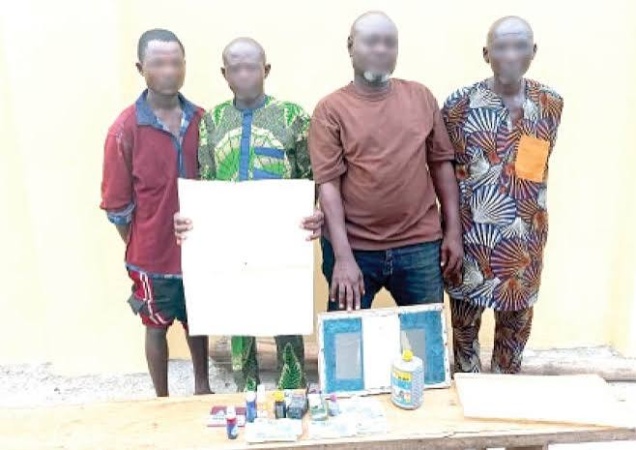
The apprehended suspects
A 50-year-old suspected herbalist, Tijani, from Owotoro in Atisbo Local Government Area of Oyo State hasconfessed to operating a fake money ritual scam for about seven years, using counterfeit currency, herbal soap and traditional rituals to defraud unsuspecting clients.
The suspect, along with three others – Dapo, accused of supplying them; Saheed; and motorcycle rider, Karim – were allegedly linked to the possession, circulation and production of counterfeit Euro currency following the interception of three men on a motorcycle Labo–Wesley area of Ibadan, and recovery of 89 suspected fake €100 notes valued at €8,900 on September 1.
The Police Public Relations Officer, DSP Olayinka Ayanlade, who confirmed the arrest, said that during investigation, Tijani led detectives to Dapo from whom the counterfeit currency was allegedly obtained.
The PPRO said that the suspects would be prosecuted after the conclusion of investigations.
In an interview with Sunday Tribune, Tijani, who was resident at Idi Ose, Moniya, Ibadan, before his arrest, disclosedthat he combined herbal medicine practice with what he described as “Guy man,” which he admitted as a fraudulent activity.
According to the suspect, he was introduced to the fraudulent practice by a friend, an Ekiti State indigene, who is now late. Tijani disclosed that he met with the deceased friend around the Bodija area of Ibadan at a drink joint, and after he introduced the business to him, they later travelled to the South Eastern part of the nation to get customers to sell herbal medicines to and also defraud.
The suspect explained that the fraud began when customers who bought herbal preparations started asking them for solutions to financial problems. He said: “When we went out to sell herbal medicines and customers tested them, some would ask for help regarding money rituals (Aájò Owó). We told them we could do it,” he stated, adding: “Igbo people like quick money; once you convince them, they believe you.”
He disclosed that although his main occupation was herbal medicine practice, he became involved in the fake money ritual business because of his knowledge of traditional practices inherited from his father, who was also a herbalist.
“Since my father was a herbalist, I knew the traditional practices. So when they asked, we would prepare something for them,” he said. He stated further that he and his friend had different temporary offices in Umuahia, Abia State, where they used to receive clients. The suspect added that whenever their antics failed, they would move from the office where the transaction between them and the client took place to hide in another part of the state until the matter would die.
How the alleged scam worked
The suspect gave a detailed account of how he and his associates allegedly convinced victims that money could be produced through rituals.
According to him, the clients who bought herbal medicine and further sought for fortune-making charms always fell victims. “We would list items for sacrifice which they would bring. These would include goat or ram and specific herbs,” he said. The suspect also listed some of the ingredients he claimed were used in preparing the soap, which included cattle egret (Eye Lekeleke), swift bird (Eye Ofefe), as well as leaves such as fortune leaves (Ewe Aje) and compassion leaves (Ewe Anu).
“Initially, we would collect a smaller fee, around N7,000 to N9,000 or N11,000, to prepare the soap. The amount they would be charged later was always between N50,000 and N120,000. For a client, we would give a specially prepared soap in a calabash, with the fake currency hidden beneath the soap before the victim would take the container away. We would instruct them not to open it for three days while performing the ritual prayers,” he said.
After the three-day deception, the suspect said the victim would later return with the container, believing that the money had been produced through the ritual.
He explained: “We would remove the soap covering the money to reveal its strange appearance in the calabash, with the fake currency shown to the victim as proof that the ritual was working. We would tell the victim to be patient for another nine,11 or 21 days while using the soap to bathe.”
Escape plan
The suspect further disclosed that the operation was structured in a way that allowed them to leave an area before victims realised they had been deceived.
He said they sometimes operated from two or three different locations, making it difficult for victims to trace them after payments had been made.
“If they complained that nothing was happening, they might try to reach us, but we might no longer be available at that location or office. We used to operate across two or three different offices because there are many people in those areas, making it easy to relocate,” he said.
However, he strongly denied ever using human body parts in his activities.
“No, God forbid! I have never used human parts in my life. Mine was strictly fake money deception,” he said.
On the source of the counterfeit currencies allegedly used to convince victims, the suspect said his late associate had originally supplied them. He explained that after the death of the friend about five years ago, he stopped receiving regular supplies of the fake notes.
He further disclosed that he had recently contacted one of the suspects, Dapo, to get him fake currencies. The suspect also admitted that he was preparing to return to the area where the alleged operation was being conducted before his arrest.
In his confession, the second suspect, Dapo, aged 67, admitted to helping obtain and package suspected counterfeit foreign currency for Tijani, saying he became involved after his previous businesses collapsed.
Dapo said he had previously supplied stationery and secretarial materials but later resorted to helping people secure bail in court when he had no money. “I was caught because of the money I packed for Tijani,” he said.
He confessed that he obtained the fake currency from Lagos through a man identified as Umoru, whom he was introduced to through a deceased associate, Idi. Oni explained that he first became aware of the fake notes when he saw them with the late Idi, adding that he was told the notes could be mixed with genuine dollars and sold to unsuspecting currency dealers.
According to him, Tijani later asked him to help obtain the suspected fake currency, and he collected N5,000 for the transaction, out of which he received N2,000 from Umoru as commission.
Dapo denied printing counterfeit money or possessing chemicals for producing fake currency. “I don’t print money, I’m not a printer, I don’t know anything about printing,” he said, adding that the materials recovered from his house were merely paper and a substance he described as a tile-setting material mixed with cement.
Confronted over his decision, at his age, to support the illegal activity for N2,000, Oni expressed remorse, saying: “I regret the whole thing.”
Another suspect, Saheed, aged 52, also denied knowledge about what his friend was engaged in. According to him, he was arrested alongside his friend after going to meet him at Beere area of Ibadan. He explained that his friend had called him to say he was in the area, prompting him to leave Oja’ba Market, where he had gone to attend to someone. He said when Tijani later returned, he called him and asked him to meet him at Beere, where they eventually met at a gas station.
According to him, he later joined his friend and an Okada rider, but they were stopped by policemen at Wesley area. He said the officers searched him and recovered an ATM card and a key, while he was also questioned about money allegedly found with Tijani during the operation. Saheed said the police subsequently took them to Testing Ground, where they were accused of operating together. He insisted that although the arrested man was his friend, he had no knowledge of what the man allegedly had in his possession.
He said: “He is my friend, and I can’t deny him. But I didn’t know that kind of thing was with him.” Saheed further swore that he had no involvement in the alleged offence, saying: “Between me and Almighty God, I had no hand in it.”
Saheed said he only knew him as a herbalist.
The 25-year-old motorcyclist, Karim, who was also arrested with Tijani and others said that he only picked the herbalist as a passenger and took him to the Beere area of Ibadan. Karim disclosed that he knew Tijani from Idi Ose, where the latter usually visited his aunt’s bar. According to him, after he arrived at Beere, Tijani asked him to wait while he attended to something. He said that Tijani returned shortly afterwards and they continued their journey on the motorcycle. Karim maintained that he had no knowledge of any illegal item in Adebayo’s possession until the discovery of the fake currencies by the police when they were stopped at a short distance from Beere. He said that he merely conveyed Tijani as a passenger and had no involvement in the alleged possession of counterfeit currency.
The PPRO said that the suspects would be prosecuted after the conclusion of investigation. (Sunday Tribune)




