ADAD
ADAD
Updating your news feed...
NEWS EXPRESS is Nigeria’s leading online newspaper. Published by Africa’s international award-winning journalist, Mr. Isaac Umunna, NEWS EXPRESS is Nigeria’s first truly professional online daily newspaper. It is published from Lagos, Nigeria’s economic and media hub, and has a provision for occasional special print editions. Thanks to our vast network of sources and dedicated team of professional journalists and contributors spread across Nigeria and overseas, NEWS EXPRESS has become synonymous with newsbreaks and exclusive stories from around the world.






.webp)
















Loading banners
Loading banners...

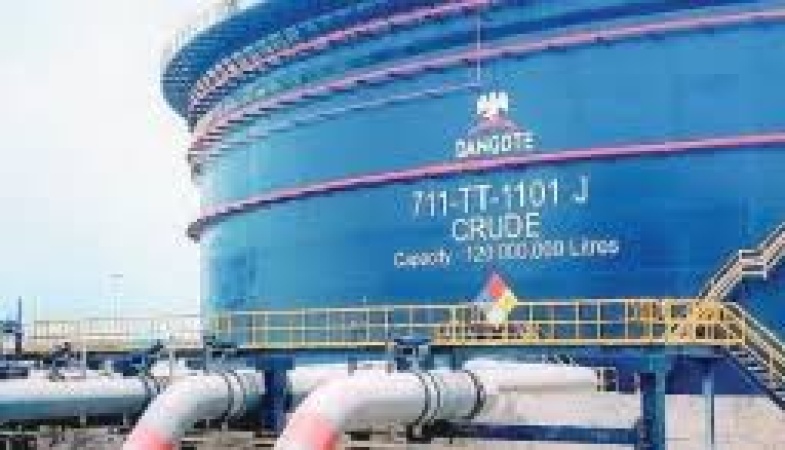
Dangote Refinery
The lingering battle between the Dangote Petroleum Refinery and petroleum marketers over the importation and pricing of Premium Motor Spirit (PMS), popularly known as petrol, has taken a fresh turn, with the refinery considering restrictions on supplies to major marketers that continue to import the product.
The proposed measure, which could take effect as early as this week, subject to further consultations and any last-minute intervention, is coming amid rising concerns over petrol prices and the quality of products being sold in the Nigerian market even as a litre of fuel inches close to N1,400.
Sources close to the refinery told Daily Trust that the immediate concern was the alleged blending of imported PMS with products purchased from the Dangote refinery by some major marketers before distribution to consumers.
While the refinery maintains that continued importation of petrol undermines domestic refining and creates unnecessary pressure on local producers, marketers insist that imports remain necessary to guarantee adequate supply, promote competition and prevent any single supplier from dominating the market.
The latest disagreement has also raised fresh questions about the ability of regulators to independently monitor the quality and specifications of imported petroleum products entering Nigeria.
Dangote raises quality concerns
According to sources familiar with the refinery’s position, Dangote is particularly concerned that some marketers could be mixing imported PMS with products supplied by the refinery before selling the resulting products to the public.
The alleged practice, the sources said, could make it difficult for consumers and other stakeholders to determine the actual source and quality of the petrol being sold.
A source familiar with the refinery’s position said the company was concerned about investing heavily in the production of high-quality petroleum products only for such products to be mixed with imported products whose quality could not be independently verified.
“It is difficult to understand why we would invest heavily in producing high-quality petroleum products for Nigerians, only for those products to be mixed with imported products of uncertain quality and the resulting product to be associated with the refinery,” the source said.
The refinery has also raised concerns about the availability of adequate laboratory and quality-control infrastructure for independently testing imported petroleum products.
The refinery said it is particularly concerned about the ability of the regulator to independently verify and certify the specifications of petroleum products entering the Nigerian market.
The concerns have emerged at a time when Nigeria’s dependence on imported petroleum products has become a major point of debate following the commencement of operations at the Dangote refinery with a capacity of 700,000 barrels per day, making it the dominant fuel supplier in-country.
The refinery has maintained that its products meet internationally recognised specifications and has progressively increased its participation in both domestic supply and exports.
Imports remain a contentious issue
A recent report by the Nigerian Midstream and Downstream Petroleum Regulatory Authority (NMDPRA) showed that petroleum product imports remained significant even as domestic refining and exports increased.
The development has generated a sharp debate over whether Nigeria should continue allowing substantial volumes of imported petrol into the country or prioritise locally refined products.
The Dangote refinery has consistently advocated a stronger domestic refining framework, arguing that Nigeria should reduce its dependence on imported petroleum products and conserve foreign exchange by processing crude locally.
Marketers on the other hand however argued that imports provide an important competitive alternative and help prevent supply shortages, particularly when domestic refineries experience operational disruptions or cannot immediately meet market demand.
The disagreement has become more intense as petrol prices fluctuate across the country.
Prices rise across cities
The latest dispute is taking place against the backdrop of fresh increases in petrol pump prices in parts of the country.
Reports from Abuja, Kano and Lagos indicated that petrol prices have hit over N1,300 per litre as motorists and Nigerians continue to groan over the impact on inter and intra-state movement.
In Lagos, a litre of fuel is now sold for N1,300 and N1,350 with prices inching close to N1,400 per litre.
Checks by Daily Trust yesterday showed that petrol prices at different filling stations had risen from about N1,280 to between N1,310 and N1,320 per litre. MRS sold at N1,310, Sunbeth at N1,319, Mobil and Conoil at N1,320, while Heyden sold at N1,310 per litre.
The rising cost of crude oil has also added pressure to the fuel market. Brent crude rose above $90 per barrel on Monday from $88.57, following renewed tensions in the US-Iran conflict.
Commercial drivers who spoke with Daily Trust said the rising fuel cost was seriously affecting their income. Many said they had reduced the number of trips they make daily because of the high cost of fuel.
Kunle Fadipe, who operates between Ikeja and Costain, said he spent N70,000 on fuel at N1,320 per litre and could only make three trips. He said commuters were also complaining about higher transport costs.
Similarly, Imole Oyefunso, who operates between Mile 12 and Ojuelegba, said he now spends N32,000 on fuel for five trips, compared with N12,000 previously.
He said drivers had not increased transport fares because patronage was already low.
Another driver, Sunday Chidioke, who buys fuel at N1,310 per litre at Heyden, said the high cost had significantly reduced his profit.
The drivers said that after buying fuel, little money remained from their daily earnings, making it increasingly difficult to sustain their businesses.
In Kano, major stations adjusted petrol prices from N1,285 to N1,310 per litre, while NNPC retail outlets reportedly increased their price from N1,285 to N1,305 per litre. Similarly, AA Rano increased pump price N1,355 while Aliko station also raised price to N1,350.
“This happened just hours a go because I bought it at N1,280 in the morning,” said a motorist in Kano.
In Abuja, petrol is now being sold at about N1,350 per litre at some outlets.
Marketers reject Dangote’s allegation
However, a major petroleum marketer who spoke with Daily Trust in confidence dismissed the allegation that marketers were blending substandard imported PMS with products purchased from the Dangote refinery.
The marketer described the proposed restriction as essentially an attempt to prevent marketers from importing petrol and give the Dangote refinery greater control over the domestic market.
“He’s just trying to block importation, that’s all. He’s just trying to block importation,” the marketer said.
According to the marketer, the underlying issue is not necessarily product quality but competition, supply and pricing.
The marketer argued that petrol demand is sensitive to price, explaining that consumers naturally reduce their consumption when prices rise.
“The higher the price, the lower the demand. The lower the demand, yes,” the marketer said.
The marketer further alleged that the refinery’s objective was to limit alternative sources of supply so that it could sell petrol at a higher price.
“All he wants is to stop supply through imports so he can sell at a higher price, and he’s the only person selling. That’s monopoly,” the marketer said.
The allegation reflects the deepening disagreement between the two sides over what constitutes a competitive and sustainable downstream petroleum market.
The marketer also rejected the argument that imported petrol was no longer necessary because the Dangote refinery could supply the entire Nigerian market.
According to the marketer, recent operational challenges experienced by the refinery demonstrated the importance of maintaining alternative sources of supply.
The marketer pointed to an alleged disruption in the refinery’s operations in July, arguing that imported petrol helped prevent a major supply crisis during the period.
Another marketer also said the latest decision by the refinery is not new, adding that Dangote had stopped coastal loading to marketers three weeks ago.
The marketer disclosed that the refinery’s gantry price was adjusted three separate times within days, between August 21 and August 29, 2026, for a cumulative increase of N100 per litre (roughly 8.6%), even as international crude benchmarks moved in the opposite direction.
Implication of Dangote, Marketers’ Spat – Expert
Wumi Iledare, Professor Emeritus of Petroleum Economics in a chat with Daily Trust called for independent investigation of the allegation from Dangote.
According to him, the allegations that marketers are blending imported PMS with Dangote-supplied product and the inability of the regulator ‘to independently verify imported-product quality’ “remain allegations and should be independently established, not assumed as fact.”
He said, “However, this latest spat between Dangote Refinery and major petroleum marketers is much bigger than a disagreement over who imports petrol and who supplies it. From a petroleum-economics perspective, it exposes a fundamental governance challenge in Nigeria’s transition from an import-dependent downstream sector to a competitive domestic refining market.
“Nigeria does not need a regulator that chooses the winner; it needs a regulator capable of ensuring that the best-performing market participant wins. The NMDPRA must be the soccer referee of the downstream petroleum market—independent enough to resist market capture, competent enough to enforce the rules, and equipped enough to see the game clearly.
“The ultimate test is public value: regulation should produce a net welfare gain through quality assurance, competitive prices, reliable supply, energy security and investment. Where regulatory incapacity allows poor-quality products, unfair competition or market distortions to persist, government failure becomes market failure—and the ultimate welfare loss is borne by the Nigerian consumer.”
NMDPRA speaks
Speaking with Daily Trust, the Head, Public Affairs of the Nigerian Midstream and Downstream Petroleum Regulatory Authority (NMDPRA), George Ene-Ita, said the regulator has the sole responsibility to determine quality parameters for products supplied, whether locally refined or imported.
On the other hand, he said Dangote refinery as a business concern reserves the right to determine with whom they do business under the willing buyer, willing seller framework. (Daily Trust)