ADAD
ADAD
Updating your news feed...
NEWS EXPRESS is Nigeria’s leading online newspaper. Published by Africa’s international award-winning journalist, Mr. Isaac Umunna, NEWS EXPRESS is Nigeria’s first truly professional online daily newspaper. It is published from Lagos, Nigeria’s economic and media hub, and has a provision for occasional special print editions. Thanks to our vast network of sources and dedicated team of professional journalists and contributors spread across Nigeria and overseas, NEWS EXPRESS has become synonymous with newsbreaks and exclusive stories from around the world.
















Loading banners
Loading banners...

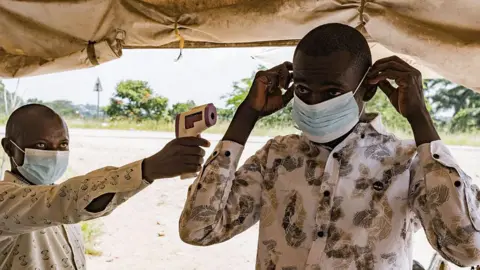
The World Health Organization (WHO) says there have now been 600 suspected cases of Ebola and 139 suspected deaths, with numbers expected to rise further given the time taken to detect the virus.
Fifty-one cases have now been confirmed in the Democratic Republic of Congo - where the first case was reported - and two in neighbouring Uganda, WHO chief Dr Tedros Adhanom Ghebreyesus said on Wednesday.
Speaking to journalists in Geneva, he said the outbreak of the Bundibugyo species of Ebola was likely to have started "a couple of months ago".
On Sunday, the WHO declared a public health emergency of international concern, but said it was not at pandemic level.
Ghebreyesus said that after meeting on Tuesday, the health organisation's emergency committee agreed the situation was "not a pandemic emergency".
"WHO assesses the risk of the epidemic as high at the national and regional levels and low at the global level," he explained.
The 51 cases confirmed in DR Congo are in its eastern Ituri province - the epicentre of the outbreak - and the North Kivu province. Of the two confirmed in Uganda's capital, Kampala, both had travelled from DR Congo, one of whom has died.
"We know the scale of the epidemic in DRC is much larger," the WHO chief said, adding that healthcare workers were among those who had died, which was a particular concern.
A WHO official said investigations were under way to find out how long the virus had been spreading for, but that their priority was to curb transmission.
The first known case was a nurse who developed symptoms and died on 24 April, in Ituri's provincial capital Bunia.
The body was repatriated to Mongwalu, one of two gold-mining towns where the majority of cases have been reported.
Four areas in Ituri have been affected by the outbreak: Mongwalu, Bunia, Rwampara and Nyakunde.
In North Kivu, rebel-controlled Goma, eastern DR Congo's biggest city and Butembo have reported cases.
DR Congo is facing its 17th outbreak of Ebola, but the Bundibugyo species - which has not been seen for more than a decade - brings its own difficulties.
Bundibugyo has only caused two previous outbreaks, when it killed about a third of those infected.
There is no approved vaccine for Bundibugyo, but experimental ones are in development. It is possible that a vaccine for another species, Zaire - which the country has dealt with on numerous occasions - may offer some protection.
There are also no drugs that target Bundibugyo, making it harder to treat.
Following criticism from the US on Tuesday that the WHO was "a little late" in identifying the outbreak, Ghebreyesus said these comments might have been caused by a lack of understanding.
"We should appreciate what was done so fast in a highly complex setting," the WHO said.
Initial symptoms of Ebola mirror illnesses such as malaria and typhoid, which are common in DR Congo.
Eastern DR Congo is also badly hit by years of conflict, bringing additional difficulties in dealing with the virus. (BBC)