 ADAD
ADAD
Updating your news feed...
NEWS EXPRESS is Nigeria’s leading online newspaper. Published by Africa’s international award-winning journalist, Mr. Isaac Umunna, NEWS EXPRESS is Nigeria’s first truly professional online daily newspaper. It is published from Lagos, Nigeria’s economic and media hub, and has a provision for occasional special print editions. Thanks to our vast network of sources and dedicated team of professional journalists and contributors spread across Nigeria and overseas, NEWS EXPRESS has become synonymous with newsbreaks and exclusive stories from around the world.








Loading banners
Loading banners...

Armed terrorists
Fresh concerns over Nigeria’s worsening security crisis have emerged following coordinated ransom demands totalling N6bn by terrorists holding hundreds of abducted victims in Borno and Kaduna states.
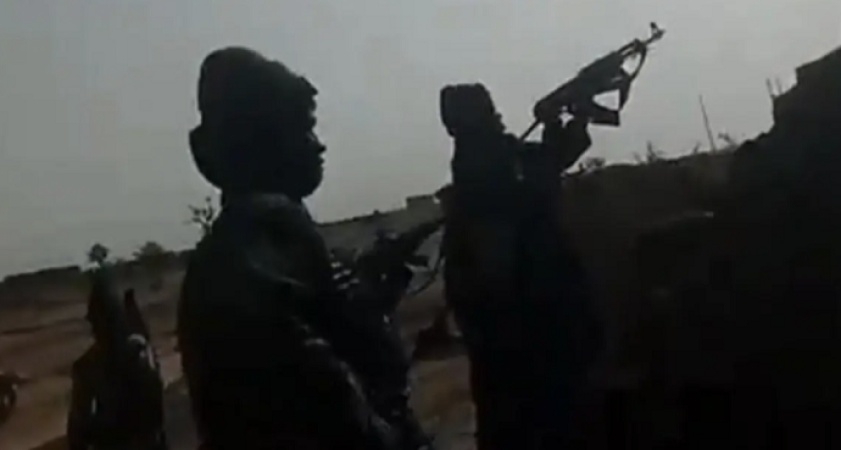
In Borno State, Boko Haram insurgents are demanding N5bn for the release of 416 women and children abducted from Ngoshe community in Gwoza Local Government Area, issuing a 72-hour ultimatum through mediators.
In a separate incident in Kaduna State, suspected terrorists who attacked Ariko community in Kachia Local Government Area on Easter Sunday demanded N1bn for the release of several kidnapped residents, including vulnerable individuals.
The twin incidents, which have left communities traumatised and families in distress, underscore the growing scale and audacity of mass abductions across the country, raising urgent questions about response strategies and the capacity of security agencies to contain the threat.
On Monday, Boko Haram terrorists demanded N5bn to free the 416 victims, including women and children abducted from Ngoshe.
In the video released by the terrorists, they dared the Nigerian government to apply force in the rescue of 416 victims.
The group warned that their demands must be met within 72 hours.
Our correspondent, who obtained the video in the early hours of Monday, reported that the group “welcomes” the Nigerian government to attempt a forceful rescue of the victims.
The terrorist group, dressed in military camouflage uniforms, said they were battle-ready in case the government considered applying force rather than meeting their demands.
The message delivered in Hausa Language and translated in English text on the screen reads “We are Jama’atu Ahlis-Sunna Lidwatu Wal-Jihad under Imam Abu.
“Today, being 19th April 2026. We are giving out a new message to the Borno South Youths Alliance and also to the Nigerian government, who are not our government.
“This is our first and last message. We give you 72 hours. If you do not meet our demands. We will share these victims, including women and children, to different locations. Yes, all of them.
“You have made yours, we have made ours. We are instructing you with the fear of Allah to not add a minute.”
However, the group did not mention their demands in the video.
And take a look at them before we do so, because you will never see them again till the world ends. And if the government thinks you can save them by using force, you are welcome to try. We depend on Allah,” the spokesperson for the group added.
Recall that on April 10, The PUNCH reported that a faction of the Boko Haram group, identified as Jama’atu Ahlis-Sunna Lidda’Awati Wal-Jihad, released a video showing the condition of victims abducted during an attack on the community, which claimed several lives and displaced many others.
In the video obtained by our correspondent at the time, the group displayed and interviewed the victims, comprising mostly women and children, with a few men.
A member of the group, who spoke on their behalf in the six-minute, 43-second clip, said the video was made following a request by a group known as the Borno South Youths Alliance, which it confirmed has been acting as a mediator since the victims were held in captivity.
However, in a statement late Sunday night, the Borno South Youths Alliance said the terrorist group stated its demands, which must be met within 72 hours to free the victims.
According to the President of the association, Samaila Kaigama, the demand was made through a video, which he said the terrorists described as a “final warning”
The statement read, “Borno South Youth Alliance wishes to inform the public and the international community that on 19th April 2026, Boko Haram reportedly issued a 72-hour ultimatum concerning ongoing mediation efforts for the release of the 416 Ngoshe women and children said to be in their captivity.
“According to information received during the mediation process led by BOSYA President, Samaila Ibrahim Kaigama, a final warning video was sent after demands were communicated, including a ransom request of N5bn for the release of the abducted women and children.”
It further noted that instructions regarding the release process were communicated.
“In view of the urgency of this humanitarian matter, BOSYA renews its appeal to President Bola Ahmed Tinubu, Vice President Kashim Shettima, Governor Babagana Umara Zulum, Concerned Nigerians and philanthropists, including Aliko Dangote, Abdul Samad Rabi’u and other well-meaning Northern billionaires,” Samaila said.
He added, “We respectfully call on all capable stakeholders to urgently intervene and use every lawful and available means to help secure the freedom of these 416 women and children.”
Recall that the terrorist group, on March 4, stormed a military base in Ngoshe where they burnt down operational vehicles, dispersed security forces, and killed an unknown number of victims before abducting several others.
The lawmaker representing Borno South Senatorial District, Senator Ali Ndume, called on the Federal Government to do everything within its powers to secure the release of the 416 Nigerians.
Speaking exclusively with our correspondent in Abuja on Monday, the federal lawmaker said the government at both the state and federal levels must resist the temptation to enter into any form of negotiation with the terrorists.
“I am not in favour of negotiating with terrorists for the release of captives. My position is very clear on that. The government should do everything possible to get the captives released,” he said.
Ndume added that some level of engagement was ongoing, adding that the government had responded by way of providing relief materials to displaced victims.
“The government, I’m sure, is doing something because we are talking at some level, helping them and getting in touch.
“The government has responded to the press conference, saying that those who are in the IDP camps need immediate humanitarian assistance.
“The National Emergency Management Agency has responded and is working with other agencies to make sure that at least relief material is sent to them.
“But as for their release, we have called the attention of the Federal Government, and it is already in the public domain that 416 of the women, children and elderly are in captivity.
“The government should do whatever it can to secure their release,” he added.
On whether the United States of America-deployed troops have succeeded in reducing the terrorism threat in the country, the lawmaker remarked, “We are all in Nigeria. If the impact is being felt, you will know. If it is not being felt, you will know.
“All I can say about this is that, honestly, we are in a very dire situation that calls for more serious attention. The declaration of a state of emergency on security has to be enforced and seen to be enforced. That is the issue.
“I have suggested that they should have a situation room. Till now, more of these threats are coming up here and there. We need to stand up to it, forget about every other thing, and stand up to the issue of security and welfare of citizens.”
In Kaduna, residents of the Ariko community raised the alarm over the abduction of several villagers by suspected terrorists, who reportedly demanded a ransom of N1bn for their release.
The PUNCH reports that the attack, which occurred on Easter Sunday, left some residents dead and many others kidnapped, throwing the community into mourning and fear.
In a statement issued on Monday by the Concerned Ariko Youths, the group described the incident as a tragic assault on innocent worshippers during a solemn period of reflection.
The statement, signed by the Chairman, Linus Audu, and Secretary, Kefas Likita, said the victims included vulnerable members of the community, such as two elderly blind men, women, children, and entire families.
“Among those abducted are two elderly blind men, two women whose husbands were killed during the attack alongside their children, several young children, two critically ill women, and entire families,” the statement read.
The youths noted that the incident had created a humanitarian crisis in the community, with families left traumatised and uncertain about the fate of their loved ones.
They further disclosed that the kidnappers had placed a ransom of N1bn on the victims, describing the demand as outrageous and impossible for the rural community to meet.
“It is neither reasonable nor humane to expect affected families, already devastated by loss and trauma, to raise such an amount,” the group said.
The latest incident is part of a troubling pattern of insecurity in Southern Kaduna, where rural communities have repeatedly come under attack by armed groups engaging in kidnapping and killings.
The group called on the Kachia Local Government authorities to urgently collaborate with security agencies and provide immediate support to affected families.
They also appealed to the Kaduna State Government to deploy adequate security measures to ensure the safe rescue of the victims, and urged the Federal Government to intensify efforts in tackling banditry across the country.
“We urge swift, transparent, and effective action to rescue the abducted victims unconditionally and bring the perpetrators to justice.
“Continued delay will only deepen the suffering of affected families and erode public confidence,” the statement added.
As of the time of filing this report, security agencies had yet to issue an official response to the incident.
Meanwhile, a retired officer of the Nigerian Army Intelligence Corps, Chris Andrew, argued that the perpetrators are unlikely to carry out mass killings on a large scale.
“The reason why they did that video—you can call it a propaganda video—but they will not be that dumb to slaughter people or kill those people,” he said.
Andrew noted that while such groups are capable of violence, large-scale killings would undermine their objectives.
“They can kill one, two, three—yes, it’s not anything to them—but they cannot be stupid to try to kill a hundred plus,” he added.
According to him, the primary motivation of the groups remained financial gain through ransom rather than indiscriminate violence.
Describing the situation as part of an asymmetric conflict, Andrew said ransom proceeds were often not reinvested into sustained operations.
“That fund is not to regroup or recoup. That fund is for them to share and go. It’s not everything you will fight with,” he said.
On the issue of response, he acknowledged the complexity of hostage situations and the likelihood of negotiations.
“There will be negotiations. There’s no how, because it concerns life,” he said, noting that such engagements were often handled through intermediaries.
Security experts and civil society leaders, however, expressed differing views on how government should respond to rising cases of mass abductions and ransom-related demands in parts of the country, warning that the situation presents difficult operational and moral choices for authorities.
A security expert, Chidi Omeje, said the situation showed that authorities were trapped between dangerous alternatives.
Omeje explained that ignoring the kidnappers’ threats could be catastrophic, while paying ransom also carried long-term consequences.
“If you ignore their threats, these are brutal terrorists who have no compassion and can carry out their threats.
“But if you decide to pay them, you are funding their terrorist activities. Either way, there is a problem,” Omeje noted.
He called for stronger intelligence support and the use of advanced technology, suggesting that international partnerships could be crucial in locating abductors.
“This is when we need assistance the most. There are technologies, including drones and intelligence systems, that can help track them wherever they are.
“If we still have military capability and partnerships, then this is the time to bring them to bear and rescue the victims,” he added.
Another security analyst, Jackson Ojo, referenced past incidents in Kebbi and Niger states, where authorities reportedly secured the release of abducted victims without paying ransom.
“The government has done it before, according to them, in Kebbi State and also in Niger State. They said they did not pay ransom, and yet the children were released. So I think the government should continue with that approach,” he said.
Ojo, however, suggested a controversial alternative involving monitored ransom delivery as a tactical trap.
“In a normal situation, if you are sending money, you do not just put it in a small package. You can send it in a way that it can be tracked. The movement of the money can be monitored, so it leads to their location,” he said.
He warned, however, that ransom payments could strengthen criminal networks.
“If you give them the money, you are indirectly empowering them to do more. That is very dangerous,” Ojo added.
Also, Amnesty International, reacting through its Country Director, Sanusi Isa, urged the government to do its best to safely and securely rescue those abducted and reunite them with their families.
“We found that while in the custody of Boko Haram, they face starvation, sexual abuse and other atrocities.
“Therefore, rescuing them must be a priority for the government now.
“Also, this should be followed with efforts to end the atrocities by Boko Haram and other armed groups,” Isa stated in a reply to The PUNCH.
The Executive Director of Civil Society Legislative Advocacy Centre, Auwal Musa, raised concerns about alleged ransom payments in the past and the broader governance and oversight challenges surrounding security funding.
“In the past, directly or indirectly, the government has been paying this money, and it has become another source of corruption for some officials.
“At the expense of human lives, money is shared between officials and criminals,” he said.
Musa warned that repeated abductions signalled a deepening crisis in national security.
“If you have over 400 people abducted in less than two weeks and you are unable to prevent or rescue them, it means the kidnapping industry has gone beyond control,” he said.
He also criticised what he described as weak legislative oversight and poor accountability in security spending.
“The National Assembly must take responsibility. They pass the budget and are supposed to oversee implementation. If agencies say they do not have funds, then something is wrong in the system,” he said.
Musa further argued that insecurity disproportionately affects ordinary citizens, alleging that political priorities weaken the urgency of response.
“If those affected were influential people, the response would be different. But because it is ordinary citizens, attention is limited. This shows there is little political will to fully address the problem,” he added.
In another development, the Nigerian Institute of Public Relations has said the level of insecurity in Kaduna State has been exaggerated, even as it commended the state government’s efforts at tackling security challenges.
The Chairman of the planning committee for the 2026 Nigeria Public Relations Week, Chief Yomi Badejo-Okusanya, stated this on Monday during a media tour of key government projects in the state.
Okusanya, who led officials of the institute and journalists on the inspection, particularly praised the establishment of the command and control centre, describing it as a critical intelligence-gathering hub.
Speaking after inspecting facilities at the centre, he acknowledged that while Kaduna, like other states, faced security challenges, the situation was not as dire as widely portrayed.
“Yes, it has some challenges like every other place, but I think two things: efforts have been made to tackle this issue, and then secondly, it’s not as bad as what people think,” he said.
He disclosed that the institute had faced pressure from some quarters to relocate its 2026 Nigeria Public Relations Week from Kaduna over security concerns.
According to him, such concerns were based on perceptions that did not accurately reflect the situation on the ground.
“There were a lot of outside pressures discouraging us from holding the event in Kaduna, arguing that the state is not safe,” he said.
Okusanya, however, advised the Kaduna State Government to improve communication on its security efforts to both residents and the wider public.
He also recommended that the command and control centre model be replicated across all the 23 local government areas of the state.
The tour also took the delegation to several public facilities, including the Badarawa Primary Healthcare Centre, Kawo General Hospital, Government Secondary School, Nasarawan Rigachikun, the Institute of Vocational Training and Skills Development, and the Kakuri Southern Terminal, which is under construction. (The PUNCH)



