Updating your news feed...
NEWS EXPRESS is Nigeria’s leading online newspaper. Published by Africa’s international award-winning journalist, Mr. Isaac Umunna, NEWS EXPRESS is Nigeria’s first truly professional online daily newspaper. It is published from Lagos, Nigeria’s economic and media hub, and has a provision for occasional special print editions. Thanks to our vast network of sources and dedicated team of professional journalists and contributors spread across Nigeria and overseas, NEWS EXPRESS has become synonymous with newsbreaks and exclusive stories from around the world.
























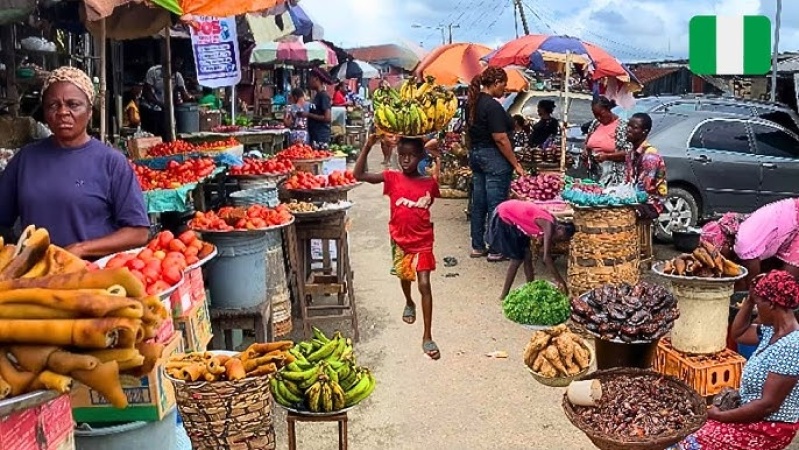
Nigerians in a market
“It was akin to a midnight coup. We didn’t see it coming. It appears the Middle East conflict is hitting Nigeria hardest. We’re choking at home. Our businesses can’t breathe. It’s crazy”.
That was how many commuters, motorists and business owners described their experience on Sunday, when they got to fuel pumps and discovered that petrol prices had been adjusted upward.
In Lagos, many filling stations sold petrol at N1,333/litre on the average. It was hitherto N1,250. It sold for about N1,550 in some parts of Abuja and the north.
It was learned that oil marketers raised their prices in response to Dangote Refinery who raised its price at the weekend. Stakeholders are already raising concerns over the volatilities in Nigeria’s downstream petroleum sector, warning of mounting economic pressure and fear of a monopolistic market structure.
Dangote Refinery in a notice sent to marketers late Friday night, disclosed that its ex-depot (gantry) price had been raised from N1,175 per litre to N1,245 per litre, while the coastal price was also adjusted upward.
The development has further strained consumers and businesses already grappling with high living costs.
Daily Sun exclusively reported last Friday that two private depots: Parker and Zamson had adjusted ex-depot (gantry) price to N1,200 per litre in response to the surging crude market, reflecting the growing pass-through effect of international oil volatility on domestic fuel costs in a deregulated environment. The report predicted that the rise in gantry price by the two depots could set the tone for the likelihood of another round of pump price increases.
The latest hike marks the fourth fuel price hike by Dangote Petroleum Refinery in March. Earlier this month, PMS was increased from around N774 to N875, then N995, N1,175, and now N1,245 per litre.
“Please be informed that due to the current global geopolitical situation, which has further escalated, the PMS gantry and coastal prices have been reviewed and updated as outlined below,” the notice read.
The notice showed that the gantry price increased by N70 per litre, while the coastal price rose from N1,512,648 per metric tonne to N1,606,518 per metric tonne.
According to the refinery, the new pricing regime takes effect from midnight on Saturday.
“Please note that the revised price will apply to all unloaded gantry and coastal volumes and is effective from 12am on the 21st of March 2026,” it stated.
Reacting to the surge, the National President of the Petroleum Products Retail Outlets Owners Association of Nigeria, Billy Gillis-Harry, warned that persistent instability in the Middle East could trigger even higher fuel prices in the coming weeks.
According to him, the situation reinforces long-standing concerns among stakeholders about the emergence of a dominant player in the market.
“If the crisis in the Middle East continues, prices will inevitably rise,” he said, stressing that the current trend validates fears of a monopoly-driven pricing environment.
Gillis-Harry noted that the implications go beyond fuel pricing, pointing to wider economic distortions as rising energy costs continue to outpace stagnant incomes.
“We are seeing a situation where energy costs are increasing, while salaries remain largely unchanged. This puts enormous pressure on households and businesses,” he said.
He explained that the challenges in the sector are deeply rooted in structural inefficiencies across the energy value chain, particularly in crude oil production and distribution systems.
“Every sector of the economy is affected. We must identify the key pressure points and address inefficiencies in the system. The crude oil value chain remains central to resolving many of these issues,” he added.
The PETROAN President further emphasised the need to shift from short-term crisis management to long-term sustainability, calling for strategic investments in infrastructure, security, and logistics.
“Strengthening transportation networks, improving operational systems, and ensuring safety across the value chain are critical steps toward achieving stability,” he said.
He also highlighted persistent operational challenges, including supply chain disruptions, seasonal constraints, and logistical bottlenecks, which continue to undermine efficiency in the downstream sector.
While acknowledging that current indicators suggest a worsening outlook, Gillis-Harry maintained that opportunities still exist to reposition the sector through deliberate reforms and a balanced approach to energy development.
“We must consider both fossil fuels and emerging energy alternatives in shaping policies that reflect our local realities,” he said. The unfolding developments have once again brought into focus the delicate balance between deregulation and oversight in Nigeria’s petroleum market.
For many stakeholders, the recent price hikes are not only a reflection of global oil dynamics but also a test of the country’s ability to prevent market distortions while ensuring energy security.
As fuel prices continue to climb amid global uncertainties, industry observers say Nigeria faces a critical moment in determining whether it can stabilise its downstream sector or slip further into volatility driven by both domestic constraints and international pressures.
Meanwhile, the Dangote refinery also last Friday reiterated that Nigeria has retained one of the lowest petrol prices globally despite recent increases driven by geopolitical tensions in the Middle East. It maintained that industry data has shown the stabilising role of Dangote Petroleum Refinery & Petrochemicals in cushioning the domestic market.
Quoting data from GlobalPetrolPrices.com, the refinery said petrol in Nigeria currently averages $0.88 (N1,191.39) per litre, significantly below the global average of $1.32 (N1,787.08) per litre, based on an exchange rate of N1,353.85 to the dollar, saying this places Nigeria among the more affordable fuel markets globally, even as international prices continue to rise.
Discover more
“Across key markets, petrol prices are notably higher, with the United States at $1.075 (N1,455.39), India at $1.095 (N1,482.47), and South Africa at $1.189 (N1,609.73) per litre. Prices rise further in advanced economies, including the United Kingdom at $1.874 (N2,537.11), France at $2.152 (N2,913.49), and Germany at $2.343 (N3,172.07), while Hong Kong records as high as $3.967 (N5,370.72) per litre.
Nigeria also compares favourably within the West African region, where petrol prices are higher in Togo at $1.192 (N1,613.79), Benin at $1.218 (N1,648.99), Ghana at $1.240 (N1,678.77) and Cameroon at $1.478 (N2,000.99) per litre,” the refinery stated.
Meanwhile, prices of food, goods and essential services have surged across markets in the Federal Capital Territory (FCT), leaving traders, consumers, and households struggling to cope, a survey by the News Agency of Nigeria (NAN) has revealed.
The rise in prices is largely linked to the recent hike in petroleum products, driven by geopolitical tensions in the Middle East. The development has sent ripple effects across the economy, inflating the cost of food, water, electricity-dependent services, and transportation.
At Orange Market along Abuja-Keffi Road, widely regarded as a bulk food hub, a basket of tomatoes that sold for N9,000–N10,000 in February now goes for between N30,000 and N35,000. A big bag of onions, previously N15,000–N25,000, is now N40,000–N45,000, while smaller baskets rose from N3,000–N3,500 to N4,000–N5,000.
Similar spikes were observed across other markets. At Lugbe Market, a dustbin basket of sweet potatoes doubled from N1,000–N1,200 to N2,000–N2,500, while five tubers of yam increased to N8,000–N10,000 from N6,000–N6,500. White beans now sell at N1,500–N1,600, up from N800–N1,300. Karu, Wuse, Utako, and Nyanya markets reported comparable increases, with prices of pepper, tatashe, and yams all climbing steeply.
The hike extends beyond food. Ice blocks, sachet water, and cold drinks have surged due to fuel-driven electricity challenges. Mr. Simon Adolo, an Imueti Table Water distributor, said: “Light issues have been a big challenge… Now, we rely more on diesel; we spend a lot of money just to produce water. The profit is very small.”
Mrs. Esther Gabriel, an ice-block dealer in Nyanya, said block prices jumped from N500 to N800 due to poor power supply. “I buy diesel and fuel for generators because we rarely get five hours of light. This is ripping me off and stifling my business,” she lamented.
Households are also feeling the pinch. Agnes Joseph, a resident of Apo Resettlement Area, noted that a bag of sachet water, previously N350–N400, now costs N450–N500. Mrs. Rosemary Akor highlighted service inflation, saying a recent haircut for her two children cost N3,000 compared to N1,400 weeks earlier. Baker Mrs. Rebecca Terve reported steep increases in baking materials, while yam seller Alhaji Jibrin Abdullahi said transport costs from Benue to Abuja had tripled.
Consumers are calling on the government to act. Ms. Ifeoma Atuegwu, a single mother of three, appealed for intervention, saying: “My standard of living is dropping daily. The government must address fuel and transport costs to stabilize markets and living conditions.”
Traders and citizens alike are urging the Federal Government to implement immediate measures to cushion the effects of fuel hikes and ensure basic goods and services remain accessible. The consensus is clear: without decisive action, the cost of living will continue to soar. (The Sun)