Updating your news feed...
NEWS EXPRESS is Nigeria’s leading online newspaper. Published by Africa’s international award-winning journalist, Mr. Isaac Umunna, NEWS EXPRESS is Nigeria’s first truly professional online daily newspaper. It is published from Lagos, Nigeria’s economic and media hub, and has a provision for occasional special print editions. Thanks to our vast network of sources and dedicated team of professional journalists and contributors spread across Nigeria and overseas, NEWS EXPRESS has become synonymous with newsbreaks and exclusive stories from around the world.
























Loading banners
Loading banners...

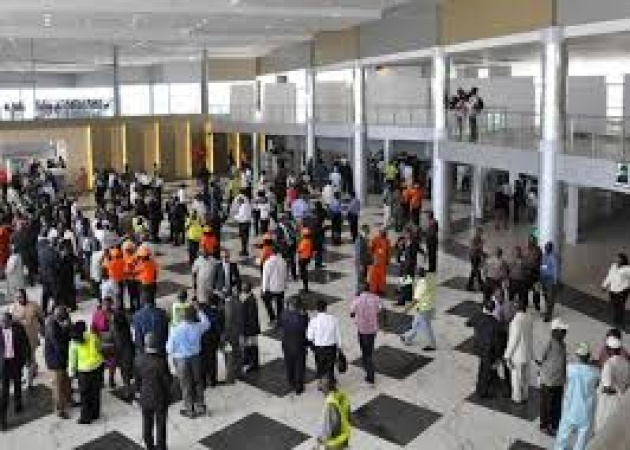
passengers at the Murtala International Airport
As tensions flare between the United States, Israel and Iran, Nigerian air passengers may soon feel the heat, with aviation fuel (Jet A-1) soaring to N2,557 per litre.
The growing crisis is forcing domestic airlines to consider hiking ticket prices to stay afloat.
Data from major Nigerian airports obtained by Daily Sun reveal that Sokoto currently has the highest aviation fuel price in the country at N2,557 per litre. It is closely followed by Kano at N2,554 per litre, while both Port Harcourt and Asaba report rates of N2,543 per litre.
Fuelling at Nnamdi Azikiwe International Airport, Abuja is at N2,538 per litre, while Enugu stands at N2,535 per litre.
Airlines buy Jet A1 in Warri airport at N2,530 per litre, Anambra airport at N2,529 per litre, Asaba airport at N2,528 per litre, while Lagos is the least at N2,500 per litre.
These prices took effect on March 20, 2026,
This comes as the Federal Competition and Consumer Protection Commission (FCCPC) warns of possible sanctions against domestic airlines over rising ticket prices. Aviation fuel, which accounts for 40 to 55 per cent of airline operating costs, has surged 100 per cent recently and forced carriers to absorb substantial losses.
An airline executive told Daily Sun that the situation is compounded by a decline in passenger traffic, leaving domestic operators grappling with both higher expenses and reduced revenue.
The time of filing this report, average domestic flight fares remained around N92,000. However, an airline executive told Daily Sun that carriers are closely monitoring the situation, warning that if aviation fuel costs continue to rise, fare hikes across operators are likely inevitable.
“We are in a very difficult situation and most Nigerian airlines are losing money. We are operating at a loss. When fuel alone is consuming more than half of what we earn from ticket sales, there is no other path forward other than adjusting fares or grounding aircraft and neither option is good for the industry or passengers.
“The situation is compounded by a drop in passenger traffic because this is the off peak period. You carry passengers from Lagos to Abuja and the number of passengers can’t even fuel the aircraft. We are all struggling to stay afloat,” he said.
Foreign carriers have not been immune to the pressure of the war either. Several international airlines have quietly reduced their capacity on major routes or deploying smaller aircraft.
Carriers such as Air France-KLM said they were considering options that could include cancelling routes in some parts of the world with less stable fuel reserves.
While Europe currently has enough stocks to supply airlines in the next month or so, other countries are more dependent on Gulf flows and could see shortages sooner.
Ben Smith, the chief executive of Air France-KLM, said that while there was currently no concern about fuelling planes for the 12-hour trip to south-east Asia, there was a risk that return flights could be compromised.
He said: “We’re putting in plans today to draw up scenarios on how we would deal with the shortage of fuel.
“South-east Asia is much more dependent on fuel coming over the Gulf than Europe is. If there’s no fuel, you can’t fly.” (The Sun)