Updating your news feed...
NEWS EXPRESS is Nigeria’s leading online newspaper. Published by Africa’s international award-winning journalist, Mr. Isaac Umunna, NEWS EXPRESS is Nigeria’s first truly professional online daily newspaper. It is published from Lagos, Nigeria’s economic and media hub, and has a provision for occasional special print editions. Thanks to our vast network of sources and dedicated team of professional journalists and contributors spread across Nigeria and overseas, NEWS EXPRESS has become synonymous with newsbreaks and exclusive stories from around the world.













Loading banners
Loading banners...

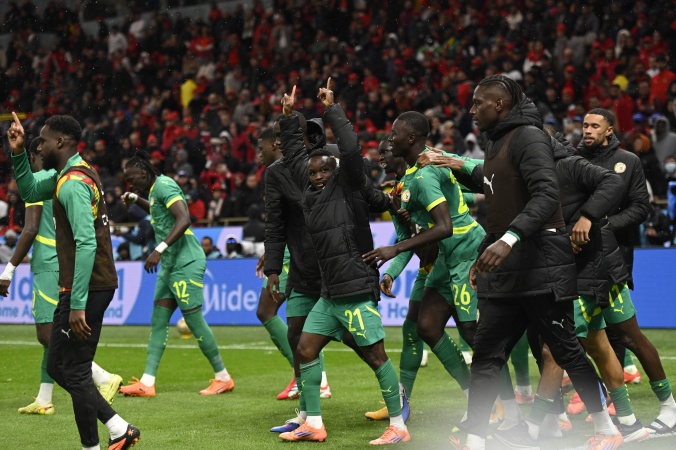
A fresh controversy appeared in African football after new reports emerged from the recent CAF Executive Committee meeting in Dar es Salaam, Tanzania, about how the 2025 AFCON final between Senegal and Morocco was handled, both on the pitch and behind the scenes.
According to Qatari media outlet Winwin, Olivier Safari Kabene, president of the CAF Referees Commission, reportedly said during internal discussions that referees were instructed not to issue cautions to Senegalese players who left the field in chaotic scenes in the disguise of protesting a penalty awarded to Morocco during the final so that the match could be completed.
“All Senegalese players who left the field should have been cautioned immediately upon their return, but we gave instructions not to do so in order to preserve the match and avoid its abandonment before the end of regulation time,” Safari is said to have told CAF officials.
If confirmed, these comments suggest that disciplinary rules were bent in the continental final, a decision that has reignited debates about how CAF handles crises.
The 2025 AFCON final, played on January 18 in Rabat, was one of the most unusual and tense in recent history. A late legitimate penalty awarded to Morocco sparked a furious reaction from Senegal: players briefly left the pitch in protest, and it took nearly 15-16 minutes before play resumed.
The match eventually went into extra time, and Senegal scored to win 1‑0. But that walk‑off and how CAF chose not to treat it as an abandonment have continued to raise questions.
CAF President Patrice Motsepe has already publicly criticized parts of what happened, saying the disciplinary sanctions imposed after the final were not strong enough. Speaking at the CAF General Assembly, he stressed that such behavior would not be tolerated in the future and promised changes to the disciplinary code and statutes to ensure tougher, clearer penalties.
“The Africa Cup of Nations in Morocco this kind of behavior… we never want to see it again. It will never happen again; we will not tolerate it. This is non‑negotiable,” Motsepe said.
His comments followed criticism that CAF’s sanctions did not go far enough to deter similar incidents down the line.
After the chaos of the final, CAF’s Disciplinary Board handed out fines and suspensions to both federations and several individuals, but not for abandoning the match itself.
For Senegal:
For Morocco:
CAF also rejected Morocco’s appeal to have the match result overturned due to the walk‑off, officially confirming Senegal as champions.
What makes the newly reported comments by the referee chief especially controversial is that they suggest CAF’s own internal decision influenced how the match officials applied the rules on the pitch. Critics argue that if the referees were told not to follow normal disciplinary procedures, it would undermine not just the final result but the credibility of CAF’s disciplinary process.
Media and fans have described the sanctions as disproportionate and unfair, pointing out that Senegal walked off the pitch and yet avoided the harshest consequences, while Morocco was heavily penalized for on‑field disruptions that did not directly determine the result.
The Executive Committee meeting reportedly revealed broader tensions within CAF. Some officials suggested that referee appointments for the tournament were not fully communicated to the Referees Committee, raising questions about transparency and internal governance.
With Motsepe pushing for disciplinary reform, CAF now faces pressure from fans, federations, and media to prove that it can both enforce its rules consistently and manage controversies without compromising fairness.(MWN)