ADAD
ADAD
Updating your news feed...
NEWS EXPRESS is Nigeria’s leading online newspaper. Published by Africa’s international award-winning journalist, Mr. Isaac Umunna, NEWS EXPRESS is Nigeria’s first truly professional online daily newspaper. It is published from Lagos, Nigeria’s economic and media hub, and has a provision for occasional special print editions. Thanks to our vast network of sources and dedicated team of professional journalists and contributors spread across Nigeria and overseas, NEWS EXPRESS has become synonymous with newsbreaks and exclusive stories from around the world.




.webp)
.webp)



Loading banners
Loading banners...

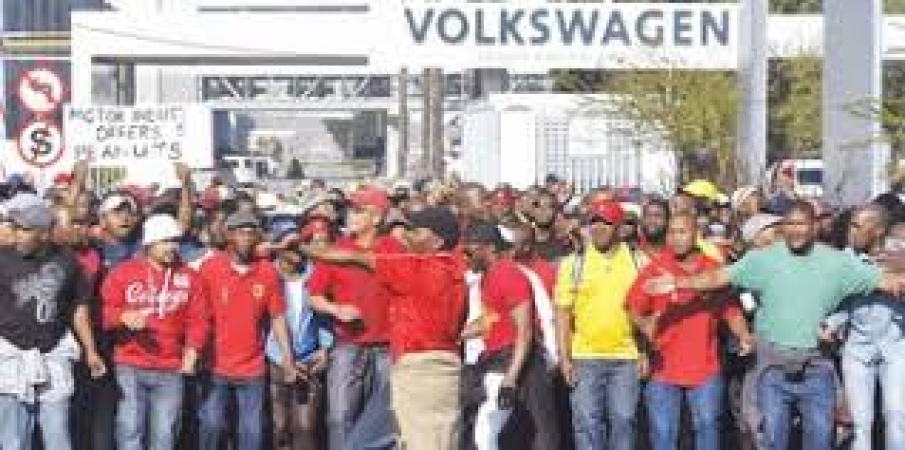
Volkswagen Group Africa (VWGA) has raised alarms over the potential closure of its Kariega plant in the Eastern Cape, threatening more than 4,000 direct jobs and tens of thousands more across South Africa’s automotive value chain.
The closure comes as South Africa’s automotive sector grapples with uncertain policy support from the government.
Volkswagen has long been a cornerstone of South Africa’s automotive manufacturing industry, but the company has warned that without urgent policy reforms, its Kariega plant could face closure.
The potential shutdown has sparked widespread concern among lawmakers and industry stakeholders, as the loss of such a critical facility would exacerbate unemployment in a country already struggling with an economic slowdown.
Since 2011, Volkswagen has invested over $538 million into the Kariega plant, demonstrating a long-term commitment to South Africa’s automotive sector.
In 2024, the company committed an additional $210 million to upgrade the facility in preparation for the production of a new SUV model slated for 2027.
Despite these investments, ongoing engagement with the Department of Trade, Industry and Competition (DTIC) has yet to produce meaningful policy reforms.
“Words without action are not leadership – they are negligence,” said Martina Biene, Chairwoman of Volkswagen Group Africa. “2026 will be a make-or-break year for Volkswagen in South Africa.”
Volkswagen’s struggles are part of a wider trend affecting South Africa’s automotive industry.
Earlier this year, Chery acquired Nissan’s Rosslyn plant in Pretoria, halting local production of the Navara pickup, which added to the uncertainty in the sector.
“While Chery promised to retain most of the Nissan workforce, the uncertainty over full workforce absorption underscores the sector’s instability,” said Jordi Vila, president of Nissan Africa.
Labour unions are calling for government intervention, with Irvin Jim, General Secretary of the National Union of Metalworkers of South Africa (Numsa), stating, “We need a decisive and coordinated state response. We are openly being raided, and there is no sense of urgency.”
Rising tariffs, cheap imports from China, and weakening consumer demand continue to compound challenges for local manufacturers.
Volkswagen has also flagged concerns over South Africa’s outdated new energy vehicle (NEV) policy, which it says limits the country’s competitiveness in the global market.
While VWGA is largely shielded from US tariffs, it faces significant domestic risks, including a shrinking local market, heavy reliance on exports, and insufficient readiness for the global transition to new energy vehicles (NEVs).
“The NEV policy is too narrowly focused on battery electric vehicles that are largely unaffordable locally,” Biene said.
She called for a broader approach that includes hybrids and transitional technologies, arguing that this is necessary to help South Africa remain competitive amid Europe’s shift to battery electric vehicles (BEVs).
The country’s automotive exports are increasingly at risk, with rising EU carbon penalties further hampering South Africa’s access to international markets.
The future of the Volkswagen Kariega plant and thousands of jobs now hinges on whether South Africa’s policymakers can implement the necessary reforms.
With the automotive sector under pressure from global competition, outdated policies, and rising imports, the country’s ability to retain foreign investment and preserve its industrial base is at stake.
“It is time to stop the proverbial presses and focus all our attention on this pending disaster,” Boshoff said.
(Business Insider)