ADAD
ADAD
Updating your news feed...
NEWS EXPRESS is Nigeria’s leading online newspaper. Published by Africa’s international award-winning journalist, Mr. Isaac Umunna, NEWS EXPRESS is Nigeria’s first truly professional online daily newspaper. It is published from Lagos, Nigeria’s economic and media hub, and has a provision for occasional special print editions. Thanks to our vast network of sources and dedicated team of professional journalists and contributors spread across Nigeria and overseas, NEWS EXPRESS has become synonymous with newsbreaks and exclusive stories from around the world.


























Loading banners
Loading banners...

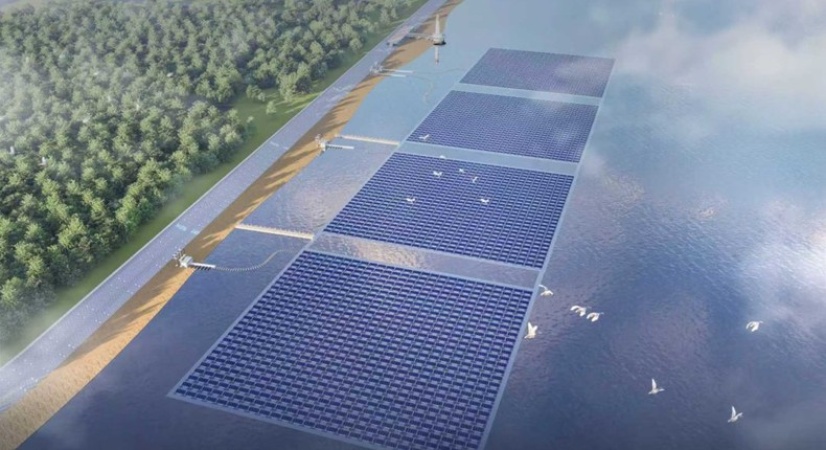
Nigeria has awarded its first-ever floating solar power project to China Civil Engineering Construction Corporation (CCECC), marking a major step in the country’s renewable energy transition.
The 7-megawatt floating solar plant, awarded by the Rural Electrification Agency (REA), will be installed on the lagoon waters surrounding the University of Lagos (UNILAG).
The project is designed to deliver clean and reliable electricity to one of Nigeria’s largest public universities, reducing dependence on diesel generators and easing pressure on the national grid.
The construction firm, CCECE while speaking on the project said "Located on the lagoon waters surrounding the UNILAG campus, this landmark project will deliver reliable, safe, stable, and clean electricity to one of Nigeria’s foremost academic institutions."
Floating solar technology allows power generation on water surfaces, preserving land while improving panel efficiency through natural cooling.
The University of Lagos (UNILAG) faces significant energy challenges, with electricity costs rising sharply after the Eko Electricity Distribution Company (EKEDC) moved the university from the “Band B” to the higher “Band A” tariff category.
Monthly grid electricity bills reportedly climbed from about ₦150 million–₦180 million to around ₦300 million, placing a heavy burden on the university’s budget.
These high charges, combined with outstanding payments, have resulted in UNILAG owing EKEDC over ₦1 billion in unpaid bills, leading to periodic disconnections and continued reliance on alternative power sources..
The floating solar plant is expected to significantly cut diesel consumption, lower costs, and improve power reliability across the campus.
Across Africa, solar power is receiving growing attention as governments grapple with unreliable grids, rising fuel costs, and the need to support industrial growth. Countries such as Morocco, Egypt, Kenya, and South Africa have ramped up solar investments as part of broader energy diversification strategies.
For many African economies, solar offers a faster and more flexible alternative to large hydropower or gas-fired plants, which often face financing delays and environmental constraints. Declining solar panel costs and modular deployment have further strengthened its appeal.
With abundant sunlight and extensive water bodies, Nigeria is well positioned to scale floating solar projects beyond UNILAG. If successful, the project could serve as a model for universities, industrial clusters, and coastal cities across the country, accelerating Africa’s shift toward cleaner and more resilient power systems. (Business Insider Africa)