
Updating your news feed...
NEWS EXPRESS is Nigeria’s leading online newspaper. Published by Africa’s international award-winning journalist, Mr. Isaac Umunna, NEWS EXPRESS is Nigeria’s first truly professional online daily newspaper. It is published from Lagos, Nigeria’s economic and media hub, and has a provision for occasional special print editions. Thanks to our vast network of sources and dedicated team of professional journalists and contributors spread across Nigeria and overseas, NEWS EXPRESS has become synonymous with newsbreaks and exclusive stories from around the world.



Loading banners
Loading banners...

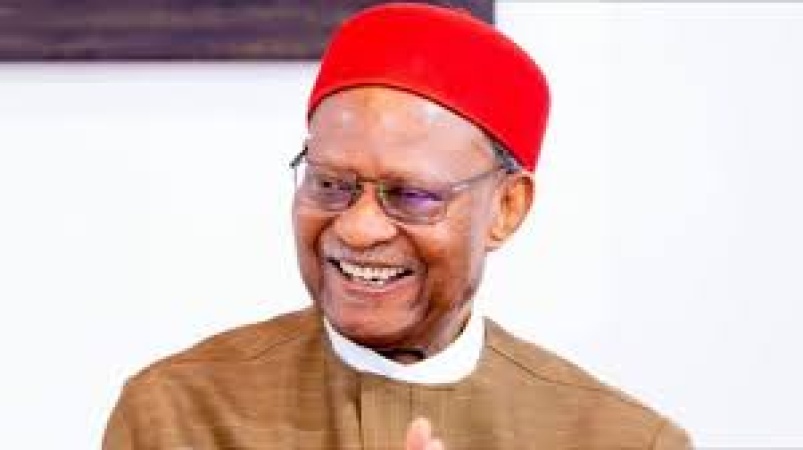
Former Commonwealth Secretary-General, Chief Emeka Anyaoku
I was wondering why his 304-page biography carries the title, ‘Eye of Fire.’ Then I saw a reviewer answering the question any reader would have in mind: In Igbo language, ‘Anya’ means ‘Eye’, ‘Oku’ means ‘Fire’. His surname, ‘Anyaoku’, therefore, means the title of that book – or the title of the book means ‘Anyaoku’.
Fingerprints of ancient philosophers suggest that anyone whose name carries a combination of ‘eye’ and ‘fire’ must be an extraordinary creation. Deep in the furnace of life, they would point at fire as a signifier of transformation, of purification, of knowledge, and of divine energy. One thinker of antiquity theorised that the ‘eye’ contained “fire within”; another said the human eye is a symbol of healing, protection, knowledge, and restoration. Former Commonwealth Secretary-General, Chief Emeka Anyaoku’s name combines these two elements.
At ninety-three today, Chief Anyaoku stands as one of Nigeria’s finest gifts to the world. I read fine words about the fine man with baritone voice: a diplomat whose life has been a quiet sermon on service, principle, and the power of dialogue over discord. Born in Obosi in 1933, schooled in the Classics at Ibadan, and trained by history to see beyond borders, Anyaoku belongs to that rare generation of Nigerians who carry the country’s moral weight into the councils of the world—and did not drop it.
Among the Yoruba, we say unless you move near someone, you can never know them and their ways. Mid-July last year, Chief Emeka Anyaoku presided over a constellation of statesmen and women in Abuja. From the North to the South, he gathered some of the best of Nigeria to interrogate the country’s present and imagine a more coherent future. I was there as a lead rapporteur. The conference, convened under the auspices of The Patriots—a conclave of elder statesmen, leaders of thought, and custodians of national conscience, had Chief Anyaoku as its archangel. He was joined by other eminent Nigerians, lending the conference both gravitas and moral authority. At the heart of the gathering was a sober ambition: to rethink and reposition constitutional democracy in Nigeria.
As the sessions unfolded, we endured long hours of argument, negotiation, and occasionally bruising debate. I watched Chief Anyaoku sit through it all with remarkable composure. At 92, he listened more than he spoke, patient where others grew restless, attentive where fatigue dulled younger minds, including mine. As the conference drew to a close and the rapporteurs drafted the communique, Chief Anyaoku went through the draft, line by line with his attentive ink, correcting this, rewriting that. He wanted a perfect document. As he read page after page and sent them back to us, I saw an old man who still thought that Nigeria could be saved. I found myself wondering why a man so advanced in years would still submit himself to the rigours of national dialogue, and worry about a future that clearly belongs to a generation that is not his.
The answer, I later realised, lies in the long arc of his life. Check his biography written by Phyllis Johnson. His publishers, Udara Books, describe the book as “the story of an influential international statesman who believes in consensus rather than confrontation, in persuasion rather than force, and in power of morality over corruption.”
Somewhere in that text (page 240) is a testament to the old man’s selfless humanity: The Nigerian civil war was raging. He thought the safety and comfort of London was not where a patriot should be ensconced. You meet a man where men ought to be. His biographer was diligent enough to record his acts of self-revelation. As peace talks faltered in London, he offered to return home to speak directly with the Biafran leader, Chukwuemeka Odumegwu Ojukwu, an old boyhood friend. Anyaoku bore proposals meant to still the guns. It was a journey his superior, Arnold Smith, judged perilous, yet necessary. As Anyaoku prepared to leave, tragedy pressed in from another direction: his infant son, barely three months old, lay critically ill in hospital, doctors uncertain he would survive. When he explained to his wife, Bunmi, that duty still called him to Biafra, her shock was human and immediate. She asked why he would leave his own son to pursue an official duty. His reply was grating in its moral clarity: “There are many more in worse state, dying every day, in Biafra.” In that sentence lay the compass of his life: private anguish must yield to public responsibility. That was the man; that is the man I saw at that Patriots’ conference last year in Abuja.
Anyaoku has always lived for Nigeria and the world that gave him wings to fly. In an interview with the University of London’s Institute of Commonwealth Studies, Anyaoku was reminded that his country, Nigeria, had been “through its own tumults and traumas” and yet he had successfully sustained his patriotic commitment to the country. The interviewer described him as “a loyal opponent” to his country’s bad governments. Anyaoku agreed with that characterisation and pointed at the example that he “strongly disagreed with the dictatorship of General Abacha but remained as patriotic a Nigerian as any other.”
So, I agree with those who submit that if the Commonwealth was Anyaoku’s principal stage, Nigeria was his most painful test. The annulment of June 12 and the grim years of Abacha were tests written and passed by Anyaoku. History says he spoke with clarity when silence would have been safer. I witnessed his shrill condemnation of injustice, his mellow pleas for clemency, and the calm acceptance of the consequences of Nigeria’s suspension from the Commonwealth following the execution of Ken Saro-Wiwa. Even then, history records him as a leader who did not abandon engagement.
In his public service we see an engagement animated by a larger moral horizon. What I witnessed in Abuja in July last year was not an old man clinging to relevance, but a statesman remaining faithful to the idea that one never retires from responsibility to one’s country.
History, sometimes, reveals a life not necessarily through offices held or honours earned. After the Abuja assignment, I was on the same flight with him coming to Lagos. The flight suffered a delay without excuses or sorry from the airline, but the statesman was not among those who grumbled. The journalist in me kept a steady eye on his composure. He sat straight, unbothered and thoughtful throughout the flight. And, coming down from the plane, he held on to himself by himself and carried the papers he held. There was no air around him, no aide, no hangers-on.
So, this old man’s story is not merely about the offices and the titles he held. It is more about how he carried out those assignments thrust upon his broad shoulders. As the third Secretary-General of the Commonwealth of Nations, he presided over an association that wrestled with racism, with dictatorship and democratic backsliding. History records him as the man with an insistent voice against bad behaviour. He is one whose stance says always that values must not be decorative.
Records say that under his stewardship, the Commonwealth became a more assertive advocate of democracy, human rights, and credible elections. When history says fifty-one Commonwealth election observer missions in a decade were not bureaucratic rituals, it is speaking about Anyaoku’s tenure. Those missions and the spirit behind them represented acts of faith in ballots over bullets.
A discussion of his years won’t be complete without capturing his role in the dismantling of apartheid in South Africa. He worked harder than hard and as apartheid staggered toward its end, the man shuttled tirelessly to South Africa; he helped to break deadlocks that carelessness might have hardened. It was fitting that Nelson Mandela, freed at last, should have his first official dinner abroad with Anyaoku as his host. Mandela later honoured him by having him address a joint sitting of the South African parliament. It is also instructive that Mandela wrote the foreword of Anyaoku’s biography.
From books to blogs and websites, I see the man’s footprints beyond diplomacy. I see a giant whose life is a catalogue of trust and service. The more you read him, the more you understand why the world has been comfortable having him play advisory roles to presidents, having him in stewardship of global institutions, in advocacy for development, environment, and peace.
I have watched him at close range as he chairs the selection committee for the Obafemi Awolowo Foundation’s Prize for Leadership, where he helps uphold Chief Awolowo’s legacy by celebrating integrity, patriotism, and people-centred leadership. I watch and marvel at the old man’s single-mindedness in keeping with the foundation’s commitment to good governance.
Eight years ago, when he turned 85, a Lagos newspaper journalist expressed surprise that he was “still walking about with a lot of agility.” What could he ascribe that to? Anyaoku’s answer: “I will ascribe my physical condition to three things. First, of course, is my God who has kept me healthy. The second is my personal lifestyle, which I think has been helpful to living a life that helps one’s good health. Third is my decision to remain intellectually active. You have to keep your brain working in order to live a healthy life. To these three things I assign my good health. I have no health problems.”
Is he happy with Nigeria we have today? The journalist asked him. Again, I quote him copiously:
“At my age, I must confess that I am saddened by the current state of affairs of our great country, Nigeria. I was one of those who greatly looked forward to the unity and greatness of this country at independence. Then we had high hopes. Nigeria at the time of independence was at par with countries like South Korea. We were even a notch better than Malaysia. Then, we were very proud of our country which had a very productive economy. Nigeria was then the highest palm producer in the world. We had the great Northern groundnut pyramid. We had massive production of cocoa. Nigeria at the time was vying with Ivory Coast as to who was the largest producer of cocoa.
“In the Plateau area, there was tin production. Nigerians were generally more satisfied with the economy than they are now. Today, Nigeria has become dependent on one source of revenue, which is crude oil. Besides, Nigeria is one of the very few major crude oil-producing countries that is at the same time a major importer of refined oil products. In my job before my retirement in 2000, I travelled round the world and I could see that most crude oil-producing countries were refining it and were not depending on importing refined oil products.
“As I said, now the countries that were at par with us at independence are way ahead of us. South Korea is more than one generation ahead of us. Malaysia is very much ahead of us. If you look around in virtually all sectors of our national life, we are underperforming. Our roads are nothing to write home about. Our health sector and hospitals, our quality of education too. When I was at the University College Ibadan, our graduates were ranked among the best in the world. Now the quality of education at our schools and universities has fallen. So these are the things that make people of my age look back in anger. My hope is that the upcoming generation will help to restore the country to where it was, and to develop better.”
The man of hope has paid his dues. And the world has been appreciative of his life and service. Anyaoku is that constant star who has been honoured by universities across continents. Someone said those honours came not merely for what he achieved, but for how he achieved it—with restraint, patience, and moral courage.
At ninety-three, Chief Emeka Anyaoku stands as proof that true greatness speaks in quiet authority. Nigeria, Africa, and the Commonwealth are immeasurably richer for his life of service. Happy 93rd birthday to a world statesman whose legacy is not just about the history he helped shape, but the enduring standards he set. (Sunday Tribune)




