Updating your news feed...
NEWS EXPRESS is Nigeria’s leading online newspaper. Published by Africa’s international award-winning journalist, Mr. Isaac Umunna, NEWS EXPRESS is Nigeria’s first truly professional online daily newspaper. It is published from Lagos, Nigeria’s economic and media hub, and has a provision for occasional special print editions. Thanks to our vast network of sources and dedicated team of professional journalists and contributors spread across Nigeria and overseas, NEWS EXPRESS has become synonymous with newsbreaks and exclusive stories from around the world.









Loading banners
Loading banners...

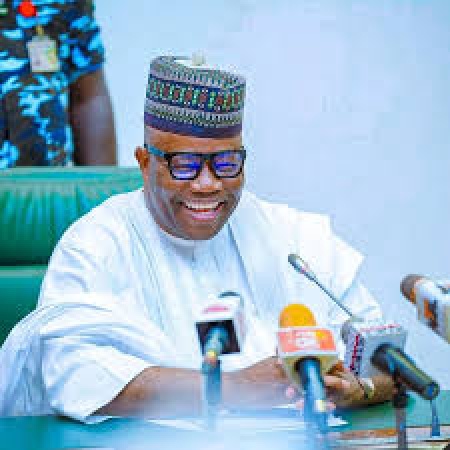
Senate President Akpabio
By ESEME EYIBOH,mnipr
In politics, silence is often louder than speech, for it speaks in the language of calculation and consequence. Forgiveness, when declared by a powerful man, is louder still—a thunderclap in a quiet chamber. It unsettles expectations, invites suspicion, and demands interrogation, not because it is weak, but because power is never presumed innocent when it chooses mercy.
When Senate President Godswill Akpabio, GCON, announced his New Year resolution to forgive all offenders and withdraw every suit he had instituted, Nigeria’s political class instinctively reached for its usual tools—cynicism, calculation, conspiracy. This decision, however, does not fit comfortably within the margins of the country’s familiar scripts of power and vendetta; it demands a slower reading.
The context itself matters. On New Year’s Day 2026, Akpabio was not behind a podium, flanked by politicians. He was seated in Sacred Heart Parish, Uyo, listening to a homily—not as Nigeria’s number-three citizen, but as a humble, God-fearing parishioner. The priest, Reverend Father Donatus Udoette, preaching with quiet authority and pastoral fervor, exhorted his congregants to let go of past hurts and choose peace over grievance. Akpabio would later say that, at some point, he realised the sermon was speaking directly to him.
The announcement that followed shortly after bore the unmistakable imprint of that moment. About nine defamation suits would be withdrawn, including the ₦200 billion case against Senator Natasha Akpoti-Uduaghan, arising from allegations he had consistently denied and publicly rejected. Other cases, some involving his close associates, would go the same way. In a political culture where litigation has become an extension of reputation management, this was no minor gesture. Akpabio had been unapologetic about defending his name through the courts. The law, in his hands, had been both shield and sword. To voluntarily lay it down is to interrupt a habit of power.
The question, therefore, is not whether Akpabio could afford to forgive. It is why he chose to do so.
To answer that, one must resist the temptation to isolate this act from the man’s broader leadership story. Akpabio has always lived publicly in dual registers. There is the assertive politician who, as governor of Akwa Ibom State, left behind concrete evidence of ambition fulfilled—flyovers, boulevards, hospitals, model schools, an international airport, and an international stadium. Supporters invoke the Latin phrase res ipsa loquitur: the facts speak for themselves.
Then there is the other register: the man who frames his political journey in spiritual terms; who describes his rise from the shadows to national limelight as evidence of divine ordering and grace; who once called himself, without irony, “the most ranked Christian in government.” A man who sees himself not merely as a participant in Nigeria’s politics, but as an instrument within a providential design—God’s will, he believes, for Nigeria at this moment.
In Nigeria, faith in politics is common. Stability of faith is rarer. Akpabio’s Christianity is not episodic. It has shaped how he understands authority itself. Power, in this worldview, is not merely seized or negotiated; it is entrusted. And what is entrusted carries moral obligation.
This is where forgiveness ceases to be sentimental and becomes political philosophy.
The same drive for tangible outcomes has characterised, albeit differently, his tenure as Senate President. It has been defined less by flamboyance than by control. The Senate he leads has been unusually productive and notably calm—more than ninety-six bills passed in two years, with over fifty-eight assented to by the President. In a chamber once notorious for theatrics, this stability is not accidental. It reflects a leadership style that values restraint over spectacle and consensus over conquest.
While his action was inspired, it also makes political sense. Withdrawing defamation suits fits neatly into this logic. Legal battles consume attention. They tether leaders to old grievances. They narrow the emotional bandwidth required for institutional leadership. To let them go is to reclaim focus—and to recommit to what ultimately matters: nation-building.
Critics will argue that forgiveness is easier from a position of strength. They are right. That is precisely why it matters. In fragile political systems, restraint by the powerful sets a tone no code of conduct can enforce. It lowers the temperature. It changes incentives.
Nigeria’s public sphere has become deeply adversarial. Every disagreement is framed as insult. Every critique is personalised. Politics has learned to confuse hostility with toughness. In such an environment, Akpabio’s choice rightly disrupts a dangerous rhythm.
Faith provides the language; humility provides the discipline. Humility here is not self-effacement. No one can accuse Akpabio of being unaware of his own stature. Rather, it is a confidence that does not require constant vindication. As the late global gospel icon, Uma Ukpai, once told him: “Only fruit-bearing trees draw missiles. If you are drawing missiles, it means you are bearing fruit.”
To accept that counsel is to understand leadership as emotional labour. To forgive is not to deny injury; it is to refuse to let injury define governance.
There is, of course, a strategic dimension. Nigerian politics does not permit innocence. The decision comes at a time when Senate unity is under constant scrutiny and rumours of internal challenge circulate freely. Choosing reconciliation over escalation strengthens institutional cohesion. It preserves authority without making it brittle.
Yet strategy does not cancel sincerity. In Nigerian leadership, the sacred and the secular are not opposing realms but overlapping obligations. Godswill Akpabio’s Catholic identity, deeply rooted in his home state, has always been both personal and public. He has hosted bishops at the national level. He is planning a worship centre within the National Assembly complex. These are not gestures of convenience; they are expressions of a worldview in which governance, godliness, and morality intersect.
This is why the withdrawal of lawsuits should be read not merely as personal forgiveness but as public modelling. Akpabio has often spoken of nation-building as a collective task, insisting that it requires citizens to rise above division and embrace shared purpose. Forgiveness, in this sense, becomes civic pedagogy.
Nigeria suffers from obvious physical infrastructure deficits. It also suffers from what might be called spiritual infrastructure decay. Distrust is habitual. Anger is efficient. Leaders who demonstrate emotional regulation contribute to national repair in ways budgets cannot capture.
The implications extend directly into legislative leadership. Managing one hundred and nine senators with competing ambitions requires more than procedural mastery. It demands moral authority—authority that flows not only from rules, but from example.
By choosing forgiveness over litigation, Akpabio strengthens his hand not through coercion but through credibility. He signals that power can afford generosity; that leadership does not require perpetual combat; that not every insult deserves a reply.
There is risk, of course. Forgiveness can be misread as weakness. Silence can be exploited. But leadership that waits for perfect safety rarely leads. Akpabio’s resolution accepts vulnerability as the price of example.
What emerges, then, is a synthesis: the force of developmental leadership from his gubernatorial years, the finesse of institutional management as Senate President, obedience to God and now a claim to moral authority through public restraint.
Nigeria often produces leaders who deliver material progress but corrode trust, or leaders who speak ethically but govern ineffectively. Akpabio’s gesture attempts to collapse that false choice.
To be clear, the true test lies ahead. Forgiveness must be sustained, not performed once and shelved. Its power will be measured by whether it cools tempers, reshapes conduct, and encourages reciprocal restraint.
For now, Akpabio has offered an unconventional lesson in Nigerian statecraft: that surrendering legal claims can strengthen authority; that stable faith produces calm rather than noise; and that humility, properly understood, is not the absence of confidence but its highest expression.
In a country struggling to rebuild trust while confronting insurgency, economic hardship, and climate anxiety, reconciliation is not a luxury. It is governance.
Sometimes, the most radical act in politics is not retaliation, but restraint. And with his New Year’s resolution, Senator Godswill Akpabio, the Senate President has demonstrated precisely that.
•Rt Hon Eseme Eyiboh mnipr is the Special Adviser, Media/Publicity and Official Spokesperson to the President of the Senate.