
Updating your news feed...
NEWS EXPRESS is Nigeria’s leading online newspaper. Published by Africa’s international award-winning journalist, Mr. Isaac Umunna, NEWS EXPRESS is Nigeria’s first truly professional online daily newspaper. It is published from Lagos, Nigeria’s economic and media hub, and has a provision for occasional special print editions. Thanks to our vast network of sources and dedicated team of professional journalists and contributors spread across Nigeria and overseas, NEWS EXPRESS has become synonymous with newsbreaks and exclusive stories from around the world.























Loading banners
Loading banners...

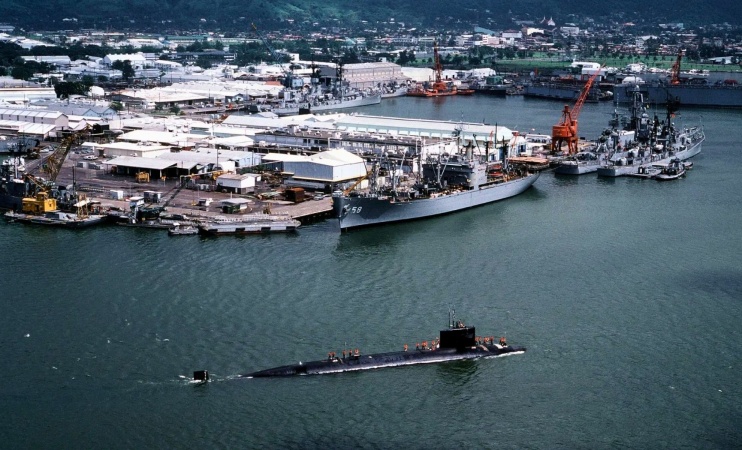
The Indo-Pacific has grown more tense. Maritime boundaries are being challenged, alliances tested, and defence footprints recalibrated. In this shifting environment, a familiar name is reappearing on maps and in strategic briefings: Subic Bay.
Once central to American power projection during the Cold War, Subic had faded from military relevance. The U.S. pulled out in 1992. The shipyard fell silent. For a time, it was just a memory. But not anymore.
Work crews are back. Steel is being cut. Partnerships have formed, funding secured. Subic is no longer dormant. Something bigger is unfolding on the coastline of western Luzon, and it reflects more than just shipbuilding.
At the centre of this revival is a $1.5 billion effort to reboot the defunct Hanjin shipyard, now rebranded Agila Subic. The facility is operated by HD Hyundai Heavy Industries Philippines, a local subsidiary of the South Korean conglomerate, and financed in part by the U.S. investment firm Cerberus Capital Management.
The reactivated yard, formally inaugurated by President Ferdinand Marcos Jr., is expected to more than double the country’s shipbuilding output. From 1.3 million to 2.5 million deadweight tonnes annually, officials say. Over 4,000 workers could be employed by 2030. Marcos also claimed it would lift the nation’s oil tanker production from five to eight vessels per year, as reported by USNI News.
Hyundai’s leadership has signalled an ambition beyond the domestic market. In recent years, the company has supplied the Philippine Navy with four frigates and six offshore patrol vessels, and it is actively pursuing further contracts.
The site also houses other U.S.-linked operations, including defence contractor Vectrus and submarine cable company SubCom. While no official announcements have confirmed weapon production at the complex, a congressional directive cited by Interesting Engineering confirms that the U.S. is studying the feasibility of establishing ammunition manufacturing in the Indo-Pacific. Materials such as nitrocellulose and nitroglycerin, used in explosive production, are under consideration.
Subic Bay’s location offers both tactical and symbolic advantages. It sits roughly 1,100 kilometres from Taiwan and southern China, within reach of any future flashpoints in the region. In recent months, the U.S. Marine Corps leased a 57,000-square-foot warehouse at the former naval depot, according to details reported in Interesting Engineering’s military coverage. Military planners say this supports rapid logistics and prepositioning in case of conflict.
The base’s revival follows the 2023 expansion of the Enhanced Defense Cooperation Agreement, which increased the number of Philippine military sites open to U.S. forces from five to nine. Ground-based missile systems, including the Typhon and Nemesis platforms, have since been deployed in the country.
A 2025 U.S. House directive called for forward-deployed ammunition production capabilities in the region. Subic Bay is understood to be among the locations evaluated. A report from the U.S. Naval Research Laboratory cited in the same source described current developments as the most significant American defence investment in the Philippines since the Cold War.
Marcos, speaking during his visit to Washington, described the moves as part of a “self-reliant defence” policy and said the Philippines could not afford to remain passive in the face of growing Chinese assertiveness.
Not everyone in Manila agrees. Vice President Sara Duterte, daughter of the former president, warned that the Philippines risks becoming a “bullet shield” for Washington. The International Center for Human Rights in the Philippines has echoed those concerns, calling the project an extension of the U.S. military-industrial complex.
The concerns come against a backdrop of rising maritime tensions. Chinese coast guard vessels have regularly confronted Philippine patrols near disputed reefs. After Marcos publicly suggested that neutrality in a Taiwan conflict was no longer viable, Chinese officials accused the Philippines of “playing with fire,” as reported by Interesting Engineering.
In a separate incident, six Chinese nationals were arrested in Subic Bay on espionage-related charges. The case has not been publicly detailed, but it has intensified mistrust between Beijing and Manila.
South Korean officials, meanwhile, have framed the project as a model of trilateral cooperation. “Here in Subic, Korea brings its shipbuilding excellence. The United States contributes its financial strength from Cerberus, and the Philippines provides its skilled workforce and strategic location,” said Ambassador Lee Sang-hwa during the shipyard relaunch event.
Subic’s resurgence coincides with other efforts to reinforce U.S. posture in the western Pacific. Agreements with Japan, Australia, and Papua New Guinea have extended basing options. Maritime surveillance and submarine patrols are increasing. The commissioning of new Virginia-class nuclear attack submarines, equipped for intelligence and strike operations, complements this expanding infrastructure.
For now, the official line remains focused on commercial goals. But the physical footprint tells a more layered story. Subic Bay is once again active, no longer a relic of Cold War deployments, but a living piece of today’s evolving security architecture. (Indian Defence Review)




