Updating your news feed...
NEWS EXPRESS is Nigeria’s leading online newspaper. Published by Africa’s international award-winning journalist, Mr. Isaac Umunna, NEWS EXPRESS is Nigeria’s first truly professional online daily newspaper. It is published from Lagos, Nigeria’s economic and media hub, and has a provision for occasional special print editions. Thanks to our vast network of sources and dedicated team of professional journalists and contributors spread across Nigeria and overseas, NEWS EXPRESS has become synonymous with newsbreaks and exclusive stories from around the world.























Loading banners
Loading banners...

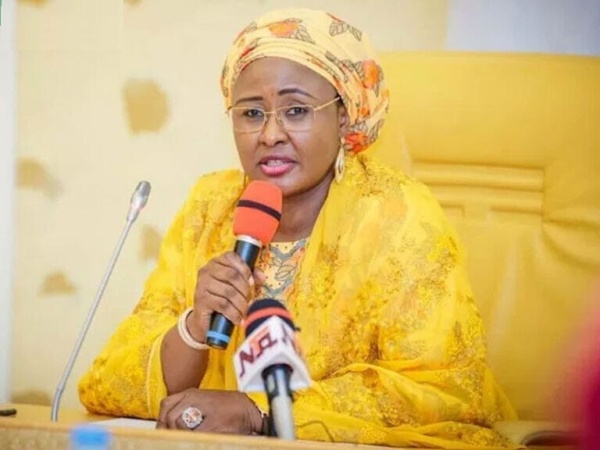
Aisha Buhari, former Nigerian First Lady
Former First Lady, Aisha Buhari, has passed a damning verdict on the eight-year tenure of her husband, the immediate past President, late Muhammadu Buhari.
In a book unveiled on Monday at the Banquet Hall of the State House, entitled ‘From Soldier to Statesman: The Legacy of Muhammadu Buhari”’, authored by Dr. Charles Omole, the former First Lady narrated how the former president was held captive by “a small court of elderly relatives and elites”, whom she further described as a “mafia of a certain kind, (with) native intelligence bent to private ends.”
In chapter 22 of the book, with a subtitle, ‘Revelations at Last after the Silence: Aisha Buhari’s Account of the Villa and the Men who fought a Presidency’, the author gave a gripping account of how those who laboured to ensure victory for Buhari in 2015 lost out in the power game at the State House with the mafia dictating who got what, when and how.
The First Lady’s predicament worsened in 2017, two years into the first tenure of the late President as the strong men who “cautioned the president that his wife’s ‘strong character’ would overshadow them if she were let in,” actually plotted to push her out of the Villa.
“In Aisha’s account, the house quickly filled with relatives and their wives and grandchildren, as well as courtiers and staff who learnt the shortcuts and shadows.
“They tried to push everybody out, including me,” she said.
“It is a blunt statement, and she knows it sounds blunt. But she stands firm on her boundaries: ‘This is my house. You can live wherever you like, but you cannot be in charge of my husband’s office and then also be in charge of me, his wife, inside my house.’
“With most of her children living and studying abroad early in Buhari’s first term, extended family members filled the void and occupied houses across the Villa. And because of his fondness and attachment to his extended family and old friends, Buhari was vulnerable to all kinds of scheming and manipulations.
“Those who knew his weaknesses exploited them to the detriment of the lofty goals of his administration.
“She describes a simple, volatile sociology: the president is not just a man; he becomes ‘common property.’ Relatives with no official roles begin to influence access; the people who dined with her husband during the long years of opposition are no longer seen; familiar faces are ‘locked out’, their names allegedly logged by security agents and reported elsewhere.
“When she privately raised these concerns and saw no change, she spoke publicly. She still remembers the shock of the 2015-16 ministerial slate: campaign stalwarts on the outside; technocrats and loyalists of others on the inside; a growing gap between the promise of a movement and the reality of a government. ‘They had money; they had people; but they did not have the power to install a president,’ she says now, almost wryly. They reduced Nigeria to a sitting-room meeting.’”
She attributed the public outcry and sordid judgement trailing the late president’s stewardship to the cabal that held him hostage.
“Her language for the proximal circle is uncompromising. Some followed him to obtain material things (money, access, contracts) and could not distinguish between ‘power’ (purpose, responsibility) and the rewards that proximity provides.”
According to her account, the practical effects were evident: schedules shifted, meals disappeared, allies were excluded, rumours circulated that signatures were forged, and a president who feared being called a dictator hesitated to dismiss men who disappointed him.
“‘He had the wrong people in the right places,’ she says. ‘He didn’t change them for eight years.’”
The book also revealed why in 2023 the former First Lady settled for the incumbent president, Bola Tinubu, as the All Progressives Congress presidential candidate while the cabal was scheming to install a certain aspirant from the North to succeed the late Buhari.
In the narrative attributed to Aisha Buhari by the author, the First Lady settled for Tinubu for two reasons: the moral imperative for power shift to the South and the electoral value of Tinubu, whom she noted had the capacity to guarantee victory for the ruling party.
“When 2023 approached, the struggle over succession intensified. Aisha’s support for Bola Ahmed Tinubu was both open and strategic. She presents it on two levels. The first is the informal norm of power rotation. We have spent eight years in the North. Peace is priceless. Let us give the South the chance.
“The second is electoral arithmetic: in her telling she asked key governors from the North a tough question: ‘Among your aspirants from the South, who can be sold in the North’?
“She took their answer as the line to follow. The governors responded and said Tinubu was the most sellable in the North. She states her husband neither instructed nor interfered. ‘He has never,’ she claims. ‘He did not interfere to make anyone President.’ But the cabal around her husband, headed by Mamman Daura, she said, had other ideas.” (Vanguard)