ADAD

Updating your news feed...
NEWS EXPRESS is Nigeria’s leading online newspaper. Published by Africa’s international award-winning journalist, Mr. Isaac Umunna, NEWS EXPRESS is Nigeria’s first truly professional online daily newspaper. It is published from Lagos, Nigeria’s economic and media hub, and has a provision for occasional special print editions. Thanks to our vast network of sources and dedicated team of professional journalists and contributors spread across Nigeria and overseas, NEWS EXPRESS has become synonymous with newsbreaks and exclusive stories from around the world.








Loading banners
Loading banners...

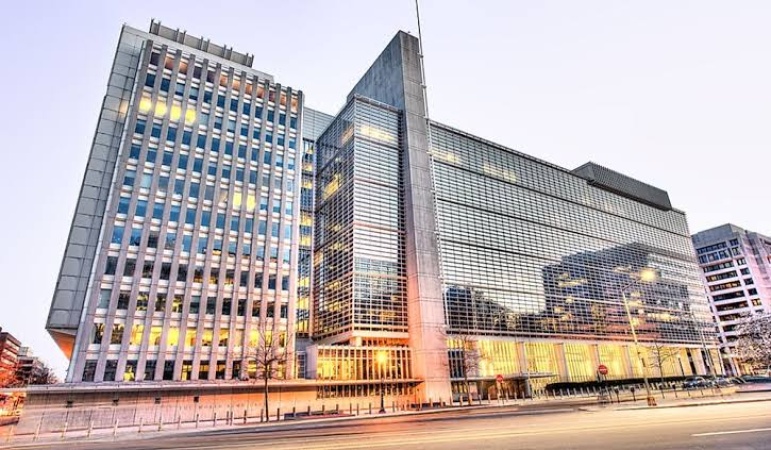
World Bank headquarters
The Federal Government is seeking a fresh $500 million loan from the World Bank to support infrastructure financing, even as the Debt Management Office (DMO) has warned that Nigeria’s debt service-to-revenue ratio could rise to 71.7 per cent by 2030.
The proposed loan, which is expected to receive approval on May 25, 2027, is part of a broader $3.85 billion Nigeria Infrastructure Financing and De-Risking Platform for Growth and Jobs (INFRAGROW) initiative designed to attract private capital into critical infrastructure projects.
The proposed facility comes amid growing concerns over the country’s ability to meet its debt obligations without significantly reducing funds available for infrastructure, healthcare, education and other essential public services.
According to the World Bank’s Initial Project Information Document, the Federal Ministry of Finance will be the borrower, while the Nigeria Sovereign Investment Authority (NSIA) will implement the project.
The $500 million facility comprises $400 million from the International Bank for Reconstruction and Development and $100 million from the International Development Association.
The wider financing structure will involve government contributions, private investors and commercial lenders, alongside $2.35 billion in guarantees.
The platform will operate through four subsidiaries focusing on project preparation, viability-gap funding, risk capital and credit guarantees. The International Finance Corporation is also expected to participate as a co-investor, while the Multilateral Investment Guarantee Agency will provide political risk insurance.
The World Bank estimates Nigeria’s annual infrastructure financing gap at $100 billion, describing it as a major constraint on economic growth, fiscal sustainability, competitiveness and job creation.
However, the fresh borrowing proposal comes against the backdrop of the DMO’s warning that debt servicing costs could increasingly consume government revenue.
its 2024 Debt Sustainability Analysis report, the DMO projected that Nigeria’s debt service-to-revenue ratio would rise from 44.9 per cent in 2025 to 51 per cent in 2026, 57.1 per cent in 2027 and 57.4 per cent in 2028.
The ratio is expected to climb to 67.3 per cent in 2029 before reaching 71.7 per cent in 2030, significantly above the agency’s recommended 50 per cent threshold.
This implies that the Federal Government could spend more than seven out of every 10 naira generated as revenue on debt servicing by 2030, leaving limited fiscal space for development expenditure.
The outlook could deteriorate further under the DMO’s shock scenario, which projects the ratio rising to 97.3 per cent by 2030. This scenario assumes a 30 per cent exchange rate depreciation, a two per cent contraction in real GDP and a 2.5 per cent decline in government revenue.
Although Nigeria’s public debt-to-GDP ratio is projected to decline from 53.7 per cent in 2024 to 27.3 per cent by 2030 under the baseline scenario, the DMO warned that debt sustainability remains vulnerable to weak revenue mobilisation, exchange rate depreciation and global economic uncertainties.
The agency also identified elevated financing, refinancing and foreign exchange risks, with Nigeria’s Eurobond spread, non-resident debt holdings and short-term debt exposure exceeding their respective risk thresholds.
To address the challenges, the DMO recommended stronger tax revenue mobilisation, improved expenditure efficiency, sustained subsidy reforms, a flexible exchange rate regime and greater reliance on concessional financing.
It also urged the government to prioritise growth-enhancing investments capable of expanding economic output and strengthening its revenue base.
The pressure is already evident in debt servicing expenditure. Nigeria spent $1.82 billion on external debt servicing in the first half of 2026, while domestic debt service payments amounted to N5.28 trillion.
Of the domestic payments, N4.95 trillion represented interest and rental costs, highlighting the growing burden of servicing the country’s debt portfolio.
The figures underscore the challenge facing the government: mobilising financing to close Nigeria’s infrastructure gap while ensuring that additional borrowing does not further constrain public finances. (Nigerian Tribune)