ADAD

Updating your news feed...
NEWS EXPRESS is Nigeria’s leading online newspaper. Published by Africa’s international award-winning journalist, Mr. Isaac Umunna, NEWS EXPRESS is Nigeria’s first truly professional online daily newspaper. It is published from Lagos, Nigeria’s economic and media hub, and has a provision for occasional special print editions. Thanks to our vast network of sources and dedicated team of professional journalists and contributors spread across Nigeria and overseas, NEWS EXPRESS has become synonymous with newsbreaks and exclusive stories from around the world.










.webp)


.webp)







Loading banners
Loading banners...

Investigations have shown that the decision of Electoral officers to load some polling units with more than the usual 500 voters per unit is responsible for delayed voting, counting and ease of transmission of votes to the INEC viewing portal, IReV.
Investigations by our correspondent, which commenced during the last governorship election in Osun State indicate that while the Independent National Electoral Commission (INEC) expects not more than 500 voters per polling unit, several units had 2,000 and more registered voters, thus creating bottlenecks during the actual voting exercise.
It was also discovered that the large number of voters per unit also constituted encumbrances to the transmission process of the votes to the INEC result viewing portal, IReV.
As a result of the overcrowded polling units during the August 15, 2026 Osun State governorship election, voting continued after dark at some polling units with large registers. In parts of Osogbo, the state capital, votes were cast under rechargeable lamps and handheld torches.
Reports from elsewhere in Osun on election day also documented voting after dark at polling units with large registers. At Polling Unit 011, Open Space, Gantry Sawmill, Ward 9, Ikire I, Irewole Local Government Area, a station with more than 2,239 registered voters, TheCable reported that voting continued until 8:00 p.m. Around 6:00 p.m., as daylight faded, residents provided a generator and bulbs so that accreditation could go on, the newspaper said, publishing a photograph of the generator at the unit. TheCable’s reporter wrote that INEC officials extended the exercise beyond the official 2:30 p.m. close because voters were still present. In Ila-Orangun, The Nation reported that voting was still going on at 8:10 p.m. at St Michael’s Primary School, where 945 voters were registered, while Secretariat Polling Unit 013 in Isedo I, with 1,134 registered voters and a single BVAS device, had only just finished voting around 8:00 p.m. and moved to ballot sorting.
Data obtained from the official metadata on the Independent National Electoral Commission (INEC) Result Viewing (IReV) portal also confirmed the timelines when some of the entries were made on IReV, indicating a more than delayed voting exercise.
Whereas voting was expected to have closed at 2.30 pm on August 15, returns on the IReV showed that entries were still being made at midnight.
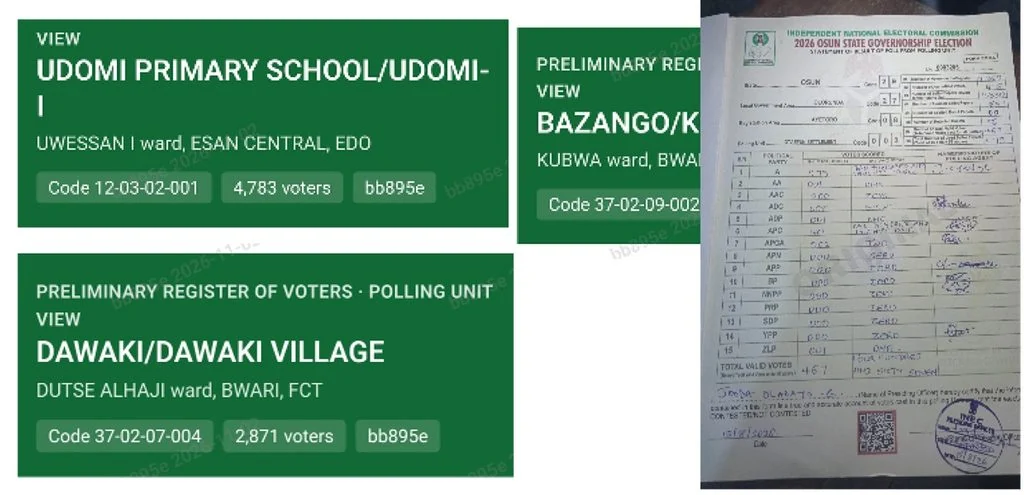
At Polling Unit 3, Ward 8, located in Ota-Efun, Olorunda Local Government Area (Code: 29/27/08/003), the Form EC8A result sheet examined bears a “Date created” timestamp of 12:12:04 a.m. on Sunday, 16 August 2026, nearly 10 hours after the scheduled close of voting.
A review of the certified Form EC8A (Serial Number 0003205), signed and stamped by the Presiding Officer, Jooda Olabayo E., records 2,352 registered voters and 2,330 ballot papers issued to the polling unit. Only 476 voters were accredited, representing 20.2 per cent of registered voters. The sheet records 467 valid votes and six rejected ballots, making 473 used ballot papers-three fewer than the number accredited. It also records no spoiled ballot papers and 1,857 unused ballot papers.
The Nigerian Tribune, in its live election coverage, documented how hundreds of voters remained stranded on queues at the Ota-Efun centre late into the night. The correspondent who monitored the polling units reported that voting did not commence as of 12:35 p.m. as tension rose at the polling unit, with several voters unable to locate their names on the INEC register displayed for accreditation despite being physically present to vote.
The development sparked complaints from affected voters and party agents, who demanded explanations from electoral officials over the discrepancies.
The crisis at Ota-Efun was not an isolated incident. Across Osogbo Local Government Area, overcrowded polling units produced identical midnight scrambles.
At the Capital Hotel area on Okin Street (PU 29-30-05-019), 1,271 registered voters were assigned to a single polling unit, making counting and reconciliation to spill past 1:00 AM on 16 August before BVAS uploads were concluded. At Alekuwodo Premises (PU 29-30-05-018): 923 voters were registered while the results were cleared after 11:30 PM; and at Igbalaye Street, opposite Jesugbodo Complex (PU 036): 766 voters were registered in one unit.
INEC had persistently said that 500 voters should be registered in one unit, the excess of which should be spilt to another voting point perhaps to make room for administrative control on election day
In the Osun governorship election, official voting hours ran from 8:30 am to 2:30 pm, a window of six hours. Standard BVAS processing requires between 90 and 120 seconds per voter for facial or fingerprint verification. At peak operational efficiency and without machine downtime, a single BVAS device can accredit a maximum of 180 to 240 voters within statutory polling hours. It means that a second machine may be compelling for such centres.
Therefore, it could be problematic to assign 2,352 registered voters to a single BVAS terminal and expect full voter participation and smooth operation.
An observer told our correspondent that had turnout reached 60 per cent at Ota-Efun, over 1,400 voters would have presented themselves, requiring nearly 24 continuous hours of accreditation.
Yet, those Osun bottlenecks offer an urgent preview for the 2027 general election. As INEC prepares to close statutory claims and objections ahead of the mandatory 15 December 2026 register certification, preliminary registers uploaded to the commission display portal show identical structural distortions across South-West polling units.
Under INEC Regulations and Guidelines for the Conduct of Elections, read together with the Commission Guidelines for Expanding Voter Access to Polling Units, the operational ceiling for any polling unit is fixed at 500 registered voters. Where an established unit surpasses 500 and moves toward 750, the electoral body is statutorily mandated to split the settlement or carve out autonomous Voting Points to ensure orderly queues and timely tallying before dark.
That framework prompted INEC to establish 56,872 new units ahead of the 2023 elections, expanding the national tally to 176,846. However, findings from a Nigerian Tribune audit of preliminary registers in urban South-West wards show that the commission failed to redistribute voters from legacy settlements.
This failure created a structural imbalance: swollen “mother units” sit just metres away from newly created, virtually empty ghost units.
In Oyo State, preliminary numbers examined across high-density wards in Ibadan North, Ibadan North-East, and Ogbomoso South show legacy stations holding between 850 and 1,400 registered voters, while adjacent units created in 2021 recorded fewer than 30 voters during the 2023 elections.
Checks to Ogbomoso South, Ibapon ward, Ajegunle Polling Unit Code 30-22-04-022, showed 1,340 voters registered in the 2023 elections, and it has now increased to a total of 1,462 voters registered.
A corresponding pattern has emerged in Ogun State. Within industrial and commercial settlements in Ado-Odo/Ota and Abeokuta South, where multiple stations carry rolls above 2,500 voters while some polling units have just 185 registered voters.
In Lagos State, sprawling suburban units across Alimosho and Oshodi-Isolo continue to post rolls exceeding 1,500 voters on single registers, setting up the exact conditions that accounted for late-night vote processing in Osun State.
The swelling numbers present an immediate legal dilemma under the Electoral Act 2026.
Section 19(1) of the Act stipulates that not later than 90 days before a general election, the commission must publish the preliminary voter roll at every registration area (ward) and on its portal for public inspection. Under Section 19(2) and (3), voters and political parties have an active statutory window to enter claims and objections against fictitious entries, deceased names, or ineligible registrants before revision officers appointed under Section 20.
If bloated records or system duplicates pass through uncorrected by the 15 December 2026 certification deadline, the certified roll becomes the unalterable legal baseline for ballot production and logistics under Section 10(6).
Under Section 51(2) of the Act, an election can only be voided for over-voting where total ballots cast surpass accredited voters recorded by BVAS. However, an artificially bloated register inflates the quota of sensitive materials distributed to that station, creating vulnerabilities once daylight fades, observer teams depart, and ad hoc personnel are left counting under lanterns.
Outside the South-West, an audit of the preliminary register of voters on the commission display portal shows that the concentration of voters in single polling stations has reached unprecedented levels.
Data from Edo State shows that Polling Unit 12-03-02-001, located at Udomi Primary School, Udomi-I, in Uwessan I Ward of Esan Central Local Government Area, carries 4,783 registered voters.
Official records from the 21 September 2024 Edo State governorship election also show the scale of the imbalance. Form EC8A result sheets (Serial Number EG/0000591) for the sister unit, Udomi Primary School, Udomi-II (PU 12-03-02-002), showed 667 registered voters on Box 1 of the return, with only 172 voters accredited. The presence of 4,783 voters on the preliminary roll of PU 001 means a single station would require nearly 20 BVAS terminals operating simultaneously to accredit all eligible voters within the statutory six-hour window.
The North-West presents a stark picture of mega-units in urban commercial centres coexisting with deserted rural stations.
In Kano State, the audit of the preliminary display across municipal councils revealed massive rolls in Dala, Fagge, and Nasarawa Local Government Areas, where single polling units located at public schools and market squares carry between 1,200 and 1,850 registered voters. Polling unit Chiranchi Pri. Sch. (Buden Gari I) with code name 19-05-02-001, Bichi Ward, Bichi, Kano has 1,215 voters registered, and another, Hagagawa Model Pri (Hagagawa IV) in the same ward has 1,762 as of November 2, 2026.
A similar pattern exists in Kaduna State, particularly within the Rigasa and Tudun Wada wards of Igabi and Kaduna South Local Government Areas. Several polling stations carry registers exceeding 1,800 voters, while new units carved out in outlying settlements recorded fewer than 25 voters during previous exercises.
In the North-Central, rapid suburban expansion around the Federal Capital Territory (FCT) has pushed polling unit populations far beyond administrative limits.
Within the Abuja Municipal Area Council (AMAC) and Bwari Area Council, rapid population shifts into commuter hubs like Kawu, Nyanya, Kubwa, and Dutse Alhaji have created polling units carrying over 2,500 registered voters. In the 2023 general election and area council polls, these stations witnessed acute voter agitation as hundreds of citizens remained unaccredited by nightfall. In the current voter register in Dawaki/Dawaki Village, Dutse Alhaji Ward, Bwari, FCT, Code 37-02-07-004, Nigerian Tribune checks show 2,871 voters among others.
In Benue and Plateau states, the concentration of internally displaced persons (IDPs) and urban migration into Makurdi and Jos North has produced legacy units with rolls of over 900 voters, while newly created polling stations in adjoining wards remain vastly underpopulated.
In the North-East, the combination of displacement and urban migration has distorted registers in Borno and Bauchi states.
In Maiduguri Metropolitan Council (MMC) and Jere Local Government Area of Borno State, several polling units originally sited in areas affected by insurgency were consolidated into urban centres without administrative redistribution. As a result, individual polling centres in camps and formal settlements hold voter registers in excess of 900 names.
Similarly, in Bauchi Local Government Area of Bauchi State, urban expansion has left legacy stations in wards like Dan Iya Hardo with over 1,200 voters, while newly created voting units nearby lie almost idle on election day. Polling units like Kofar Marafa, Kofar Marafa, with Code 05-02-11-061 have 1,182 voters registered.
Concerns about uneven voter distribution predate the latest register display. In its midday statement during the Osun governorship election on 16 July 2022, Yiaga Africa warned that some polling units had more than 750 registered voters and urged INEC to redistribute voters to avert logistical difficulties and disenfranchisement.
During the 15 August 2026 Osun governorship election, the Nigeria Civil Society Situation Room also raised concerns about inadequate BVAS deployment at polling units with large registers. In its election-day interim statement, the coalition cited a unit in Ila-Orangun with more than 1,100 registered voters where only one BVAS device was reportedly available, resulting in significant congestion.
Separately, Yiaga Africa’s Executive Director, Samson Itodo, called in November for an independent audit of the voter register, arguing that its irregularities extended beyond the figures released by INEC. (Nigerian Tribune)