ADAD
Updating your news feed...

NEWS EXPRESS is Nigeria’s leading online newspaper. Published by Africa’s international award-winning journalist, Mr. Isaac Umunna, NEWS EXPRESS is Nigeria’s first truly professional online daily newspaper. It is published from Lagos, Nigeria’s economic and media hub, and has a provision for occasional special print editions. Thanks to our vast network of sources and dedicated team of professional journalists and contributors spread across Nigeria and overseas, NEWS EXPRESS has become synonymous with newsbreaks and exclusive stories from around the world.






















Loading banners
Loading banners...

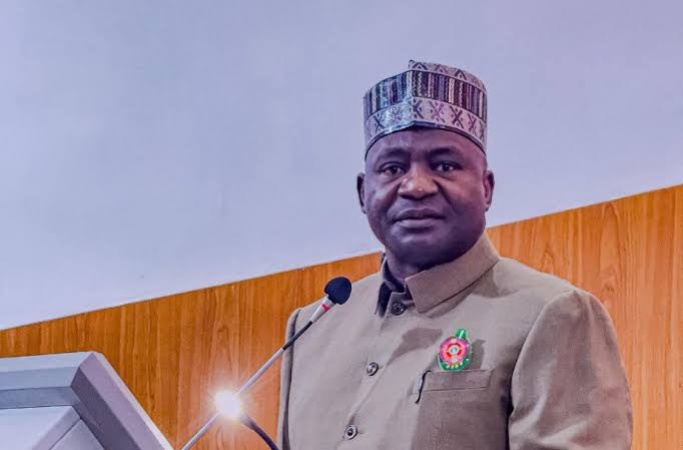
NAFDAC DG Kashifu Inuwa, CCIE giving the opening keynote at the Global Tech Africa 2026 in Kano
By BONIFACE AKARAH
Africa accounts for less than two per cent of the data used to train artificial intelligence models, a situation the Federal Government says must change if Nigeria is to play a meaningful role in the continent’s emerging digital economy.
Director-General of the National Information Technology Development Agency (NITDA), Kashifu Inuwa Abdullahi, raised the concern at the Global Tech Africa event in Kano, themed “Connecting Africa, Accelerating Growth”, where he outlined government plans to expand digital skills, innovation, broadband connectivity, domestic computing capacity and emerging technologies.
Inuwa said the administration of President Bola Tinubu was pursuing a digital economy strategy aimed at building indigenous technological capacity and positioning Nigeria as a leading digital hub in Africa.
He said human capital remained central to the government’s digital transformation agenda, pointing to the Three Million Technical Talent (3MTT) programme and the Digital Literacy for All (DL4ALL) initiative as key interventions for developing Nigeria’s technology workforce.
According to him, the government is also integrating digital skills into formal education from kindergarten to tertiary institutions to prepare future generations to develop indigenous solutions and compete in the global technology market.
Through DL4ALL, the government is targeting 95 per cent digital literacy by 2030, with the aim of enabling Nigerians across different communities and economic sectors to access, understand and use digital services.
Inuwa, however, stressed that digital transformation must go beyond connecting people to the internet.
“Digital transformation must go beyond providing internet access and smartphones to creating a progression from connectivity and digital literacy to technology adoption, productivity and national prosperity,” he said.
He explained that technology should enable citizens, businesses and traders to improve efficiency, reduce operational costs, expand markets and generate economic value.
On innovation financing, Inuwa disclosed that NITDA, in collaboration with the Japan International Cooperation Agency (JICA) and the Nigeria Sovereign Investment Authority (NSIA), was working towards establishing six funds to support startups developing innovative solutions.
He also Identified the Bank of Industry and other development finance institutions as important sources of funding for entrepreneurs, while calling for increased private-sector investment in the country’s innovation ecosystem.
“Private investors can provide not only capital but also equity partnerships, corporate governance, business expertise and leadership to help startups grow,” he said.
The NITDA boss said the government’s digital infrastructure agenda also included plans to extend fibre-optic infrastructure across all 774 local government areas, the 36 states and the Federal Capital Territory.
He said the expansion of connectivity must be matched by sufficient domestic computing capacity, which informed NITDA’s National Sovereign Cloud Initiative.
According to him, the initiative seeks to strengthen Nigeria’s computing infrastructure, promote digital sovereignty and ensure that data generated within the country can be securely processed and stored locally.
Describing data centres as “the refineries of the digital economy”, Inuwa said Nigeria needed to develop the capacity to own and control these critical digital assets.
He said this would help reduce dependence on foreign computing infrastructure and position Nigeria as a computing hub for West and Central Africa.
Turning to artificial intelligence, Inuwa said Africa’s limited contribution to AI training data raised concerns about the continent’s representation in emerging technologies.
He called for greater local participation in developing Large Language Models and other AI solutions that reflect Nigeria’s languages, cultures and socioeconomic realities.
The NITDA director-general also used Kano’s history as a major commercial centre for the Sahel region to argue for renewed efforts to connect the city to new markets through digital technology, modern trade and the African Continental Free Trade Area (AfCFTA).
He observed that e-commerce and changing business models had disrupted traditional trading patterns, allowing customers in neighbouring countries to purchase goods online without travelling to Kano.
However, he said Kano could reclaim part of its commercial influence by using digital platforms to connect North Africa and the Middle East with sub-Saharan Africa.
Inuwa’s presentation placed digital skills, infrastructure, local computing capacity and artificial intelligence at the centre of Nigeria's strategy to build a stronger indigenous technology ecosystem and participate more competitively in the global digital economy.