 ADAD
Updating your news feed...

NEWS EXPRESS is Nigeria’s leading online newspaper. Published by Africa’s international award-winning journalist, Mr. Isaac Umunna, NEWS EXPRESS is Nigeria’s first truly professional online daily newspaper. It is published from Lagos, Nigeria’s economic and media hub, and has a provision for occasional special print editions. Thanks to our vast network of sources and dedicated team of professional journalists and contributors spread across Nigeria and overseas, NEWS EXPRESS has become synonymous with newsbreaks and exclusive stories from around the world.




















Loading banners
Loading banners...

INEC Chairman Prof Joash Amupitan
The Independent National Electoral Commission (INEC) has come under criticism, following the omission of some political parties’ candidates from its final list for the 2027 general election, with pro-democracy advocates and constitutional lawyers questioning the commission’s powers to exclude candidates.
Constitutional lawyers have questioned whether INEC possesses the authority to independently disqualify candidates from participating in elections.
A constitutional lawyer, Monday Mawah, said neither the Constitution nor the Electoral Act empowered the commission to selectively remove candidates from an election list.
Speaking during a television programme, Mawah said the recent Supreme Court judgment and provisions of the Electoral Act concerning the submission of political parties’ membership registers should not be interpreted as granting INEC the power to disqualify individual candidates.
He explained that where a political party failed to comply with the statutory requirement for submitting its membership register within the stipulated timeframe, the consequence could be a restriction on the party’s ability to field candidates rather than the selective exclusion of individuals.
Mawah argued that if INEC believed the PDP had violated electoral regulations in Ogun, the commission should have applied the relevant provisions consistently instead of singling out two candidates.
He cited the party’s claim that it submitted 40 candidates’ names in Ogun, out of which 38 were included in the final list.
According to him, if the commission’s position was that the party had breached the law, it should explain the legal basis for allowing some candidates to remain on the list while excluding others.
He also wondered why INEC initially published Adebutu’s particulars before subsequently removing his name, describing the development as an attempt to interpret the law in a manner not expressly authorised by the relevant legal provisions.
The lawyer maintained that INEC should approach the courts for clarification of the Supreme Court judgment rather than take administrative decisions that could affect candidates’ eligibility.
In his own opinion, an Abuja-based legal practitioner, Emmanuel Umahi Ekwe, said INEC possesses statutory powers to scrutinise and determine compliance with the requirements for nomination of candidates under the Electoral Act.
“He said, however, that such powers are not absolute and must be exercised strictly within the confines of the Constitution, the Electoral Act and binding judicial pronouncements.
The lawyer told the Nigerian Tribune that the distinction that must be appreciated in the Adebutu and Pantami cases is the difference between the disqualification of an individual candidate and the exclusion of a candidate arising from the failure of a sponsoring political party to satisfy statutory requirements.
“The Supreme Court’s decision in INEC v. Zenith Labour Party, delivered on 24 September 2026, affirmed the validity of Sections 77(5), (6) and (7) of the Electoral Act 2026. Consequently, a political party that fails to comply with the statutory membership register requirements risks losing its eligibility to field candidates.
“Nevertheless, this does not confer on INEC an unlimited power to disqualify candidates at will. The Commission must establish the specific statutory infraction, apply the law consistently and afford affected parties the opportunity provided by law to challenge its decisions.
“My position, therefore, is that INEC has the power to enforce statutory nomination requirements, including excluding candidates where the law justifies such action. But it cannot arrogate to itself powers beyond those conferred by law or substitute its administrative judgment for that of a competent court,” he said.
Ultimately, Ekwe submitted that the rule of law requires that every decision affecting the political rights of a candidate must have a clear legal foundation and remain subject to judicial scrutiny. “The integrity of our electoral process demands not only strict compliance with electoral laws but also fairness, consistency and due process in their enforcement,” he said.
The constitutional limits of INEC regarding the disqualification of candidates submitted by parties were also clarified by two Senior Advocates of Nigeria (SANs): Dr Abiodun Layonu and Mr Francis Amobi Nzelu.
Speaking with the Nigerian Tribune on the power of INEC to disqualify candidates and the legal framework governing candidacy in Nigeria, Dr Layonu revealed that the process of becoming a candidate is strictly governed by the 1999 Constitution (as amended), the Electoral Act 2022, and INEC guidelines.
He insisted that INEC’s role is administrative and supervisory, adding, “Once political parties conduct primaries and submit their list of candidates, the commission is constitutionally bound to comply with valid orders from competent courts.
“If affected aspirants challenge their nomination in court, INEC is bound to obey valid court judgements.”
Dr Layonu posited that where a court decision is appealed up to the Federal High Court or higher, INEC typically pauses final action on the contested candidacy until the judicial process is concluded.
The senior lawyer suggested that because Nigeria operates a party-based ballot system where party logos appear on ballot papers, INEC can implement court-ordered substitutions until the legal deadline before an election.
On his part, Nzelu contended that the electoral body does not have the constitutional power to delist or disqualify candidates nominated by political parties.
In his words: “Nigerians go to bed and wake up to a new set of laws. This issue is very straightforward.
“If a political party has conducted primaries and nominated a candidate and forwards that name, the only conditions of removal are if the person dies or voluntarily withdraws in writing.
“INEC is an umpire. They cannot be game players. Under which law are they operating? I have not seen the law yet,” he said.
The SAN, who made reference to a recent case in Abuja where INEC monitored the ANPP primaries in Anambra State, countersigned results that included candidates for Senate, House of Representatives, and House of Assembly, only for the party leadership to attempt substitution in Abuja, and maintained that INEC rightly resisted the change.
Nzelu expressed concern that political parties are committing blunders by attempting to arbitrarily substitute candidates who validly won primaries.
His words: “Anybody who has gone through primaries as a major winner, his party returns his name, INEC countersigns, and they want to remove them, they should go to court and seek redress.
“They should not take knives to fight the battle.”
A political science lecturer, Professor Ola Adelana, and two other legal practitioners: Wale Obanigba and Ola Amure, who also weighed in on the matter, said that INEC lacked unrestricted powers to disqualify candidates duly nominated by parties, stressing that its electoral responsibilities must be exercised within the limits of the law.
Adelana, who examined the issue from the perspective of political institutions, constitutional democracy and electoral governance, said: “The power to disqualify an individual candidate is not necessarily the same as the power to determine whether a political party is legally eligible to sponsor candidates in an election. That distinction is central to understanding the Adebutu situation.”
The don argued that INEC did not possess unrestricted judicial powers to disqualify candidates duly nominated by political parties, citing the Supreme Court’s decision in Action Congress v. Independent National Electoral Commission (2007).
Aselana said the court had rejected the proposition that INEC could independently assume the judicial responsibility of disqualifying a candidate nominated by a political party.
He explained that the commission’s constitutional responsibility to organise, undertake and supervise elections did not automatically confer on it the authority to determine disputed questions concerning the constitutional eligibility of candidates.
However, he cautioned against interpreting the position to mean that INEC must accept every nomination submitted by political parties irrespective of statutory requirements.
He said political parties were bound by the Constitution and the Electoral Act, particularly provisions regulating membership registers, party primaries and candidate nomination.
On the implications of the Supreme Court’s September 24, 2026 judgment in INEC v. Zenith Labour Party, the lecturer said the decision reinforced the distinction between an individual’s eligibility to contest an election and a political party’s eligibility to sponsor candidates.
He explained that Section 77(4) of the Electoral Act 2026 required political parties to submit their membership registers to INEC at least 21 days before their primaries, congresses or conventions.
He added that Section 77(5) restricted participation in party primaries to members whose names appeared in the submitted register, while Section 77(7) provided that a party which failed to submit its register within the stipulated period would not be eligible to field candidates for the election.
Adelana said: “The consequence of non-compliance under Section 77(7) is directed at the political party’s eligibility to field candidates, rather than the personal disqualification of every individual member.”
Similarly, Obanigba said INEC did not have unrestricted powers to invalidate the nomination of a candidate duly nominated by a political party except in circumstances expressly provided for by law.
He said Sections 77(5), (6) and (7) of the Electoral Act 2026, as affirmed by the Supreme Court in *INEC v. Zenith Labour Party*, made compliance with membership-register requirements a condition for participation in party primaries.
He noted: “It follows that a person whose name is absent from the register cannot validly emerge as the party’s candidate.”
The legal practitioner said political parties that failed to submit their membership registers within the prescribed period were also ineligible to field candidates for the election, adding that INEC was obligated to enforce the provisions.
He distinguished this from allegations of irregularities in the conduct of party primaries, arguing that INEC could not independently invalidate a candidate’s nomination on that ground.
“In this circumstance, it is my view that INEC cannot, on its own, invalidate a candidate’s nomination on account of alleged irregularities in the conduct of party primaries. Such a determination is a matter for a court of competent jurisdiction,” he said.
Obanigba identified the appearance of Adebutu’s name in the PDP membership register submitted to INEC within the statutory timeframe as the critical issue in the controversy.
He also raised questions about the possibility of the former governorship candidate seeking judicial redress, noting that Section 285(9) of the Constitution prescribed 14 days for instituting pre-election matters.
“Whether he can still seek judicial redress will depend on when the cause of action arose, the nature of the relief sought and the applicability of Section 285(14) of the Constitution,” he said.
Also contributing, Amure said INEC’s constitutional and statutory responsibilities to regulate, monitor and administer elections did not translate into unlimited powers to disqualify candidates nominated by political parties.
He said: “A distinction must be drawn between INEC’s power to enforce statutory requirements for participation in an election and the power to disqualify an individual candidate who has been duly nominated by a political party. They are not necessarily the same thing.”
Amure explained that Section 29 of the Electoral Act 2026 required political parties to submit the names of candidates who emerged from valid primaries, together with affidavits confirming that they satisfied the constitutional requirements for the offices they sought.
He said the Adebutu controversy reportedly arose from allegations that his name was missing from the PDP membership register submitted to INEC, while the former governorship candidate maintained that he had registered digitally, obtained his membership card and had his documentation submitted to the Commission within the prescribed period.
The lawyer identified two critical questions requiring clarification: whether the PDP submitted its membership register within the period prescribed by Section 77(4), and whether the absence of Adebutu’s name from a register submitted within the stipulated period automatically disqualified him from contesting the election.
He said Section 77(7) specifically addressed a political party’s failure to submit its membership register, while Section 77(5) dealt with eligibility to participate in party primaries.
Amure said: “The Supreme Court’s decision upheld these statutory provisions, but that does not necessarily mean that every allegation concerning an individual’s membership automatically establishes the legal basis for excluding that individual from the final list.”
Another legal practitioner and rights activist, Chief Niyi Aborisade, also averred that it is only the court that has the prerogative of disqualifying candidates nominated by political parties based on certain grounds.
He however said the issue had stirred controversy over time due to certain recent court decisions on matters concerning the current Electoral Act.
“The power to disqualify a candidate rests with the court, but INEC has put measure in place which, on the face of it, gives the commission power not to register a candidate.
“The matter has been a subject of court decision recently. Sections 77(5), 77(6) and 77(7) of the Electoral Act 2026 empowers the INEC that any candidate whose names are not in the registers of the parties submitted to INEC within the stipulated time will not be allowed to contest the 2027 elections. (The Independent National Electoral Commission (INEC v Labour Party SC/495/2026)
“The Supreme Court of Nigeria has upheld these sections of the Electoral Act in a judgment of 24.09.2026,” Aborisade stated.
He noted that the conditions under which the INEC resorts to disqualifying a candidate is if the name of the candidate in the party register submitted to the INEC within the stipulated time.
“There are other factors in the Act as well which empower the INEC not to register the candidate. However, as in all cases, the absolute power rests with the court to interpret the provisions of the Electoral Act in line with the FEDERAL CONSTITUTION OF NIGERIA. The Supreme Court has ruled in favour of the Electoral Act and INEC.”
On the possible options opened to candidates affected by the INEC disqualification, Aborisade said it is curious the way and manner the commission had gone about his case.
He said the INEC needs to offer more explanation on its action, stressing the Nigerian Constitution remains the grund norm of the land.
Why INEC can disqualify candidates — Sani
On his part, a chieftain of the Arewa Consultative Forum (ACF), Anthony Z Sani, said INEC has the power to disqualify a candidate, since it has an unambiguous threshold for eligibility.
According to Sani, “INEC has minimum requirements or qualifications for those who aspire to elected positions. It is, therefore unthinking of anybody to imagine INEC has no power to disqualify those who do not meet the minimum requirements spelt out in the constitution and the electoral act as amended.”
He emphasised that the commission could disqualify a candidate where it is established he failed to meet the basic requirements under the electoral law. “There is the minimum level of education, which aspirants must present for nominations by their political parties.
“Anything short of what is spelt out in the Constitution and the Electoral Act would naturally attract disqualifications by the INEC,” Sani stated.
“The second requirements are due processes of party primary, which political parties must apply for nominations of candidates.
“Anything short of due processes spelt out by the constitution and electoral act would naturally attract disqualifications by INEC.”
He noted that under the law, including the Electoral Act in a multiparty democracy, “The good news is that multiparty democracy is governed by rule of law. Anybody who feels aggrieved is at liberty to approach the court for redress.”
INEC reconfirms voter register manipulation, vows sanctions against officials
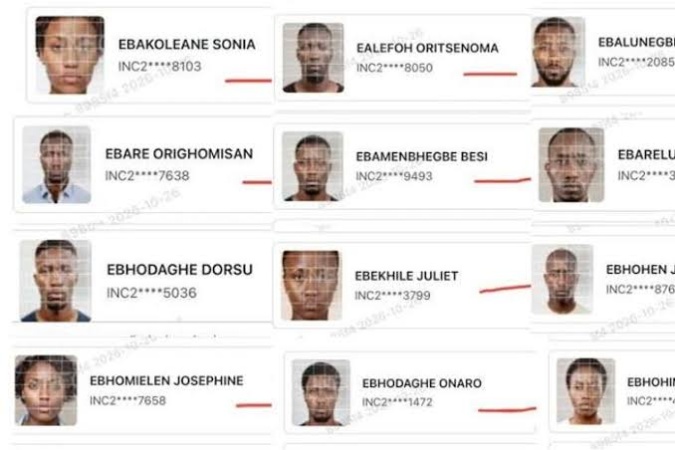
Meanwhile, INEC has reconfirmed suspected manipulation of its voter registration system by some officials, following the discovery of more than 1.5 million questionable registration records, warning that those found culpable will face severe sanctions.
The commission’s Director of Information and Communication Technology, Dr Lawrence Bayode, disclosed this during an interview on Channels Television’s Politics Today, where he revealed that some registration officials allegedly exploited their access to the commission’s registration platform to introduce irregularities into the national voter database.
Bayode, who described the discoveries as disturbing and embarrassing to the commission, said the alleged manipulation was not limited to isolated locations but had been identified across several states.
He explained that the commission deployed its Automated Biometric Identification System (ABIS), which uses fingerprint and facial recognition technology, to examine the 11,088,238 registrations recorded during the 2026 Continuous Voter Registration exercise.
According to him, the system flagged 1,545,052 records for various irregularities, including suspected multiple registrations and other discrepancies requiring further investigation.
He said that although a substantial number of the flagged records had already been removed, 268,000 remained for human verification before the commission could determine their authenticity.
Explaining why the commission did not automatically exclude all the flagged records, Bayode said the system was designed to identify suspicious entries, while human adjudication was necessary to establish whether they were genuinely fraudulent.
He said: “Any suspect has to be adjudicated to a human come and confirm what the ABIS has reported.”
The ICT director disclosed that some of the questionable registrations were allegedly facilitated by officials who exploited a special registration provision designed for persons with disabilities who had incomplete fingers or no fingers.
He explained that the provision allowed eligible individuals without complete fingerprints to register through an alternative process, but some officials allegedly abused the facility to create fictitious voter profiles.
According to him, the officials allegedly used their access credentials to create such profiles, exploiting the system’s provision for special registration to introduce questionable records into the database.
Bayode also disclosed that the commission discovered instances of identical photographs appearing against different voter profiles, as well as photographs allegedly sourced from calendars and picture frames and used to deceive its web-based registration platform.
He, however, distinguished between legitimate photographs enhanced with artificial intelligence applications and suspicious images used to create fictitious identities.
He explained that some genuine registrants might have used AI applications on their mobile phones to improve the quality of their photographs, insisting that such cases should not automatically be treated as fraudulent registrations.
The director said: “Some of the profiles have similar photo for different profiles with one photo. And you cannot find seven, eight people who are from the same family.”
Describing the alleged manipulation as extensive, he said some officials had identified loopholes in the registration system but rather than report them for correction, allegedly exploited them.
Bayode, who expressed disappointment over the development, said: “They saw the loophole and they leveraged on the system.”
He further disclosed that the commission had withdrawn access from the officials under investigation, adding that digital records and one-time password (OTP) authentication could help establish those responsible for the questionable registrations.
According to him, the registration system sends an OTP to an official’s registered email address or telephone number before access is granted, making it difficult for officials to claim that their credentials were used without their knowledge.
“If anybody is using your login details to do anything, it means that you are conniving with that person,” he said.
Bayode, however, said he was taking time to establish sufficient evidence before submitting his investigative report to the commission, stressing that he did not want innocent officials implicated without conclusive proof.
He assured that the commission would review the evidence and follow due process, expressing confidence that officials found culpable would face severe consequences.
He said: “This is an embarrassment. … Maybe the punishment now will be so huge than what they experienced in 2020.”
On the implications of the questionable registrations for the 2027 general election, the ICT director warned that fictitious voter profiles could potentially be exploited to manipulate elections if the irregularities were not identified and removed before the final register was certified.
Using a hypothetical polling unit with 800 registered voters, including 400 fictitious profiles, he explained that the production of Permanent Voter Cards for such entries could create an opportunity for electoral manipulation.
He, however, maintained that the commission’s Bimodal Voter Accreditation System (BVAS) had biometric safeguards capable of preventing individuals whose fingerprints were not captured from successfully participating in the voting process.
On concerns about the credibility of the preliminary register, Bayode explained that its release was necessary to allow Nigerians to participate in identifying questionable entries through the claims and objections process.
He said the commission had to balance the time required to complete biometric screening with the statutory timelines for publishing the preliminary register, adding that the document released was not the final register for the 2027 elections.
He maintained that the commission was working to complete the verification and cleaning exercise before December 15, when the final register is expected to be certified.
The ICT director also expressed openness to independent scrutiny of the voter database, saying the commission could engage a third party to examine the records if it considered such an exercise necessary.
He added that interested parties could request Certified True Copies of relevant records to examine the commission’s findings and corrective measures.
On public confidence in the electoral umpire, particularly following controversies surrounding the 2023 general election, Bayode acknowledged that the latest revelations had further complicated INEC’s efforts to rebuild public trust.
He said: “We are trying to build the trust, whether you like it or not, the trust is on the ground zero.”
He expressed regret that the alleged actions of some officials could undermine the commission’s efforts to restore confidence in the electoral process, insisting that INEC had learnt lessons from previous elections and continued to improve its technological systems, including BVAS and the INEC Result Viewing Portal (IReV).
Bayode assured Nigerians that the commission remained committed to conducting a credible 2027 general election, stressing that the integrity of the voter register was fundamental to the credibility of the entire electoral process. (Nigerian Tribune)




