 ADAD
Updating your news feed...

NEWS EXPRESS is Nigeria’s leading online newspaper. Published by Africa’s international award-winning journalist, Mr. Isaac Umunna, NEWS EXPRESS is Nigeria’s first truly professional online daily newspaper. It is published from Lagos, Nigeria’s economic and media hub, and has a provision for occasional special print editions. Thanks to our vast network of sources and dedicated team of professional journalists and contributors spread across Nigeria and overseas, NEWS EXPRESS has become synonymous with newsbreaks and exclusive stories from around the world.



















Loading banners
Loading banners...

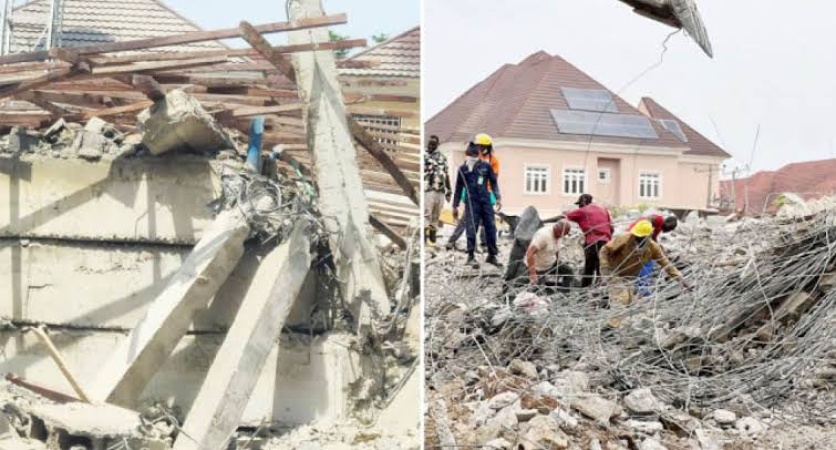
A collapsed building in Lagos
The recurring incidents of building collapse in Nigeria has again raised questions on structural and regulatory supervision in the real estate sector.
Checks by Daily Trust show that about N4.6 trillion has been lost to building collapse which led to the destruction of goods and valuable items.
Additionally, between January 2020 and June 2026, Nigeria recorded dozens of building collapses that killed hundreds and injured many more. Nationwide, more than 650 collapses have killed over 1,600 people since 1974, according to figures the Federal Government cited last month.
Lagos, Nigeria’s commercial capital accounts for over half of all recorded incidents. High-profile collapses there in 2021, 2022 and 2024 claimed dozens of lives and destroyed livelihoods.
Consequently, incidents continue to climb: residential blocks, commercial properties and even schools have given way, often during heavy rains or while occupants slept.
These are not isolated tragedies but symptoms of systemic failure in materials quality, regulation and enforcement.
Experts attribute these incidents to substandard block-moulding combined with defective materials, unprofessional construction practices, inadequate supervision and the push to cut costs
In Nigeria, the Standards Organisation of Nigeria (SON), state works ministries and local councils are mandated by law to regulate and ensure that building materials are up to standards.
N4.6trn lost
The Chartered Institute of Forensics and Certified Fraud Investigators of Nigeria (CIFCFIN), in partnership with the Council for the Regulation of Engineering in Nigeria (COREN) and the Nigeria Building and Road Research Institute (NBRRI) has set up an initiative to curb building collapses, noting that Nigeria is currently losing trillions
Speaking at the induction of the inaugural cohort of CEFFI professionals, Dr Iliyasu Gashinbaki, President and Chairman of the Governing Council of CIFCFIN, said the initiative stemmed from disturbing findings in a 2026 engineering study.
According to Gashinbaki, the study identified 111 validated building-collapse incidents in Nigeria between 2015 and 2025.
He said the incidents resulted in 321 deaths and 344 injuries, representing an average of approximately 32 deaths and 34 injuries annually within the dataset.
Gashinbaki added that fire-related losses were equally sobering.
He said a recent analysis of documented incidents between 2022 and 2025 estimated at least N4.6 trillion in destroyed goods, property and business assets.
He said this amounted to roughly N1.15 trillion annually across the dataset.
Gashinbaki said the figures demonstrated the need for Nigeria to move from reactive responses to evidence-based investigation and accountability.
He said the CEFFI initiative would bring together engineering, forensic science, law, regulation and investigation to strengthen the response to engineering failures.
“Where there is suspected negligence, fraud, malpractice or deliberate compromise of safety, properly conducted forensic engineering can preserve the technical evidence required,” he said.
He urged regulators, project owners, contractors, professional bodies and law-enforcement agencies to ensure that engineering failures did not end with repairs, abandonment or silence.
Gashinbaki said the initiative would help promote safer infrastructure, stronger institutions, better stewardship of public resources and the protection of human life.
Only recently, one person was injured after a five-storey building under construction partially collapsed on Durban Street, Wuse II, Abuja.
The National Emergency Management Agency, NEMA, confirmed the incident, which occurred at about 6:30 pm on Saturday, October 17, 2026.
In a statement issued by its Press Unit, the agency said its Abuja Operations Office received an alert about the collapse and immediately activated relevant emergency response agencies.
NEMA said the FCT Fire Service and its AYA Emergency Response Ambulance Bay team were among the responders mobilised to the scene to coordinate search and rescue operations.
The agency confirmed that no life was lost in the incident, while the injured worker was evacuated to a nearby hospital for medical attention.
What can be done
Two measures matter most. First, criminal and civil liability must extend to manufacturers, suppliers and complicit professionals where negligence leads to collapse, with State Houses of Assembly legislating penalties stiff enough to deter, alongside whistleblower protection.
Second, SON must move from paper standards to street-level enforcement: mandatory certification for block producers, regular market sampling and lab testing, and tighter import checks. Supporting this, local councils should license and inspect block-moulding sites, publishing lists of certified producers and revoking licenses for repeat offenders.
Approval processes must include mandatory on-site inspection at foundation, lintel and roof stages, not just at submission – with inspectors trained, equipped and rotated to reduce corruption. Digital permit platforms publishing inspection status would add pressure that paper files cannot. (Daily Trust)




