 ADAD
ADADUpdating your news feed...

NEWS EXPRESS is Nigeria’s leading online newspaper. Published by Africa’s international award-winning journalist, Mr. Isaac Umunna, NEWS EXPRESS is Nigeria’s first truly professional online daily newspaper. It is published from Lagos, Nigeria’s economic and media hub, and has a provision for occasional special print editions. Thanks to our vast network of sources and dedicated team of professional journalists and contributors spread across Nigeria and overseas, NEWS EXPRESS has become synonymous with newsbreaks and exclusive stories from around the world.


Loading banners
Loading banners...

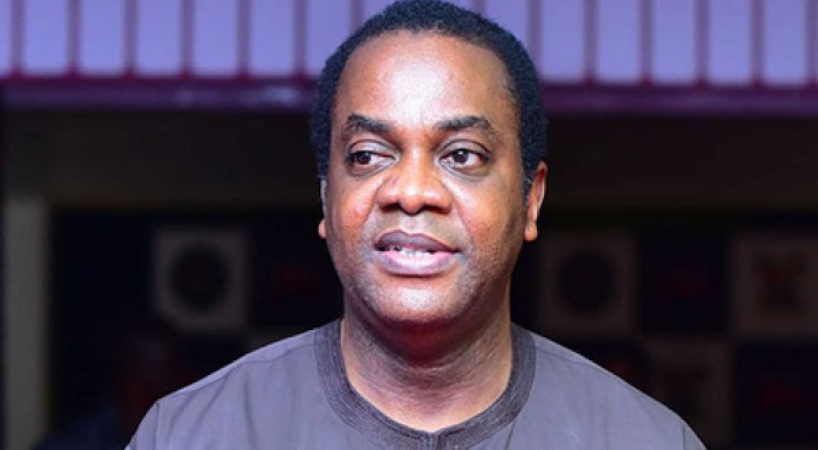
PRP presidential candidate, Donald Duke
Presidential Candidate of the People’s Redemption Party (PRP), Donald Duke, has questioned Nigeria’s high crude oil production costs, saying the country spends more on securing its oil than on producing it.
Speaking during an interview with ARISE NEWS on Thursday, Duke aid security expenses and deteriorating infrastructure had pushed production costs to between $25 and $45 per barrel despite the actual cost of extracting crude being between $12 and $15, arguing that addressing these expenses could help Nigeria lower petrol prices and reduce the cost of living.
“The actual production cost of a crude in Nigeria is anywhere between $12 and $15. What takes it up to $25 or $45 is security costs and dilapidated infrastructure. So you’re paying more for security than producing the oil and even the NNPC says that they’re trying to bring it down to $20 a barrel. So in other words, the oil producing companies have added the security. You can’t tell me that you pay about $10 or $15 to secure one barrel that is produced actually between $12 and $15.”
He defended his proposal to reduce petrol prices, arguing that Nigeria’s status as an oil-producing country should translate into cheaper energy for its citizens. “I think the fundamental objective of government is the productivity of its citizens. So you’ve got to tackle all the things that are inimical to the productivity of your citizens.”
Duke said energy was central to achieving that objective, questioning why Nigeria continued to struggle with high petrol prices despite its crude oil resources. “Now, energy is a kernel of it. Energy, capital, those things are very important. You’re an oil producing country. Supposedly you produce 1.7, 1.8 million barrels a day.”
Explaining his proposed pricing model, Duke said. “Transportation takes it to $38. The refining costs about $10 a barrel. So that gives you $48.”
Duke insisted that the government should consider the revenue generated. “The kernel here is this. It’s $471. Age yield will come to about $570. That’s all fine. But there are other by-products. There are about seven by-products from BunnyLite.”
He maintained that petrol prices had a direct effect on inflation. “My point is this. If a product is so critical to running your economy, which is probably the main inflation index you have, because the price of fuel affects literally everything, it’s incumbent on you and on government that is focused on the productivity of its citizens to dampen it as much as possible.”
Duke also clarified that his original proposal was to reduce petrol to ₦300 per litre, not ₦200. “The point is, the margins that you make from other products, you can even use it and further dampen the price of $300. I never said $200. I said $300. $300.”
When questioned about Nigeria’s existing crude oil commitments, including forward sales tied to loans, Duke acknowledged that. “300 figure is not tenable because the APC government, right, did a forward sale that didn’t make sense. But the reality is that you now have to blend. And if you blend it to say 700, 700 is still far better than 1,300.”
He argued that the government could combine available domestic crude with additional supplies purchased from producers operating in Nigeria. “If you don’t have the Nigerian crude, which is the fault of the same government, it’s APC. I’m coming, I’m coming. If you don’t have that crude, then you now go into the blended. What do you have and what can you buy? And try and buy it from the producers in Nigeria if they will allow you. So that at least you gain on freight.”
Duke proposed an arrangement under which the government would supply crude to a refinery.
“Now, you contract refine. Recall, several years back, we used to swap crude for products, right? So it’s literally the same thing. You swap this, and I gave you my breakdown that it’s $10 maximum. I’m using the maximum here, $10 per barrel for refining.
“So it’s not, and it’s your crude. So you’re giving the refinery and saying, look, we agree on a price. I pay you that price. The product is mine. I know the by-products and how I distribute it, how I sell it, you know, it is left to me.”
Duke maintained that even if ₦300 was no longer immediately achievable, the government could still significantly reduce the current cost of petrol. “If you take what you have and buy it back from your JV, JV partners and blend and put it together and blend the prices, the average, it will not be 300. It will be far less than what you’re paying today.”
Asked whether ₦700 or ₦800 per litre was a more realistic benchmark, Duke replied. “Benchmark. Yes. If you’re not, if the crude is not yours.”
The PRP presidential candidate also rejected the argument that cheaper petrol would automatically lead to increased smuggling. “Are you going to punish your citizens for your inability to map your borders? Let me give you another solution. You see, as a government, you must constantly think of solutions to problems.
“You can dye your fuel. You can dye your fuel black if you wanted to. It doesn’t affect its application. And if you dye it black and you see black fuel or green fuel around your neighbouring countries, you have NIA. They go there in cooperation with the nation’s security agencies and find out how that black fuel, which is unique to Nigeria, got there.”
Turning to the Lagos-Calabar Coastal Highway, Duke renewed his criticism of the project.b”It’s actually the Lagos Coastal Highway. Don’t call it Lagos-Kalaba. And I’ve said that over, it will not get there. And the minister has vindicated me. And he talks also about the terrain.”
He questioned the decision to construct a new coastal route while an existing road already connected parts of the region. “It’s not that you can’t build a road across Bayelsa, but it’s just not affordable. And it doesn’t make sense because there is a road going to Calabar, if that is it.
“But I think the idea behind the road was to give a coastal road from here, from, and they said it from Victoria Island, for goodness sake, right from Amadu Bello Way and you go straight to Epe, then on the side of it, you’re sand filling along. To me, it’s a land grab. Let’s be honest with ourselves.”
Duke also questioned the reported decision to divert the proposed route onto the East-West Highway. “Now, they have now said that they’re going to divert the road onto the East-West Highway. Weren’t they aware of the East-West Highway from get-go?”
He argued that the country’s financial position did not justify the project. “ It’s just not feasible. We don’t have the kind of money to do it. We’re literally borrowing to even the stretch, the Egbe stretch. We’re borrowing. We can’t do it.”
Duke contrasted the project’s cost with funding for essential public services, questioning the government’s spending priorities. “Look, this programme, I think even this morning, you said health, which is critical to governance. Only 36 million Naira was released last year, from a budget of almost 300 billion. So what are our priorities?”
Explaining his opposition to the direction of Tinubu’s administration, Duke said Nigeria needed to prioritise economic growth and productivity rather than focus heavily on revenue collection. “Focus on growing your economy. You can’t grow your economy at 30-something percent interest rate. It’s not possible. No one would go to a bank and borrow money at such high costs. And even the banks won’t even give you, because they know that you can’t pay, right?”
He linked the country’s inflationary pressures to the cost of energy, saying reducing petrol prices was necessary to make businesses more productive. “The central bank will tell you it’s because of inflation. What are the inflationary items? Your cost of fuel is horrendous. So that is an inflation. And that’s why it makes it incumbent to try and bring down the price of fuel as low as possible.”
Duke also criticised the government’s economic management. “This tax minister who sells himself coordinating minister of economy, you know, big names kill small dogs, right? He’s looking at revenue, not the totality of the economy.”
He said the government should expand its revenue base through economic growth rather than depend heavily on petrol-related earnings.
“If you say you’re the largest economy in Africa and your GDP is about 400-and-something billion or so, the figures, you should be able to raise about 15 to 20 percent of your GDP as your budget. We’re still at 5 percent. So we’re not even capturing the numbers we should.
“We’re just focusing on petrol. But it’s a double-edged sword, because if you focus on that, you’ll remain poor, as we are.”
Asked about his immediate priorities if elected president, Duke identified energy, healthcare, education, infrastructure and the productivity of Nigerians as areas requiring urgent attention.
“Everything in Nigeria is almost a state of urgency, but I’ll strengthen, I’ll come back to this energy thing because it’s what is stifling the country, right? I’ll focus on health, I’ll focus on education, of course, infrastructure, but more importantly, I’ll be focussing on the productivity of Nigerians.”
He said the relationship between wages and living costs had become unsustainable, pointing to the inability of workers to afford basic expenses. “Nigerians are not productive because the banks are not lending. The cost, look, the average, if you’re a worker, your one salary can’t fill your minimum wage, can’t fill your tank. Those are the things killing Nigerians.”
Duke declined to promise an immediate salary increase, saying he would instead prioritise reducing the expenses consuming workers’ earnings. “I didn’t say I would increase salaries. Oh, okay. No, I can’t sit down on this chair and say I’m going to increase salaries because there’s so many things you’ve got to look at.
“But what I will strive to do is reduce the cost of those things that grapple at our salaries.”
Duke also questioned Nigeria’s foreign exchange management, arguing that the value of the naira should reflect the country’s economic capacity and be managed according to available foreign currency supply. “The other day we said we floated our currency. You don’t control anything. You don’t control supply. You can control demand, but you don’t control supply. Your currency is your economic worth.
“Just as your reputation is your personal worth, you don’t float it, you manage it. If you look at the dynamics, you know that you don’t have enough supply coming in a foreign exchange. Then you’ve got to look at what the demand is like and try and curb it.”
The former governor also warned against using the size of Nigeria’s foreign reserves as the main measure of economic progress. “ We should stop judging the well-being of our economy by the size of our reserves, right? That means that, oh, you’re geared towards importation. We should be geared towards production.
“For instance, we have reserves of 100 billion. We’re going to clap for ourselves, oh, we’ve done very well. No, it means that you’re going to be employing more people outside the country to manufacture goods for you.”
On the political situation ahead of the 2027 presidential election, Duke criticised opposition parties supporting Tinubu, drawing examples.
“Some of the opposition parties, supporting the president. It was reminiscent of what happened in Abacha’s transition. You know, the five leprous fingers? Yes. So you now have four leprous fingers, because one of the fingers has dropped off.”
“You should find time because we shouldn’t be glib about where we’re going. I said that where we’re going in this country is, we’re looking at disaster. We are looking at disaster. We’re doing nothing about it. We’re playing politics with ourselves.” (AriseNews TV)




