Updating your news feed...
NEWS EXPRESS is Nigeria’s leading online newspaper. Published by Africa’s international award-winning journalist, Mr. Isaac Umunna, NEWS EXPRESS is Nigeria’s first truly professional online daily newspaper. It is published from Lagos, Nigeria’s economic and media hub, and has a provision for occasional special print editions. Thanks to our vast network of sources and dedicated team of professional journalists and contributors spread across Nigeria and overseas, NEWS EXPRESS has become synonymous with newsbreaks and exclusive stories from around the world.






















.webp)

Loading banners
Loading banners...

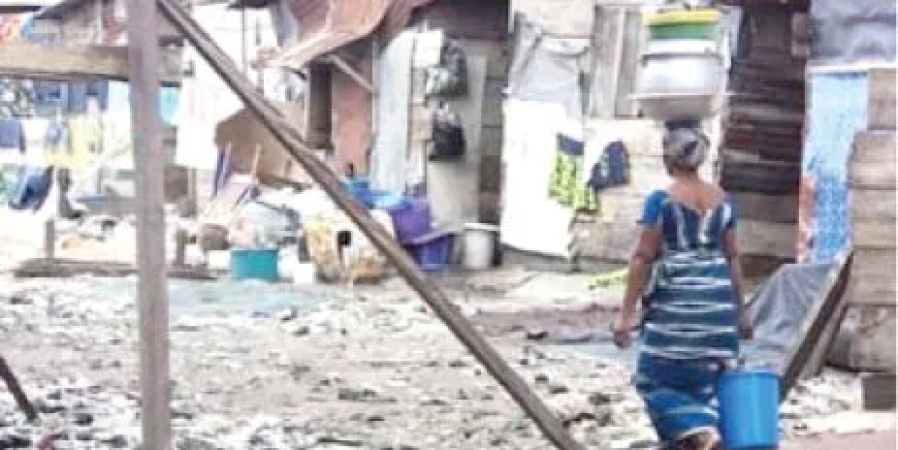
By 5:30am, the day has already begun for residents of Tunkarimu, one of Ajegunle’s crowded informal settlements. The first sounds are not those of traffic or commercial activities but footsteps and voices from residents scrambling to use one of the few bathrooms serving occupants of 16 rooms in the densely populated community. For those heading to work, the morning routine is a race against time.
Describing life in the community, a resident who identified himself as Adeolu said, “Taking a bath in the morning is a nightmare here. The bathroom is very small, yet many people depend on it, so you wake up early and still meet a long queue of people waiting for their turns.”
Adeolu said the wait could be long enough to disrupt the day’s plans. “Sometimes you have to stand there for a long time before you can get in. It becomes frustrating, especially when you are already thinking about going to work or starting your day’s business,” the 65-year-old Adeolu, who claimed to have been born and brought up in Lagos, said.
He added that the situation could worsen when the only available source of water for washing – a well – dries up due to the number of people it serves daily.
A middle-aged man in Okorogbo Street who simply identified himself as Samuel also said: “Some of us stay up late to fetch water into any available bucket or container, which we keep inside our rooms as reserve for the next day.”
Our correspondent observed that inside the settlement, such inconveniences are part of everyday life. For residents who pay N10,000 a month for a room, affordable accommodation comes with a catalogue of compromise, which range from overcrowding to shared facilities, limited privacy, poor sanitation and the constant anxiety that comes with living in an informal settlement. Yet they stay because the alternative is often beyond their means.
For Lagos’ poorest residents, the biggest obstacle to decent housing is not necessarily the monthly rent, it is the upfront payment.
A conventional apartment may require an annual rent running into thousands of naira, in addition to agency, legal and other charges.
For a casual worker, petty trader, cleaner, porter or low-income artisan earning money daily or weekly, getting such a lump sum is nearly impossible.
In the not-too-far area of Tolu, Wowo Street is another of such settlement. In the cramped rooms lining the settlement, 61-year-old Basil Owunka’s family of eight prepared for another night of living with little space and less privacy. Theirs is a room that could hardly pass for a proper dwelling elsewhere.
Popularly referred to as “Face Me, I Face You,” such one-room apartments usually breed daily quarrels among housewives and children as they serve as homes to many. For some residents, however, the attraction is the N5,000 or N10,000 per month that enables them secure roofs over their heads.
In a city where formal accommodation often demands rents running into hundreds of thousands of naira, the figure offers a lifeline to workers whose incomes arrive in small, uncertain amounts.
But according to another resident who identified himself as Basil, the low rent comes with difficult bargain. He said residents would usually trade comfort for affordability, privacy for overcrowding and security of tenure for the assurance that they can sleep somewhere at the end of the day.
Basil, who works as a labourer at a local sand dredging site at Tin-Can Island, revealed that a room at Tolu area was affordable to the poor. And according to him, for a casual worker, roadside trader, cleaner, porter or petty businessman, the problem is rarely lack of willingness to pay rent but the upfront cost collected by property owners at the luxurious areas of Ajegunle.
He said the situation was further worsened by greedy agents, who, according to him, are the brains behind the high prices of accommodation in the area.
He said, “A landlord may demand a year rent before handing over the keys. When you add agency, legal and caution fees, a seemingly affordable apartment can suddenly require hundreds of thousands of naira.”
Basil, who claimed to have resided in Wowo Street at the Olodi Apapa area of Tolu for over 20 years, explained that for low income earners, the dream of living in a near-comfortable apartment is an impossible financial wall.
“I once lived in a descent accommodation along the Old Ojo Road. That was before I lost my job as a sailor onboard a fishing trawler. I was kicked out of my apartment by my landlord because I owed house rent for about two years and couldn’t pay. To survive, I joined people carrying sand from local boats at Tin-Can First Gate,” he said, explaining that he moved into his present accommodation when efforts to secure another job failed.
He also said Tunkarimu was meant for people who could not raise a large annual rent at once, adding that the rooms are barely large enough for the occupants as a mattress can occupy much of the available space. Clothes, cooking utensils and other belongings compete for the remaining corners.
Interestingly, despite overcrowded compounds with rusted corrugated roofs, the area has attractions and fun side.
Kehinde, a bricklayer, who revealed that they live a communal lifestyle in the area said: “At times when I don’t have enough money to feed myself, it is not a problem as I can ask my neighbour’s wife to help me with a small soup while I buy fufu with the small money in my pocket.”
According to him, residents ask one another for anything they don’t have at home, including matches, salt or garri.
He said that for some households, the same room serves as bedroom, living room, kitchen and store. At night, family members ‘squeeze together’ to sleep, and by morning, the space becomes a staging ground for another day of work.
The shared bathroom is one of the clearest reminders of the price residents pay for cheap accommodation. Some of the residents who did not want their names mentioned described the morning queue as a daily source of frustration.
“You cannot just take your time because many other people are waiting behind you. You have to hurry through your bath so that others can use the bathroom,” they said.
For someone who must leave early for work, a delay at the bathroom can mean arriving late and losing income. “At times, I wonder how we have become used to living this way. You pay your rent but you still have to struggle for basic things like taking a bath in the morning,” one of the residents said.
This daily frustration captures a wider contradiction at the heart of Lagos’ informal housing crisis. The N5,000 or N10,000 rent therefore tells only one part of the story. In some parts of the area, some of the old houses are now giving way to new buildings as they have been sold out.
Weekend Trust reports that most of the recently acquired properties have been converted into hotels or entertainment centres.
Along the smelly canal that runs from the back of Boundary Market to Liverpool, there are wooden structures that also serve as residences. Here, residents also pay through the quality of their living environment. Shared bathrooms and toilets can become congested during peak periods. Water supply may be unreliable. Poor drainage can leave pathways flooded after heavy rainfall, while inadequate waste disposal can worsen sanitation problems.
In tightly packed communities, fire is another concern as structures are often built close to one another, leaving limited access for emergency responders.
Residents know these risks but continue to stay because they have few affordable alternatives.
Another resident said: “The room is not what I would want for myself or my family, but if I leave, where would I go? The rent outside is too much.”
Weekend Trust also reports that the people living in these settlements are not disconnected from Lagos economy as they sell food in the streets, work as cleaners, carry goods in markets, repair vehicles, operate small shops, fish, wash cloths, drive commercial vehicles and perform countless other low-paid jobs. They leave their homes early and return late, yet their wages are often insufficient to secure decent accommodation.
Amukoko is another crowded suburb of Ajegunle where there is housing crisis, particularly in waterfront communities, where generations have built homes and livelihoods around fishing, trading and other informal activities.
For residents, the community is more than a place to sleep, it is where they work, raise children, conduct businesses and maintain social networks. When a family loses its room, it may also lose access to customers, schools, workplaces and relatives who provide support. (Daily Trust)