Updating your news feed...
NEWS EXPRESS is Nigeria’s leading online newspaper. Published by Africa’s international award-winning journalist, Mr. Isaac Umunna, NEWS EXPRESS is Nigeria’s first truly professional online daily newspaper. It is published from Lagos, Nigeria’s economic and media hub, and has a provision for occasional special print editions. Thanks to our vast network of sources and dedicated team of professional journalists and contributors spread across Nigeria and overseas, NEWS EXPRESS has become synonymous with newsbreaks and exclusive stories from around the world.












.webp)



Loading banners
Loading banners...

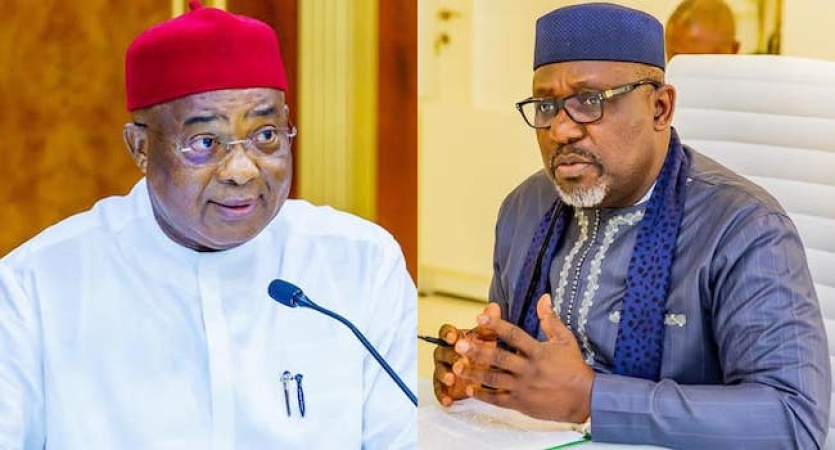
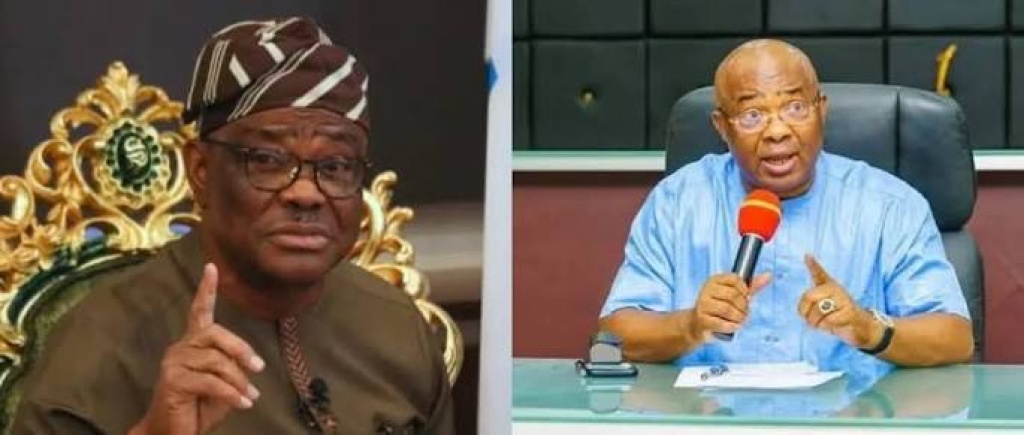
Imo State Gov Hope Uzodinma and his predecessor, Rochas Okorocha
Governor Hope Uzodinma of Imo State wants to move into the Senate in 2027. Standing against that ambition, however, are not just a rival’s court papers but the National Assembly’s own calendar and the 1999 Constitution itself.
The timing problem is stark. Uzodinma’s tenure as governor runs until January 2028. The 11th National Assembly, by contrast, is scheduled for inauguration in June 2027, a full eighteen months before his governorship naturally ends. Layered on top of that is Section 183 of the Constitution, which provides that the Governor shall not, during the period when he holds office, hold any other executive office or paid employment in any capacity whatsoever.
The implication is direct. If Uzodinma wins the senatorial election, he cannot simply be sworn in alongside his governorship, since he would have to leave one office before taking up the other. Officials in his government have already floated a workaround in which the governor would vacate office early so his deputy completes the remainder of the term, freeing him to take the Senate seat in June 2027.
It is against this backdrop that former Governor Rochas Okorocha has sued INEC, over the commission’s publication of Uzodinma’s name as the APC candidate for the Imo West senatorial seat. His suit stands on two distinct legs.
The first is a numbers dispute. Okorocha claims he actually won the 18 May APC primary, scoring 150,780 votes to Uzodinma’s 102,158, and is asking the Federal High Court to set aside INEC’s August 1 publication and declare him the party’s validly nominated candidate instead.
The second, and more novel, is an eligibility challenge. Okorocha is separately contesting Uzodinma’s competence to contest the seat at all while still governor, citing Section 183. His argument is not merely that Uzodinma lost the primary, it is that Uzodinma cannot validly be a candidate for a seat he would be constitutionally unable to occupy on the day the 11th National Assembly is inaugurated, since his governorship would still, on the calendar as it stands, have a year left to run.
The floated solution of resigning early so the deputy governor completes the term has a real precedent, though not one that maps cleanly onto Imo’s situation. David Umahi’s move from the Ebonyi governorship to the Senate in 2023 is the closest recent comparison. His second term as governor ended on 29 May 2023, and he was sworn in as senator for Ebonyi South just over two weeks later, on 13 June 2023. Crucially, Umahi did not need to resign early or invoke Section 183 at all, since his governorship simply expired on schedule at almost the same moment the 10th National Assembly was inaugurated, leaving no overlap for the Constitution’s incompatibility clause to bite on.
Uzodinma has no such clean handover available. His term does not expire until January 2028, so an early exit for a June 2027 Senate inauguration would be a genuine truncation of an electoral mandate voters gave him for a fixed term, not a routine end of tenure transition. Whether a governor can lawfully cut short a popular mandate by resignation simply to take up a different elective office is a live constitutional question in its own right, distinct from anything Section 183 spells out explicitly. The section bars holding two offices at once, but is silent on whether a sitting governor may pre-emptively resign specifically to clear the way for a seat he has not yet even been declared to have won.
That gap is what gives Okorocha’s second leg its bite. He is not waiting for a resignation crisis to unfold after the election, he is arguing the incompatibility should disqualify the candidacy now, before the vote is even held. None of Nigeria’s settled case law on candidate eligibility squarely answers whether a future, not yet arisen incompatibility can invalidate a candidacy at the nomination stage, which makes this untested legal terrain.
Beyond the eligibility question, Okorocha’s first leg, the primary vote dispute, sits inside a much older body of law. Nigerian law does not permit independent candidacy. Sections 221 and 222 of the 1999 Constitution recognise political parties as the only vehicles authorised to sponsor candidates for elective office, and Section 65(2)(b) requires that a person seeking election be a member of, and sponsored by, a political party.
Sponsorship is the constitutional gatekeeper, though it is not unconditional. The Supreme Court held in SDP v. INEC (2023) that because neither the Constitution nor the Electoral Act permits independent candidates, parties hold a monopoly over who they sponsor. That monopoly, however, is exercised inside statutory guardrails, not outside them.
The governing framework is the Electoral Act 2026, which superseded the 2022 Act after President Bola Tinubu signed the amendment into law on 18 February 2026, altering how parties nominate candidates and manage their internal affairs. Three provisions matter most. Primaries are mandatory, and INEC must watch them.
Section 84(1) provides that every party seeking to nominate candidates shall hold primaries for all elective positions, monitored by INEC, language that is mandatory rather than permissive. Section 84(2) narrows the options further, confining nomination to direct primaries or consensus only, dropping indirect delegate primaries. A candidate produced outside these rules cannot stand. Section 84(13) states that where a party fails to comply with the Act in conducting its primaries, its candidate for that position shall not be included in the election, giving the requirement statutory teeth.
Substitution after a valid primary is also tightly restricted. A party cannot remove or substitute a candidate who emerged from a valid primary, and the current Section 33 limits substitution to recognised exceptions, principally death or the candidate’s own voluntary withdrawal within the stipulated time.
Consensus, too, has its own discipline. Section 84(9) requires a party adopting a consensus candidate to secure the written consent of every cleared aspirant, indicating voluntary withdrawal and endorsement. Where that consent cannot be secured from all cleared aspirants, the party must revert to direct primaries, and a consensus candidate must still be one of the cleared aspirants the others are stepping aside for, not a stranger to the contest.
The courts have already built a body of precedent around these questions. Amaechi v. INEC (2008) remains foundational. The Supreme Court held that while it is the party that wins an election, the party cannot act outside the law, and refused to reward the unlawful substitution of a candidate who had legitimately emerged from the primary process.
It is precisely this logic, that lawful emergence from a primary, not physical appearance on a ballot, determines who a party’s candidate is, that Okorocha is now asking the Federal High Court to apply to his own claimed primary win. APC v. Marafa (2020), drawing on the Zamfara precedent, reinforced that parties must strictly comply with their own constitutions and the Electoral Act, with consequences that can extend beyond individual aspirants to the party’s entire participation in an election, as demonstrated in 2019, when the Supreme Court nullified every APC victory in Zamfara’s National Assembly elections after ruling the party had not conducted valid primaries at all. Atuma v. APC (2023) held that once a party has validly chosen a candidate through a genuine primary, it cannot arbitrarily change that candidate or cancel the primary without just cause, and that submitting the winner’s name to INEC is compulsory. Lado v. CPC (2011) and PDP v. Ezeonwuka (2018) set the jurisdictional boundary, establishing that nomination is ordinarily an internal party affair, but that courts acquire jurisdiction the moment there are allegations of non-compliance with the Electoral Act or a party’s own guidelines. Standing itself is narrowly held.
Only a person who participated in the primary as candidate or aspirant has legal standing to challenge its outcome, as established in Igwemma v. Obidigwe (2019). Okorocha’s own participation in the 18 May primary is what gives him standing to sue at all on both legs of his case.
A genuinely unresolved frontier, flagged in a July 2026 analysis by lawyer Muiz Banire, is what happens when INEC’s own monitoring report contradicts the list a party eventually submits. Treating the party’s list as automatically supreme would make INEC’s statutory monitoring meaningless, while treating INEC’s report as automatic sponsorship would usurp a power the Constitution vests in parties alone. Banire concludes that judicial determination, not unilateral assertion by either side, must resolve such conflicts, and predicts the Supreme Court will eventually have to pronounce on it directly. Between the vote count dispute and the Section 183 eligibility question, Okorocha’s suit may become exactly that test case twice over.
The Imo West dispute’s primary count dimension sits inside a far broader wave. Nearly four months after APC’s 2026 primaries, reconciliation efforts had failed to contain fallout across several states, leaving aggrieved aspirants to choose between litigation or defection. Ondo aspirants are suing APC and INEC over primary outcomes, Osun’s Iyiola Omisore has rejected reconciliation after being screened out, and in Katsina a sitting APC lawmaker defected to PDP after his party declined to adopt him as consensus candidate. In Ogun, party leaders unilaterally settled on a senator as consensus governorship candidate, while at least one prominent aspirant was conspicuously absent from the meeting that produced that consensus.
In Gombe, a PDP aspirant petitioned the party’s appeals panel alleging he was screened and cleared but never informed of the primary that produced his rival. In Zamfara, aspirant Sani Abdullahi Shinkafi has sued APC and INEC over a May 2026 senatorial primary he says was neither a valid direct primary nor a lawful consensus process, a near carbon copy of the 2019 Zamfara crisis that ended in the Supreme Court wiping out the party’s entire slate.
Underlying much of this is a genuinely new legal controversy, whether an aspirant who loses a primary in Party A can decamp and become Party B’s candidate without ever contesting Party B’s primary. One reading holds that Section 77’s membership register rule only bars a defector from voting in a new party’s primary, and does not clearly stop that same person later emerging through consensus. The question is already before appellate courts, with a High Court ruling favouring defectors under appeal by INEC.
The legal implications extend well beyond Imo West. Section 285 of the Constitution compels pre election matters to be resolved within tight windows before elections, yet the anomaly is generating disputes at industrial scale. Rivers, Edo, Ogun, Ondo, Lagos, Benue, Plateau, Kwara, Kebbi, Kano and Zamfara have all produced suits in the current cycle, making candidate selection, not the general election itself, the real adjudicative battleground of 2027.
Doctrinal uncertainty persists at the point that matters most, since until an appellate or Supreme Court pronouncement on the Section 77 defection question, every party using consensus to onboard a recent defector operates in a legal grey zone, precisely the incentive structure that produces more litigation rather than less. Okorocha’s Section 183 argument also opens a new front of pre-emptive incompatibility challenges. If it succeeds, it would establish that a candidacy can be struck down before an election even occurs, based on a projected inability to occupy the office on inauguration day, a theory with obvious application to any other sitting governor eyeing a National Assembly seat before their gubernatorial term naturally expires. If it fails, it will just as clearly establish the opposite, that incompatibility only matters once it actually arises, leaving early resignation as a legitimate if politically costly cure.
Locus standi is becoming a shield as much as a filter too, since only aspirants within a party can challenge that party’s nomination process, meaning a consensus arrangement in which every cleared aspirant signs a written withdrawal, however coerced, can become effectively unchallengeable from outside. And enforcement consistency will determine whether Section 84(13) has real teeth, since its promise that a non compliant candidate shall not be included in the election only deters bad faith nominations if courts and INEC apply it evenly, while selective or delayed enforcement quietly converts a mandatory rule into a discretionary one.
The political implications are just as significant. A mid term resignation, even a clean one, carries its own political cost. Should Uzodinma pursue the vacate for the deputy route, it would mean a governor stepping away from a mandate voters gave him for a full term roughly a year and a half early, a precedent other governors eyeing the Senate or federal appointments may be tempted to copy, and one likely to draw its own scrutiny over whether convenience is being dressed up as constitutional compliance.
Consensus is functioning, in practice, as a rebranding of imposition. At least 22 governors have already endorsed a single consensus presidential candidate, and the same top down model is being replicated downward, anointing senators, House members and state assembly candidates, sometimes installing relatives or inexperienced loyalists with little grassroots standing. This is corroding intra party democracy at the moment parties can least afford it.
Analyst Jackson Lekan Ojo has warned that candidates imposed through manipulation or godfatherism tend to produce weak governance because they lack genuine public legitimacy, a direct line from how a candidate emerged to how they govern once elected. Parties are risking repeats of Zamfara 2019 too. APC figures there have explicitly invoked that history, warning that the same pattern of internal wrangling and imposed candidates cost the party the state in 2019 and contributed to losses in 2023, a lesson the current Shinkafi suit shows has not stopped the practice, only made it more contested.
Voter trust and turnout are the longer term casualties, since when primaries function as ceremonial endorsements of decisions made elsewhere, and aspirants without money are screened out regardless of merit, citizens increasingly conclude elections are decided before ballots are printed, a dynamic one commentary framed as the point at which democracy most often dies in Nigeria, since parties meant to recruit leaders are instead being captured by them.
Governance costs follow the litigation, win or lose, since research on Nigeria’s post election litigation culture has linked the pattern to diversion of public funds toward court battles and entrenchment of godfather networks that prioritise loyalty over competence in subsequent appointments, meaning the anomaly’s damage carries through into who actually gets appointed once a disputed candidate wins office.
Stripped of the political noise, Okorocha’s suit rests on two distinct legal propositions, that a primary’s outcome, not a party’s subsequent preference, determines who its lawful candidate is, and that a candidacy itself can be void from the outset if the office it targets is one the candidate would be constitutionally barred from occupying on the day it matters. What makes this moment different from earlier cycles is that the first question is now being tested simultaneously in Katsina, Ogun, Osun, Ondo, Gombe, Zamfara and at the presidential level of a major opposition party, while the second, so far, is Imo West’s alone. Whichever way the Federal High Court rules on either leg, Okorocha’s gambit is shaping up to be the case that settles far more than one senatorial seat. (The Sun, excluding headline)