Updating your news feed...
NEWS EXPRESS is Nigeria’s leading online newspaper. Published by Africa’s international award-winning journalist, Mr. Isaac Umunna, NEWS EXPRESS is Nigeria’s first truly professional online daily newspaper. It is published from Lagos, Nigeria’s economic and media hub, and has a provision for occasional special print editions. Thanks to our vast network of sources and dedicated team of professional journalists and contributors spread across Nigeria and overseas, NEWS EXPRESS has become synonymous with newsbreaks and exclusive stories from around the world.











Loading banners
Loading banners...

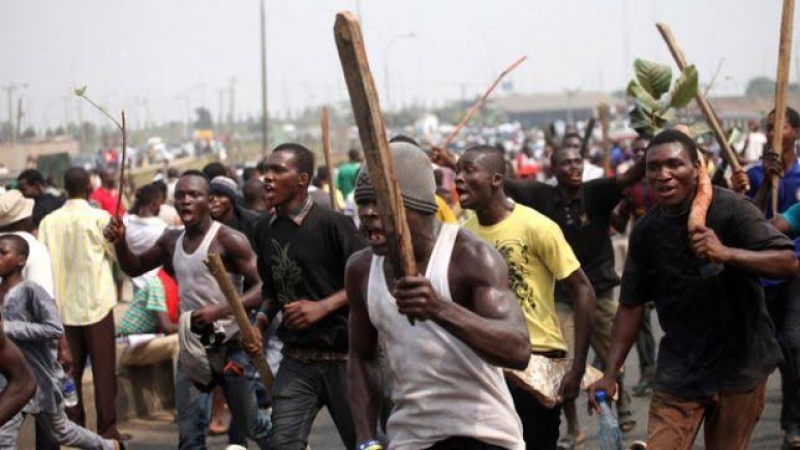
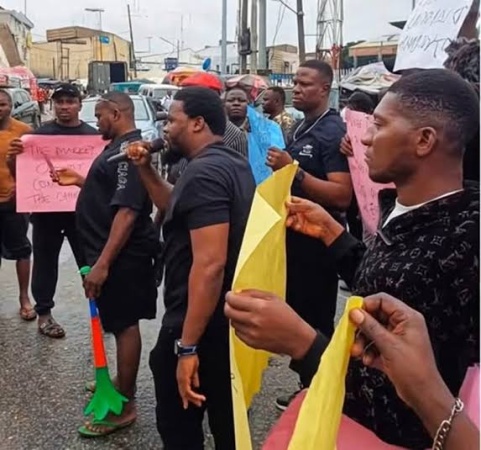
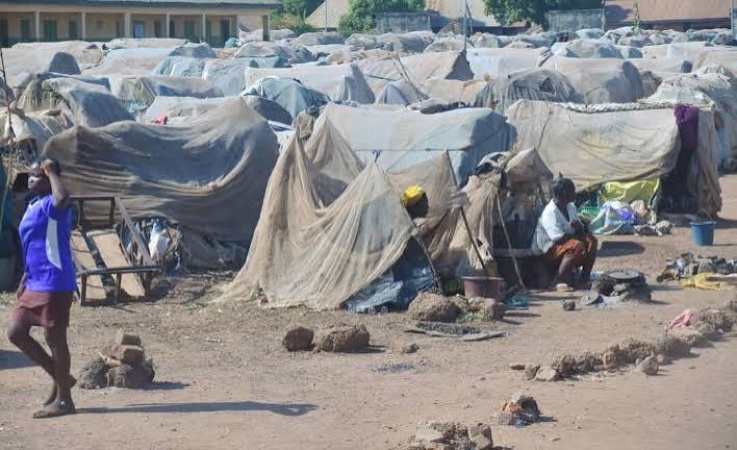
The protesting Trade Fair Complex traders
The Chinese-must-go protest staged by some traders at the Trade Fair Complex in Lagos on Tuesday has triggered apprehension among Nigerians resident in China and traders doing business at the foremost complex in Lagos State.
The traders, from videos obtained by our correspondent, were seen protesting against alleged infiltration of their retail businesses by the expatriates, demanding their exit.
Findings revealed that the Nigerian community in China was immediately thrown into panic mode immediately the provocative videos surfaced online.
A trader at the Trade Fair Complex who identified himself simply as Veen, said the mood of the citizens in China was perplexing.
His words: “Our brothers and friends in China were alarmed by the videos in which the protesters asked Chinese business people to go.
“A brother of mine particularly asked if those protesters understood the problem such videos could cause them over there. They are worried that the Chinese authorities could begin victimising them or even start deporting them.”
Another trader who gave his name simply as Nnamdi said: “Nigerians in China bombarded everybody they know in the market with calls when they saw the video. As you are answering one call, two or more calls are jamming your conversation and consequently obstructing the call you are answering.
“They were calling out of fear of the backlash the protest by our people could have on them. The callers kept pleading that we should appeal to our people to calm down and discontinue the protest because it will end up as an ill wind that will do nobody any good.”
A respondent who gave his name as Ebenezer said a relation in China expressed concerns that the protest could take away the little business gains they are getting with their host and consequently affect the businesses back at home.
“That is the fact, my brother. If China gets angry and terminates certain privileges our people are getting over there, will it not affect the businesses back at home? If you see how troubled our people over there were on that day, you would wonder if it was more than that protest by a few traders.”
Aside from the anxiety that the protest has created for Nigerians in China, our correspondent reported that traders at the Trade Fair Complex have also been jittery since the incident occurred.
From the entrance of the market to the nooks and crannies, most traders refrained from speaking about the incident. A good number of the people feigned ignorance of the protest. I am not aware of any protest was the quick answer from many of the traders, including motorcyclists.
To locate the exact place the protest took place, our correspondent literally combed the expansive market. Check at Balogun, ask at GL, the protest probably took place at Auto Parts First Gate, I think it was at Auto parts main gate, among others, were the different responses provided by the different people approached by our correspondent.
After so much walking around, our correspondent eventually found that the protest occurred at the Main Gate section of Auto Parts.
A trader who eventually summoned the courage to speak said: “Many people are scared of talking because security operatives are moving around arresting people over the protest.
“As I am talking to you now, security operatives are moving from one part of the market picking up suspects.”
The trader’s eyes kept scanning our correspondent’s body as he spoke. It was obvious he wasn’t totally at ease speaking on the protest.
He hinted that many traders had been arrested in connection with the protest. Security operatives with the assistance of the market leaders are picking up everybody that appeared in the video or have links with the protest. Some of the protesters have fled to evade arrest.
Another trader who gave his name as Nnanna said the market was like a war zone after information about the protest went viral.
He said: “Every existing security agency in the country from the police and Immigration to the military and NSCDC gathered here. Before we knew it, the local government chairman landed and calmed frayed nerves.
“Thereafter, a Chinese lady came and spoke in their language, telling their people everywhere that there wasn’t any problem.”
Nnanna noted that the protest did not get the approval of the market leader, alleging that “it was sponsored by a disgruntled businessman. He mobilised about 30 or so people to organise the protest, which was needless.
“As it stands now, some of the guys have been asked to provide documents they are using for importation and tax papers.
“We persuaded the guys to jettison the protest to no avail. We know there are issues, but the manner they went about it wasn’t civil at all. There are better ways to handle issues beyond staging a meaningless protest asking China to go.”
Why we protested
One of the protesters has explained their grouse with the Chinese in a video circulating on X.
The protester, whose name was manageably heard to be Obelechukwu, said: “I am the face you saw in that video and agitation going on in social media today 14 September. The video has gone so viral that content creators and bloggers have exaggerated it.
“Sometimes, it is not what bloggers say that is the truth. Why we asked Chinese to leave the market is simple. They are manufacturers and everybody knows the whole world needs the Chinese.
“If not for the Chinese most of us in the market wouldn’t have got to where we are today.”
He alleged that the Chinese “in the market will go and manufacture goods and start selling where we are selling too. If you import goods from China for N2,100 and you want to sell for like N2,500 or N3,000 after your expenses, they will come and sell it for N1,700, and they are not selling in cartons.
“When they started, they were selling in large quantities. But now they sell in units. How are we going to sell the goods we imported from the same Chinese companies?
“In our markets, we pay for insurance and tax to the government. I run a certified business in Nigeria. I pay my tax to the government. All this money that I am paying, where is it coming from? Is it from the same business that the Chinese are spoiling?
“They also go to where we waybill goods and collect our customers’ numbers. They call them and even sell on credit to them.
“Everything has a boundary. There are roles for manufacturers, wholesalers and retailers. You will not expect me, a wholesaler or distributor for a Chinese manufacturer, to watch the same manufacturer bring the goods to sell at my doorstep.
“I believe there should be a big gap between the manufacturing country, which is China, and the wholesalers and retailers like us Nigerians. We only asked them to give us some distance by relocating to another place a little away from the market.”
A trader, Chinedu, explained that an importer could purchase an item from China, incur the cost of bringing it into the country and then have to sell it at a higher price to remain in business, only to discover that Chinese merchants operating within the same market were offering the same or similar products at lower prices.
The trader argued that Chinese merchants should remain outside the retail environment or operate at a distance that would preserve the role of Nigerian distributors and retailers.
In a Facebook post, one Martin Nworah said local traders and distributors were concerned that Chinese manufacturers and wholesalers were bypassing traditional supply chains by establishing direct retail outlets within local markets.
According to Nworah, the concern is that Chinese businesses can move from supplying Nigerian middlemen to selling directly to consumers.
He argued that the traditional trading model depends heavily on the middleman and that when a wholesaler assumes the role of the retailer, the existing retailer can be pushed out.
Nworah said the issue should prompt business leaders and government to consider ways of encouraging collaboration while protecting the interests of the different participants in the supply chain.
He also urged financially capable Nigerian traders to consider moving into manufacturing either individually or through partnerships, rather than depending entirely on imports.
The Secretary of the Traders Association in the complex, Juventus Okpala-Okaka, said the association had received complaints from youths in the market over the activities of Chinese merchants.
He said the market leadership responded by establishing a committee to investigate the complaints.
“We heard their complaint and decided to set up a committee that would look into it,” he said.
According to Okpala-Okaka, the protesters nevertheless began their action on Monday.
The association subsequently invited representatives of the protesters to meet with its president, who appealed to them to suspend the protest while the committee considered their grievances.
Godwill788, in a social-media video, described the dispute as a question of creating a level playing field between Nigerian importers and Chinese businesses.
He called on the government to examine the regulatory environment governing foreign businesses, customs duties and other costs.
An X user, @General-Somot posted a video of a trader, saying that businesses had to bear customs, clearing, rent, tax and other costs, while alleging that the Chinese are selling goods at prices local traders could not match.
According to the trader, the development could leave Nigerian businesses increasingly dependent on foreign suppliers.
Another trader, whose video was shared by @LadyProwess, later sought to explain the protest and what he said was the reason behind the traders’ demand.
He stressed that the traders were not denying the importance of Chinese suppliers.
He said Chinese businesses had helped Nigerian traders over the years, but argued that manufacturers and wholesalers should not directly compete with Nigerian retailers inside the same market.
Akin Olaoye, writing on X, framed the dispute as a problem with the structure of the value chain rather than simply the presence of foreigners in Nigeria.
He said Nigerian traders import goods, clear them, finance their stock and pay rents before competing with sellers who may have purchased directly from manufacturers and subsequently retail the same products in the same market.
For Olaoye, the central question is therefore not simply whether foreigners should be allowed to operate in Nigeria, but what rules should govern the different levels of the trading chain.
He argued that if foreign operators are to be restricted to wholesale activities, such a rule should be clearly established through the appropriate legislative process.
Another X user, Aticu St Thaddeus, said the traders’ complaint was linked to what he described as an earlier understanding that Chinese businesses operating in the market would concentrate on wholesale.
Experts seek review of Nigeria’s policy on investments, incentives
A cross-section of experts have expressed concern over what they described as an affront on the part of foreigners, who have veered into the retail end of the economy to the detriment of the local businesses.
Firing the first salvo, Prof. Jonathan Aremu, a renowned economist, called for a review of the nation’s economic policy on investments and incentives, noting that this has become inevitable in view of the flagrant disregard for the extant rules by foreigners operating in the country.
He spoke against the backdrop of the ruckus at the Lagos International Trade Fair Complex, where Chinese nationals are reportedly operating retail outlets to the detriment of their local counterparts.
Aremu, a Professor of International Economic Relations at Covenant University, admitted that certain laws in our statute books allow foreign investors to operate 100 per cent in businesses owned by them.
“Nigerian law has a lot of incentives for investors. There are certain areas where investors can have 100%. That means their business can be owned by themselves and they can practice it in Nigeria, which means that if a foreigner has his own business he can operate it 100% and it doesn’t have to be hi-tech.”
However, he noted matter-of-factly that it is time to review the nation’s investment and incentive policies.
“What we are saying now is that as much as possible, if we are not very careful, the way we just say a foreigner brings substantial money, and we allow him or her to operate without any sailing, it is not right.
“What about if he brings the money by this week and takes it next week? My argument is that as much as possible in calculating the flow of investment, we need to really know more about how the funds flow rather than only saying that this is what we are anticipating.
“When a foreigner brings investment in this year, there are five major components in which that investment can go out.”
The Consultant to ECOWAS Common Investment Markets noted that foreign investors are required to declare profit that does not remit back, change in foreign share capital, spread and surplus credits, other foreign liabilities and liability to head office.
“These five components must capture the activities of any investor coming to Nigeria and until you use all those five components, you cannot capture the activities of investors in Nigeria.
“The National Bureau of Statistics Act has been empowered to monitor investment hitherto carried out by the Research Department of the Central Bank of Nigeria. Unfortunately, the NBS is not doing anything about it. Nobody is monitoring that.”
Also, Dr. Muda Yusuf, CEO of Centre for the Promotion of Private Enterprise (CPPE) has argued that the retail end of the economy, especially the open markets should be the exclusive preserve of the local businesses.
“Foreigners coming into our marketplaces, taking stores, and competing with our retailers should not be acceptable. That is unfair competition because our retailers and distributors are actually distributors to many of these Chinese manufacturers, and in the value chain, there has to be division of labour.
“We have to define the roles of those who are foreigners and those who are nationals. Just like our multinationals, they don’t produce and at the same time go to the open markets to open retail stores.
“That is not fair. That is completely emasculating those who are indigenous people in the distributive trade sector. And the distributive trade sector is one of the largest employers of labour. I think second only to agriculture. It is a major contributor to our GDP.
“So this is not a sector that we should allow foreigners to take over or foreigners to go and compete with those that they have already even appointed as their distributors. That is selfishness and we should not allow that. They should be content with being producers.”
While aligning with the general concern being expressed by the traders, Stanley Okoye, a financial analyst said it would be rather hasty to dismiss it as just another xenophobic attack.
According to him, “The traders raised critical concerns which should not be swept under the carpet or simply dismissed as an attack against foreigners.”
Raising some posers, he said: “The question that needs to be tackled is how much space foreign-owned businesses should occupy in the nation’s retail ecosystem, especially given the fact that most of these goods being sold in the market were sourced directly from China. In such a situation how would the local businesses be able to compete with their Chinese counterparts? That’s the question.”
Pressed further, he said, “This is the kind of thing the government must address and very fast too. As much as we are in dire need of foreign direct investment into the country, we must not fall short of the fact that local businesses must be protected.
“By all means, we also need to distinguish between foreign investment that builds manufacturing, creates jobs, transfers technology and expands productive capacity, and foreign participation that simply takes over existing retail spaces.”
While noting that the answer is not to develop hatred for the Chinese nationals, but must be seen from the point of view of protection of the national economy.
The protest, he reiterated, “should not be taken out of context and strictly from the view of agitation, but must be seen with the lens of nationalism which is applicable everywhere in the world.”
China’s exports to Nigeria reached a record $24.9bn
In 2025, China’s exports to Nigeria reached a record $24.9 billion, rising from $18.9 billion in 2024, according to data from China’s National Bureau of Statistics. The 2025 figure surpassed the previous peak of $22.6 billion recorded in 2021 and was nearly three times the $9.72 billion recorded in 2016.
Nigeria does not simply buy from China occasionally. Chinese manufactured goods have become deeply embedded in the country’s import structure and supply chains.
The National Bureau of Statistics’ Q1 and Q2 foreign Trade in Goods Statistics, Nigeria imported N11.01trillion worth of goods, accounting for 39.27% of its total N28.04 trillion import bill.
The Kenyan warning
Nigeria is not the only African country confronting tensions surrounding foreign participation in small-scale trade.
Kenyan traders reportedly raised concerns about an influx of Chinese nationals into retail operations, alleging that they were competing directly with local businesses in areas traditionally occupied by Kenyan entrepreneurs. Some traders accused Chinese merchants of using aggressive customer-attraction methods and questioned the legality of some retail operations.
To address these issues, Kenyan President William Ruto ordered a crackdown on foreigners operating small-scale businesses, saying foreign investors should focus on creating jobs and expanding production rather than competing with Kenyans in small businesses. (The Nation)