ADAD
ADAD
Updating your news feed...
NEWS EXPRESS is Nigeria’s leading online newspaper. Published by Africa’s international award-winning journalist, Mr. Isaac Umunna, NEWS EXPRESS is Nigeria’s first truly professional online daily newspaper. It is published from Lagos, Nigeria’s economic and media hub, and has a provision for occasional special print editions. Thanks to our vast network of sources and dedicated team of professional journalists and contributors spread across Nigeria and overseas, NEWS EXPRESS has become synonymous with newsbreaks and exclusive stories from around the world.







Loading banners
Loading banners...

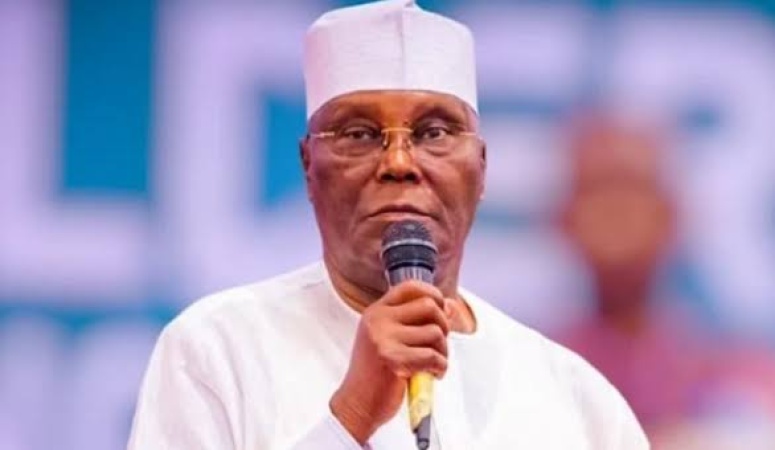
Former VP and ADC presidential candidate, Atiku Abubakar
The controversy over petrol subsidy removal has erupted into a fresh political battle, with former Vice President Atiku Abubakar proposing a new production-based subsidy regime, while the Presidency and Minister of the Federal Capital Territory (FCT), Nyesom Wike, rejected the proposal and accused him of political inconsistency.
The Allied Peoples Movement (APM) also challenged the Federal Government’s account of savings from the subsidy removal, demanding a comprehensive breakdown of the funds generated and distributed since President Bola Tinubu ended the regime in May 2023.
The exchanges have placed petrol subsidy, refinery economics and the management of the proceeds of subsidy removal at the centre of the emerging 2027 presidential contest.
Atiku, the 2027 presidential candidate of the African Democratic Congress (ADC), unveiled his proposed petroleum subsidy framework under the Atiku Economic Recovery Plan (AERP) 2027.
He said his administration would not return to the former import-based subsidy regime but would introduce a production subsidy targeted at qualifying Nigerian refineries.
Under the proposal, public and private refineries would be allowed to obtain domestic crude at a preferential price, subject to production, efficiency, transparency and domestic-supply conditions.
The former vice president said the arrangement would operate within a predetermined annual fiscal ceiling approved through the national budget.
“My proposal is not to resurrect the old subsidy regime. We will move subsidy from importation to production, from middlemen to Nigerian refineries, and from unverifiable claims to verifiable barrels,” Atiku said.
“The principle is simple: the subsidy will follow the barrel.
“The cost will be known. The ceiling will be known. The beneficiaries will be known. And, most importantly, the benefit delivered to Nigerians will be measurable.
We will determine what Nigeria can afford before we subsidise. We will not subsidise first and discover the bill afterwards.”
Atiku said crude allocation, refinery intake, production yields, inventories and domestic deliveries would be reconciled to ensure that every subsidised barrel could be traced from allocation through refining to the Nigerian consumer.
“No phantom cargoes. No fictitious imports. No unverifiable under-recoveries. No retrospective claims,” he said.
“If you receive subsidised Nigerian crude, you must refine it in Nigeria, supply the agreed products to Nigerians and pass the benefit to Nigerians. Otherwise, you do not qualify.”
He said the arrangement would apply to all qualifying public and private refineries and would not be structured to favour any particular operator.
“No refinery would receive subsidised crude without a corresponding, independently verified quantity of petroleum products being supplied to the Nigerian market under a transparent pricing formula reflecting the benefit of the preferential crude price,” he said.
Atiku also proposed that the subsidy should progressively reduce as domestic refining capacity expands, refinery utilisation improves, competition increases and production costs decline.
“Our objective is not permanent subsidy. It is to use temporary and disciplined support to build a refining industry strong enough eventually not to need subsidy,” he said.
He also opened a fresh front over previous subsidy transactions, promising to investigate the handling of public funds under the former regime.
Atiku said anyone found through due process to have fraudulently obtained or diverted subsidy funds would face prosecution and asset recovery.
“Anyone who stole subsidy money should prepare to return it. But we will not replace one opaque system with another,” he said.
The proposal, however, immediately drew a strong response from the Presidency.
Special Adviser to President Tinubu on Information and Strategy, Bayo Onanuga, accused Atiku of seeking to reverse the administration’s petroleum-sector reforms for political gain.
In a statement titled “Restoring Petrol Subsidies: Atiku’s Volte-Face and Desperation for Power,” Onanuga said Atiku was entitled to propose alternative policies but should explain how his proposed subsidy would be financed.
“Desperate for power, he needed to make a promise that he knew, if he were candid with our people, does not make fiscal sense, is retrogressive, and is against the genuine interest of the people,” Onanuga said.
The Presidency said the petrol subsidy regime that existed before May 2023 had been dismantled as part of the administration’s petroleum-sector reforms.
It said the former arrangement required government to absorb the difference between the actual cost of petrol and the regulated pump price.
The Presidency challenged Atiku to state the annual cost of his proposed subsidy, its source of funding and the legal framework under which it would operate.
Onanuga also rejected Atiku’s claim regarding a N30 trillion subsidy-removal windfall.
“Contrary to Atiku’s claim in his interview, no N30 trillion subsidy windfall or savings exists anywhere except in his imagination,” he said.
The Presidency argued that subsidy removal had reduced the fiscal burden on government and increased resources available to the three tiers of government.
The Federal Ministry of Finance currently puts estimated subsidy savings across the Federation at N15.8 trillion, with N5.43 trillion attributed to the Federal Government, N6.52 trillion to states and N3.88 trillion to local governments.
The ministry said the N15.8 trillion should not be interpreted as a single pool of cash retained by the Federal Government, stressing that the savings were shared through the Federation Account.
It further said the Federal Government’s N5.43 trillion share, combined with other incremental revenues of N3.12 trillion and incremental borrowing of N11.85 trillion, gave it approximately N20.4 trillion in additional resources during the period.
The government said additional expenditure during the period amounted to about N30.64 trillion.
But the figures have themselves become the subject of a fresh political dispute.
The APM challenged the government’s N15.8 trillion figure and demanded a detailed account of the proceeds of subsidy removal.
In a statement by its National Publicity Secretary, Abubakar Yusuf, the party said the government must disclose the exact amount generated, received and distributed since the subsidy was removed.
It also demanded a breakdown of allocations to individual states and local governments, dates of disbursement and the purposes for which the funds were deployed.
The party said the government’s figures required clarification in view of an earlier claim attributed to former Finance Minister and Coordinating Minister of the Economy, Wale Edun, regarding savings from subsidy removal.
The APM also rejected what it described as the government’s vague explanation of how the reported savings were distributed.
The party said Nigerians were entitled to know “where the money went” and how the savings had affected their economic conditions.
While the APM questioned the government’s accounting, Atiku also demanded explanations over petroleum-related expenses recorded after Tinubu announced the end of subsidy.
The former vice president cited NNPC Limited’s audited financial statements, which he said recorded approximately N4.84 trillion in Energy Security Expenses in 2023 and N7.13 trillion in 2024.
He said the government should explain the economic substance of the expenses and whether they incorporated under-recoveries, pricing differentials or other petroleum-supply costs.
“We are not interested in playing games with accounting terminology,” Atiku said.
“If government continued absorbing differences between the economic cost of petroleum products and what was recovered from the market, then Nigerians are entitled to ask how that differs economically from the subsidy they were told had disappeared.”
He added: “You cannot abolish subsidy at Eagle Square and allow subsidy-like costs to resurface in government accounts without explaining the contradiction.
Nigerians cannot pay for subsidy removal twice — through punishing pump prices and through unexplained subsidy-like costs against their commonwealth.”
The former vice president also demanded a reconciliation of what he described as approximately N30 trillion in Federation revenues, deductions, savings, transfers and related funds.
He stressed that he was not alleging that the entire amount represented fuel subsidy or that it had been stolen.
“We are not saying N30 trillion is fuel subsidy or that N30 trillion has been proven stolen,” Atiku said.
“We are saying that approximately N30 trillion reflected across Federation revenues, deductions, savings, transfers and related classifications requires a complete, month-by-month public reconciliation.”
He challenged the Federal Government to publish details of the transactions.
“Publish every deduction. Identify every beneficiary. Show every transfer. Show every balance. Show the legal authority. If the money is properly accounted for, open the books and end the argument,” he said.
Wike, meanwhile, attacked Atiku over his new subsidy proposal, accusing the former vice president of changing his position for political reasons.
Speaking in Abuja while inspecting infrastructure projects in the FCT, Wike described Atiku as a “voodoo economist.”
“Atiku, who is confused, who acts like a voodoo economist, Atiku will say anything just to be president,” Wike said.
The minister recalled that Atiku had pledged during the 2022 presidential campaign to remove fuel subsidy within his first 100 days in office if elected.
“Now, in 2026, he is not going to remove the fuel subsidy. Is he going back to the fraud, which he had alleged that fuel subsidy was?” Wike asked.
He said presidential candidates should maintain consistency in their policy positions.
“Leadership is not you coming out, you say one thing now in the morning, in the afternoon you say a different thing, in the night you are talking of a different thing. That is not it,” he said.
Wike also questioned the feasibility of Atiku’s proposal in the current petroleum market, citing the Petroleum Industry Act and the emergence of large-scale private refining capacity.
He said the former Nigerian National Petroleum Corporation had been transformed into NNPC Limited and was no longer the sole importer or producer of petrol.
“He is living in the past. If not, he will know that with the Petroleum Industry Act, NNPC is now fully commercialised,” Wike said.
“It has transformed the old NNPC into a limited liability company, NNPC Limited, and no longer the sole importer or producer of fuel.”
He then challenged Atiku over the role of private refineries under the proposed subsidy arrangement.
“Will Atiku, as President—which he never will be—pay subsidy on fuel produced by Dangote Refinery?” Wike asked.
The minister said the old subsidy regime had encouraged smuggling, arbitrage and other distortions while putting pressure on government revenue.
He said Atiku should instead explain how savings from subsidy removal should be deployed.
“All I thought he would have argued is, ‘Yes, I still believe in the removal of fuel subsidy, and I think that the savings made would have been utilised in this way or that way,’” Wike said.
The Presidency also warned against returning to a subsidy arrangement, saying it could affect investment in domestic refining.
Onanuga said the emergence of the Dangote Refinery was part of the changes in the downstream petroleum market following subsidy removal.
“The Dangote Refinery would not have kickstarted production for local consumption were the subsidy regime operative,” the Presidency said.
It also said returning to subsidy could expose government to a fresh fiscal burden.
“If petrol is sold below its economic cost, which is about N1,200 to N1,300, someone must absorb the difference,” Onanuga said.
The Ministry of Finance has similarly maintained that subsidy removal reduced the fiscal burden and allowed resources to flow through the Federation Account rather than through the former subsidy mechanism.
Atiku, however, insists that his proposal is fundamentally different from the former regime because it would be capped, budgeted, independently audited and tied to actual domestic production.
The competing positions have now placed subsidy and its financial implications squarely in the political contest ahead of the 2027 presidential election.
Atiku wants a new production-based intervention.
The Presidency wants the subsidy removal reforms sustained.
Wike says Atiku’s proposal contradicts his earlier position.
The APM wants the Federal Government to account for the savings it says accrued from the removal of subsidy.
The fight has therefore shifted from whether the old subsidy regime should return to what form, if any, government support for petrol should take, how much it should cost and how the money already saved has been accounted for. (The Sun)