ADAD
ADAD
Updating your news feed...
NEWS EXPRESS is Nigeria’s leading online newspaper. Published by Africa’s international award-winning journalist, Mr. Isaac Umunna, NEWS EXPRESS is Nigeria’s first truly professional online daily newspaper. It is published from Lagos, Nigeria’s economic and media hub, and has a provision for occasional special print editions. Thanks to our vast network of sources and dedicated team of professional journalists and contributors spread across Nigeria and overseas, NEWS EXPRESS has become synonymous with newsbreaks and exclusive stories from around the world.
























Loading banners
Loading banners...

By Dr HARRISON SAMUEL
Every few years, a disease nobody was watching moves to the front of the world's attention. Sometimes it is genuinely new. More often, it is an old adversary that never really left, waiting for the right conditions to spread again.
Researchers describe this pattern as emerging and re-emerging infectious disease. An emerging disease is one caused by a pathogen appearing in a population for the first time or increasing rapidly in incidence or geographic range. A re-emerging disease is one that declines for a period, often because control measures weaken or population immunity falls, and then returns with renewed force. Zoonotic spillover, the spread of a pathogen from animals to humans, is an important driver of these events.1
Understanding why this keeps happening, and why Nigeria sits close to several of these threats, is worth a few minutes of anyone's time.
DISEASES COVERED IN THIS ARTICLE
The diseases discussed here illustrate different patterns of emergence and resurgence.1,2
Emerging or newly significant threats: avian influenza A(H5N2), Oropouche virus, SARS-CoV-2/COVID-19 and Nipah virus.
Re-emerging or resurging diseases: Ebola virus disease, Marburg virus disease, Lassa fever, mpox, poliovirus, Zika virus, rabies and diphtheria.
They are not all emerging in exactly the same sense. Some are genuinely novel threats, some have expanded beyond their previous geographic or epidemiological boundaries, while others are familiar diseases that continue to return when the conditions for transmission are favourable.
The common thread is their relevance to health systems, clinicians and communities.
The threat is not exclusively viral. Emerging and re-emerging infectious diseases are shaped by interacting biological, environmental and social factors, including climate change, globalisation, socioeconomic inequalities, misinformation and disparities in access to healthcare and vaccination.2,3
When immunisation coverage falls or vaccination services are disrupted, preventable infections can regain a foothold, while changing environmental and social conditions create new opportunities for pathogens to emerge and spread.2,3
A WORLD REORGANISING AROUND FAMILIES OF PATHOGENS
For years, global pandemic planning worked from a simple list. The World Health Organization named specific diseases such as Ebola, Lassa fever and MERS, then ranked them according to how dangerous each seemed. It was a reasonable starting point, but it had an obvious flaw.
Viruses evolve. A pathogen family considered low risk today can produce something genuinely dangerous tomorrow, and a list built around named diseases cannot anticipate a threat it has no name for yet.
That thinking has changed.
In 2024, WHO published a scientific framework for epidemic and pandemic research preparedness that placed greater emphasis on pathogen families rather than individual named diseases.4 The scale of the exercise was considerable. More than 200 scientists from over 50 countries assessed 28 viral families and one core group of bacteria, spanning 1,652 known pathogens.4,5
Two ideas anchor the framework.
A Prototype Pathogen is a well-studied representative of a priority family, chosen so that research into it can provide a foundation for understanding related pathogens rather than starting from zero each time something new appears.
Pathogen X is a deliberate placeholder, an acknowledgement that the next major outbreak may come from a source nobody is currently tracking.4,5
This was not administrative reshuffling for its own sake. The same year brought several reminders of why preparedness cannot focus only on diseases already familiar to us. A new mpox strain prompted renewed international concern, the first confirmed human case of avian influenza A(H5N2) was reported in Mexico, Oropouche virus activity increased across the Americas, poliovirus was detected in Gaza after a long absence, and Rwanda experienced its first Marburg virus outbreak.4,5
None became the pandemic many feared. Together, however, they demonstrated exactly the pattern the new framework was designed to anticipate: threats can arrive from several directions at once, and not all of them will announce themselves in advance.
WHY SOME DISEASES KEEP COMING BACK
The conditions that allow infectious diseases to emerge are increasingly well understood. Zoonotic spillover remains important, but it does not happen in isolation. Globalisation, climate change, urbanisation and population growth can all create new opportunities for pathogens to spread, particularly where these changes occur alongside inadequate sanitation and other environmental pressures.6
Lassa fever illustrates this well. It is endemic in several West African countries, including Nigeria, and its principal reservoir, the multimammate rat, is widely distributed across the region. Estimates suggest that the disease causes tens of thousands of infections annually, while severe disease can carry a substantial risk of death.6
The reservoir itself cannot simply be eliminated, which means Nigeria cannot wait for Lassa fever to disappear. Prevention has to involve surveillance, environmental measures, early diagnosis and community-level action.
CLIMATE CHANGE IS ALREADY SHAPING AFRICA'S DISEASE BURDEN
Climate change is no longer simply an environmental issue for infectious disease control. Changes in temperature, rainfall, flooding and other environmental conditions can alter the distribution of vectors, reservoirs and pathogens.
A 2025 review of the African evidence found that climate change is contributing to the changing epidemiology of several emerging and re-emerging infectious diseases, including Ebola, Marburg virus disease, Lassa fever, dengue, malaria and cholera.7 The effects are not uniform across the continent, and West and Central Africa carry a substantial share of the climate-linked infectious disease burden described in the review.7
In Nigeria, changing rainfall patterns, flooding and environmental disruption may alter conditions that influence the spread of infectious diseases.
There is a clear imbalance between Africa’s contribution to global greenhouse gas emissions and its health burden from climate change. Despite contributing relatively little to global emissions, African populations are experiencing substantial health effects associated with a changing climate.
WHAT THIS LOOKS LIKE ON THE GROUND IN NIGERIA
These patterns become concrete in Nigeria's own surveillance data.
Between 2018 and 2023, the geographic footprint of reported Lassa fever expanded from 20 to 34 of Nigeria's 37 states, according to an analysis of NCDC data.8 The disease also reached more than 17 per cent of the country's 774 local government areas.8
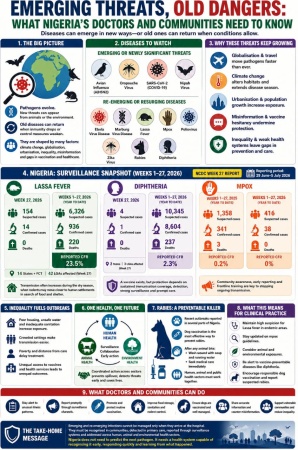
By Week 27 of 2026, Nigeria had recorded 6,326 suspected Lassa fever cases, 936 confirmed cases and 220 deaths, giving a case fatality rate of 23.5 per cent. During Week 27 alone, 154 suspected cases, 14 confirmed cases and no deaths were reported across 14 states and the Federal Capital Territory, involving 42 local government areas.9 Compared with the corresponding period in 2025, when 6,257 suspected cases, 801 confirmed cases and 143 deaths were recorded, both the number of confirmed cases and the case fatality rate have increased.9
The seasonal pattern also matters. Lassa fever transmission tends to increase during the dry season, when food scarcity can push rodents into closer contact with human settlements.8 That makes food storage, rodent control and awareness important parts of prevention, rather than issues that can be left entirely to outbreak response teams.
Diphtheria provides another reminder that vaccine-preventable diseases can regain public-health importance when immunity gaps and weaknesses in surveillance or outbreak response persist. By Week 27 of 2026, Nigeria had recorded 10,345 suspected diphtheria cases, 8,604 confirmed cases and 237 deaths, giving a case fatality rate of 2.3 per cent. During Week 27, four suspected cases and one confirmed case were reported, with no deaths.9 In the same week in 2025, when 8,953 suspected cases, 6,127 confirmed cases and 557 deaths were recorded, Nigeria has recorded more cases but substantially fewer deaths in 2026.9
Mpox tells a similar story of continued transmission rather than a single, isolated outbreak. Nigeria recorded 189 confirmed mpox cases in 2024.10 By 19 October 2025, the number had increased to 389 confirmed cases and six deaths across 35 states and the Federal Capital Territory.10 More recent data from the Nigeria Centre for Disease Control and Prevention, reported as of epidemiological week 27 in July 2026, recorded 416 suspected cases, 38 confirmed cases, and no deaths.9
The response has therefore had to move beyond hospital-based treatment. WHO reported the training of 570 frontline health workers across 15 high-risk states, alongside updated clinical guidance and community sensitisation activities involving house visits, radio and market outreach.10
Surveillance can show where transmission is occurring. Community understanding helps determine what happens next.
THE INEQUALITY QUESTION NOBODY LIKES TO ASK
Infectious diseases do not meet everyone on equal terms.
Where a person lives, works and seeks healthcare can influence the likelihood of exposure, the ability to prevent transmission and the chance of receiving timely treatment.
This is central to the argument made by Bambra in her 2022 commentary on pandemic inequalities.11 Drawing on Ebola, Zika and COVID-19, she describes four pathways through which social inequality shapes an outbreak: unequal exposure, unequal transmission, unequal susceptibility and unequal treatment.11
The evidence behind these pathways is important.
During the 2014 to 2016 West African Ebola outbreak, transmission was higher in poorer communities. During the Zika epidemic in Brazil, populations living in poorer conditions experienced a substantially greater burden of microcephaly. During COVID-19, studies from several countries reported markedly higher mortality among more deprived populations.11
These differences are not simply demographic statistics. Overcrowded housing, inadequate sanitation, unsafe water, occupational exposure, poverty and limited access to healthcare can all influence how an infection moves through a community and who bears the greatest burden.
An outbreak response that ignores who is most exposed, and why, will underperform even when vaccines and treatments are available.
A BROADER LENS: ONE HEALTH
There is another reason infectious disease control cannot stop at the clinic door.
Human health, animal health and environmental health are interconnected.
The One Health approach brings these three areas together.12 It recognises that surveillance of wildlife and livestock health should complement surveillance of human disease rather than follow behind it after an outbreak has already begun. This is particularly relevant when pathogens move between animals and humans.
In practical terms, One Health means that doctors, veterinarians, environmental health professionals, laboratory scientists, public health authorities and communities cannot work as though they are dealing with separate problems.
The same pathogen may be viewed as a clinical problem by a doctor, an animal health problem by a veterinarian and an environmental problem by a public health officer.
It is still the same threat.
Diphtheria also illustrates why the One Health lens can extend beyond traditionally recognised zoonoses. A recent detection of toxigenic Corynebacterium diphtheriae in a donkey in Ontario, Canada, prompted a public health investigation because of the potential for animal-to-human transmission and highlighted the need for coordinated surveillance across animal and human health sectors.13
RABIES: THE RE-EMERGENCE NIGERIA CANNOT AFFORD TO IGNORE
Nowhere does this connection show itself more plainly than in rabies.
It is one of the oldest recognised zoonotic diseases. An effective vaccine has existed for more than a century. Yet rabies continues to cause preventable deaths in Nigeria and many other countries.
The distinction between eradication and elimination is important. Eradication means reducing a disease to zero everywhere, permanently. Elimination means reducing it to zero within a defined area while maintaining the measures necessary to prevent its return.14
Canine-mediated rabies has been eliminated in some high-income settings through sustained dog vaccination and population management, but large-scale elimination remains uncommon in many low- and middle-income countries.14
Nigeria has had several recent reminders of this vulnerability.
In Lagos, the Nigerian Veterinary Medical Association's Lagos chapter confirmed a rabies outbreak in the Ajah area after laboratory testing at the National Veterinary Research Institute in Vom, Plateau State.15 The Lagos State Ministry of Agriculture and the NCDC were notified, while containment measures including contact tracing and intensified surveillance were initiated across the affected area.
The outbreak also raised concerns about unqualified individuals posing as veterinarians and administering vaccines without appropriate veterinary oversight, highlighting how weak regulation can undermine disease-control efforts.15
Enugu State's Ministry of Agriculture and Agro-Industrialisation confirmed another outbreak in Igbo Etiti Local Government Area in April 2026.16 The state government urged vigilance and called on dog owners to ensure vaccination and responsible control of their animals.
More recently, the FCT Administration confirmed eight rabies cases and two deaths, with five cases reported in Gwagwalada and three in Kwali Area Councils.17 The confirmed samples were sent to the National Veterinary Research Institute in Vom.17
Although vaccination campaigns had been conducted across the FCT in December 2025 and January 2026, the available vaccines were reportedly insufficient to cover all areas.17
That detail captures an important distinction in public health: having a vaccination programme is not the same as having the supplies required to implement it fully.
These outbreaks occurred in different parts of the country, but they point towards the same underlying vulnerability: incomplete or interrupted dog vaccination and weaknesses in sustained surveillance can allow a preventable zoonotic disease to persist.
The lesson from rabies extends beyond rabies itself.
Human health services cannot eliminate a disease maintained in animal populations by working alone. Veterinary services, local government authorities, public health agencies and communities all have a role.
WHAT THIS MEANS FOR CLINICAL PRACTICE
None of this sits far from the daily work of a family clinic.
A patient presenting with an unusual fever, an atypical rash or a respiratory illness behaving differently from what would normally be expected deserves careful assessment and, where appropriate, early notification through established surveillance channels. That instinct for recognising an unusual pattern is one of the quiet strengths of primary care.
Animal bites deserve particular attention. A person bitten or scratched by a potentially rabid animal should immediately wash the wound thoroughly with soap and running water and seek medical assessment without delay for appropriate post-exposure management.14
This is simple advice, but it is advice that can save a life when delivered and acted upon promptly.
For clinicians, several practical priorities follow from the evidence. Maintain a high index of suspicion for Lassa fever during periods of increased transmission, particularly in endemic areas. Stay familiar with current mpox guidance as transmission continues across Nigeria. Consider relevant animal and environmental exposures when assessing compatible illness. Remain alert to vaccine-preventable diseases such as diphtheria when patients present with compatible clinical features, particularly where immunisation coverage is uncertain. Encourage responsible dog vaccination and prompt reporting of suspected rabies.
There is also a broader clinical message.
Where a patient lives, and under what material conditions, is not incidental background information. It can influence exposure, transmission, access to care and the eventual outcome.
The wider lesson for Nigeria is equally important.
Emerging and re-emerging infections cannot be managed only when they arrive at the hospital. They have to be recognised in communities, detected in primary care, reported through surveillance systems and addressed across human, animal and environmental health sectors.
Nigeria does not need to predict the exact pathogen that will cause the next outbreak.
It needs a health system capable of recognising it early, responding quickly and learning from what happened.
REFERENCES
Wang S, Li W, Wang Z, Yang W, Li E, Xia X, et al. Emerging and reemerging infectious diseases: global trends and new strategies for their prevention and control. Signal Transduct Target Ther. 2024;9(1):223. doi: 10.1038/s41392-024-01917-x.
Zumla A, Hui DSC. Emerging and Reemerging Infectious Diseases: Global Overview. Infect Dis Clin North Am. 2019;33(4):xiii-xix. doi: 10.1016/j.idc.2019.09.001.
World Health Organization, United Nations Children's Fund, Gavi, the Vaccine Alliance. Agencies call for sustained investments in immunization efforts amidst looming funding cuts. Geneva: WHO; 2025 Apr 24. https://www.who.int/news/item/24-04-2025-increases-in-vaccine-preventable-disease-outbreaks-threaten-years-of-progress--warn-who--unicef--gavi
World Health Organization. Pathogens prioritization: a scientific framework for epidemic and pandemic research preparedness. Geneva: WHO; 2024. https://www.who.int/publications/m/item/pathogens-prioritization-a-scientific-framework-for-epidemic-and-pandemic-research-preparedness
Ukoaka BM, Okesanya OJ, Daniel FM, Ahmed MM, Udam NG, Wagwula PM, et al. Updated WHO list of emerging pathogens for a potential future pandemic: Implications for public health and global preparedness. Infez Med. 2024;32(4):463-477. doi: 10.53854/liim-3204-5.
De Gaetano S, Ponzo E, Midiri A, Mancuso G, Filippone D, Infortuna G, et al. Global trends and action items for the prevention and control of emerging and re-emerging infectious diseases. Hygiene. 2025;5(2):18. doi:10.3390/hygiene5020018.
Agyarko RKD, Kithinji D, Nsarhaza KB. Climate Change and the Rise of Emerging and Re-Emerging Infectious Diseases in Africa: A Literature Review. Int J Environ Res Public Health. 2025;22(6):903. doi: 10.3390/ijerph22060903.
Eneh SC, Obi CG, Ephraim Ikpongifono U, Dauda Z, Udoewah SA, Anokwuru CC, et al. The resurgence of Lassa fever in Nigeria: economic impact, challenges, and strategic public health interventions. Front Public Health. 2025;13:1574459. doi: 10.3389/fpubh.2025.1574459
Nigeria Centre for Disease Control and Prevention. Weekly Epidemiological Report. Volume 16 No. 27. Week 27: 29 June–5 July 2026. Abuja: NCDC; 2026. https://ncdc.gov.ng/reports/weekly/2026/7/27
World Health Organization Regional Office for Africa. Nigeria reviews mpox guidelines and boosts community awareness to reduce transmission. Brazzaville: WHO Regional Office for Africa; 2025. https://www.afro.who.int/countries/nigeria/news/nigeria-reviews-mpox-guidelines-and-boosts-community-awareness-reduce-transmission
Bambra C. Pandemic inequalities: emerging infectious diseases and health equity. Int J Equity Health. 2022;21(1):6. doi: 10.1186/s12939-021-01611-2.
Ristori MV, Guarrasi V, Soda P, Petrosillo N, Gurrieri F, Longo UG, et al. Emerging Microorganisms and Infectious Diseases: One Health Approach for Health Shared Vision. Genes (Basel). 2024;15(7):908. doi: 10.3390/genes15070908.
Okechukwu C, Rebellato S, Pitfield H, Magnusson K, Sereshk R, Slavic D, McClinchey H, Wilson S, Kus J, Lee C. Isolation of toxigenic Corynebacterium diphtheriae from cutaneous lesions in a donkey in Ontario, Canada, 2024: Implications for zoonotic disease transmission and One Health approach. Can Commun Dis Rep. 2026 Feb 19;52(1-2):8-14. doi: 10.14745/ccdr.v52i0102a02.
Zha R, Lu J, Chen J, Guo C, Lu J. Exploring one health-based strategies for rabies elimination: Overview and future prospects. PLoS Negl Trop Dis. 2025;19(6):e0013159. doi: 10.1371/journal.pntd.0013159.
Nigerian Veterinary Medical Association, Lagos State Chapter. Public health alert on confirmed rabies outbreak in Ajah, Lagos State. Lagos: NVMA; 2025. Vet doctors confirm rabies outbreak in Ajah | News Express Nigeria
Enugu State Ministry of Agriculture and Agro-Industrialisation. Public health notice on dog rabies outbreak in Igbo Etiti Local Government Area. Enugu: Government of Enugu State; 2026. Rabies outbreak hits Enugu community as govt issues urgent public health advisory | News Express Nigeria
Federal Capital Territory Administration. Rabies cases and deaths confirmed in Gwagwalada and Kwali Area Councils. Abuja: FCTA; 2026. FCTA confirms 8 rabies cases, 2 deaths, issues alert | News Express Nigeria
•Dr Harrison Samuel, Chief Medical Officer, is a member of the Association of Resident Doctors, Federal Capital Territory Administration (FCTA) chapter.